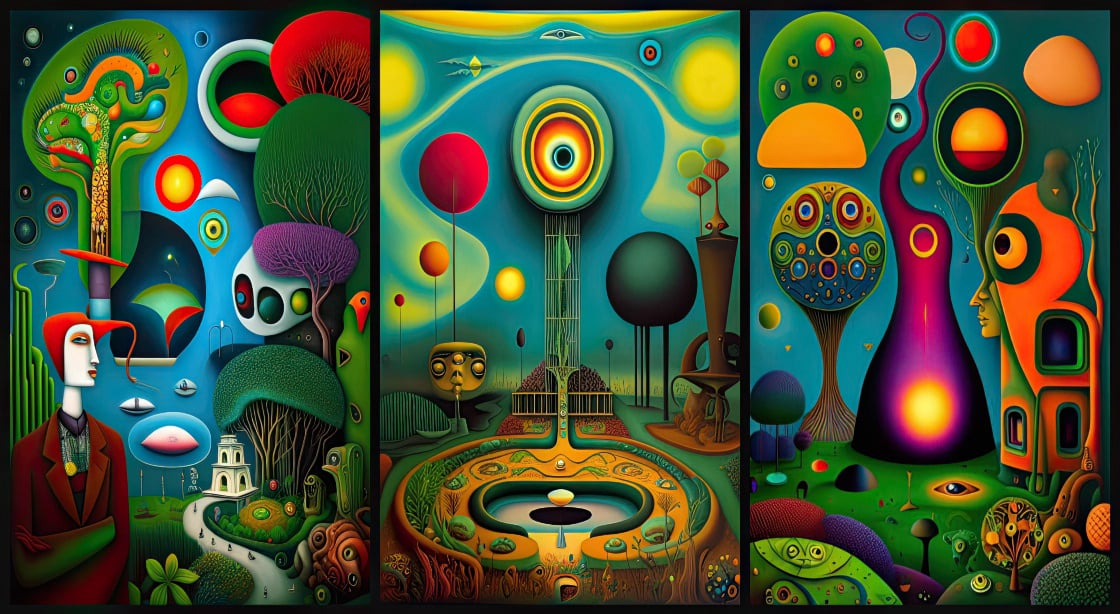
"Triptych Art" is my favorite form of artistic expression and when I am asked: "Why?", the answer is very simple: "Because it is the most difficult". It very often happens that the parts of the triptych individually are real masterpieces, but that the triptych as a composition is an artistic failure.
However, in addition to numerous dangers, it also provides the creator with enormous opportunities, especially when it comes to creating a complex narrative, as well as creating an optimal arrangement of shapes and colors.
As for me, Every Tryptich Tells a Story, which is often accompanied by appropriate music to achieve the right experience.
Left panel: "The Harmonious Observer"
Central panel: "The Symphony of the Spheres"
Right panel: "Photosynthetic Mind"
"A Tribute to Classicism" is a contemporary triptych that reimagines the core ideals of classical art — harmony, proportion, balance, and beauty — through the lens of digital surrealism and posthuman aesthetics. While rooted in the philosophical spirit of classicism, this work consciously embraces horror vacui and chromatic abundance as a modern counterpoint to the classical pursuit of restraint.
Each panel represents a symbolic layer in this visual dialogue:
"The Harmonious Observer" reflects the rational individual contemplating an overloaded, organic cosmos.
"The Symphony of the Spheres" translates the ancient concept of celestial harmony into a radiant system of abstract geometry and planetary rhythm.
"Photosynthetic Mind" envisions a future intelligence — one that blends botanical form and cognitive function — as a meditation on growth, sentience, and synthetic nature.
Rather than imitating the past, this piece proposes a conversation with classicism, carried out in a language of saturated form and symbolic abundance. It asserts that harmony is not a relic of antiquity, but a living principle — one that can still emerge from complexity, multiplicity, and imaginative excess in the digital age.
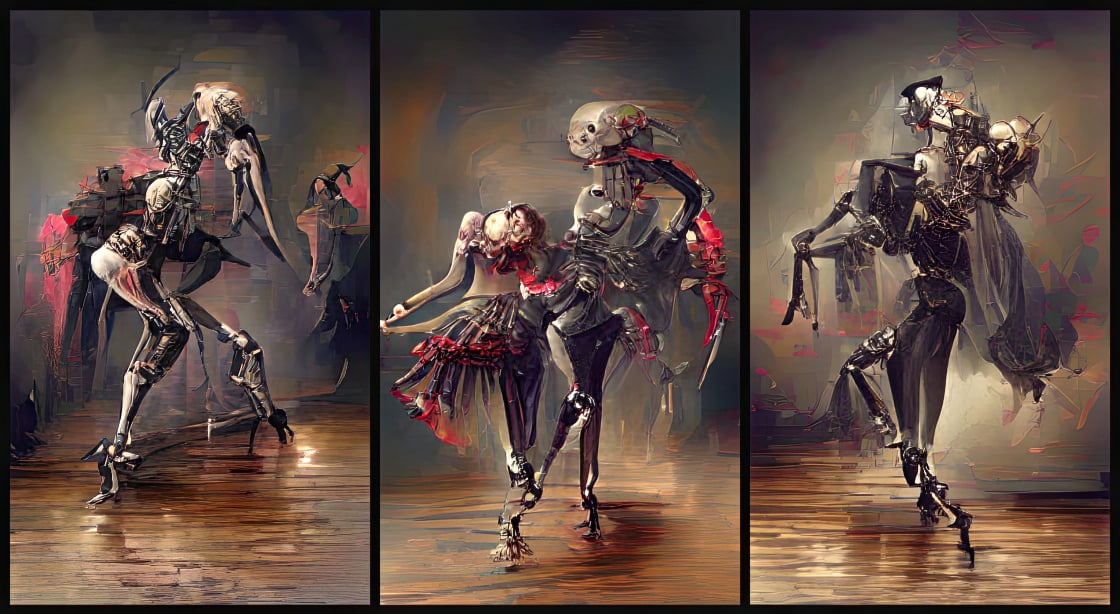
"Dance Macabre" represents a contemporary version of a classic art motif.
The aesthetic of biomechanical dance figures in a dark environment creates an atmosphere that is both unnerving and inviting, inviting the viewer to delve deeper into the theme the work implies.
Dance as a motif in each scene symbolizes different types of interactions - from fighting to love, with elements of control and submission. The presence of mechanical parts in the figures is an attempt to explore the boundaries between man and machine, whereby the aim is to emphasize the contrast between the fragility of human elements and the solidity of machine elements, as an inevitable conflict between nature and technology.
Taken as a whole, this work attempts to challenge and inspire, asking important questions about the future of humanity and the limits of our possibilities.
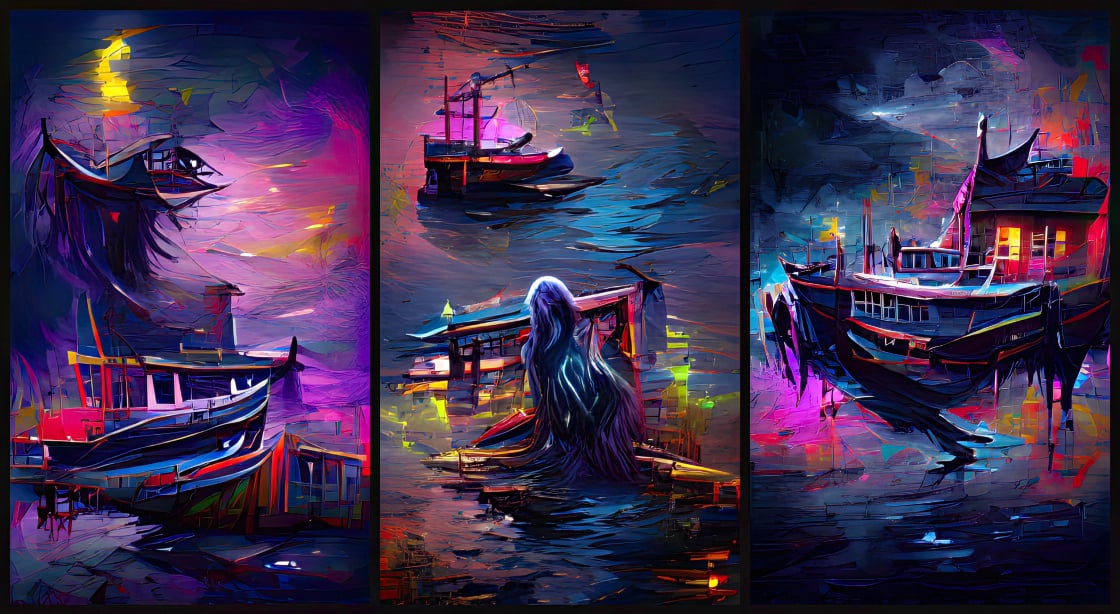
Left panel: "Stranded and Forgotten"
Central panel: "Lonely Prey"
Right panel: "Evening Silence"
"Dark Spirit of the Dockside" is an expression of the admiration and respect I have always had for the brilliant writer Edgar Allan Poe. Through the dynamics of the composition and the strong use of colors, with the dominant presence of the dark central figure who, when the moment comes, destroys the ships, I tried to create a mystical fatalistic atmosphere, which he always managed to achieve with ease in his works. Each panel has its own unique narrative, but together they try to create a cohesive story that can be interpreted as a journey through life, which is always guided by the action of higher forces.
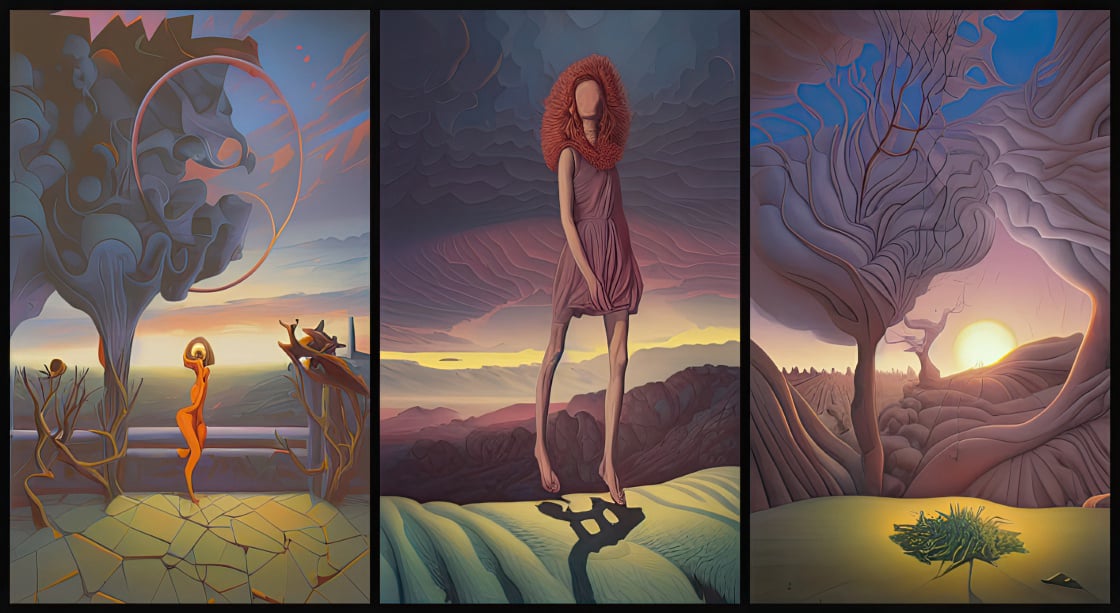
Left panel: "Way to Tranquility"
Central panel: "I Hover, Therefore I Am"
Right panel: "The Light of Harmony"
By combining abstract and surreal visual elements that include deep thematic layers of introspection and spirituality, "Goddess of Solitude" tries to bring the potential viewer closer to the importance of the idea of spiritual transcendence, which goes beyond our physical existence. Through the search for inner peace, accompanied by a spiritual journey, enlightenment awaits us at the end of the road through realized unity with the universe.
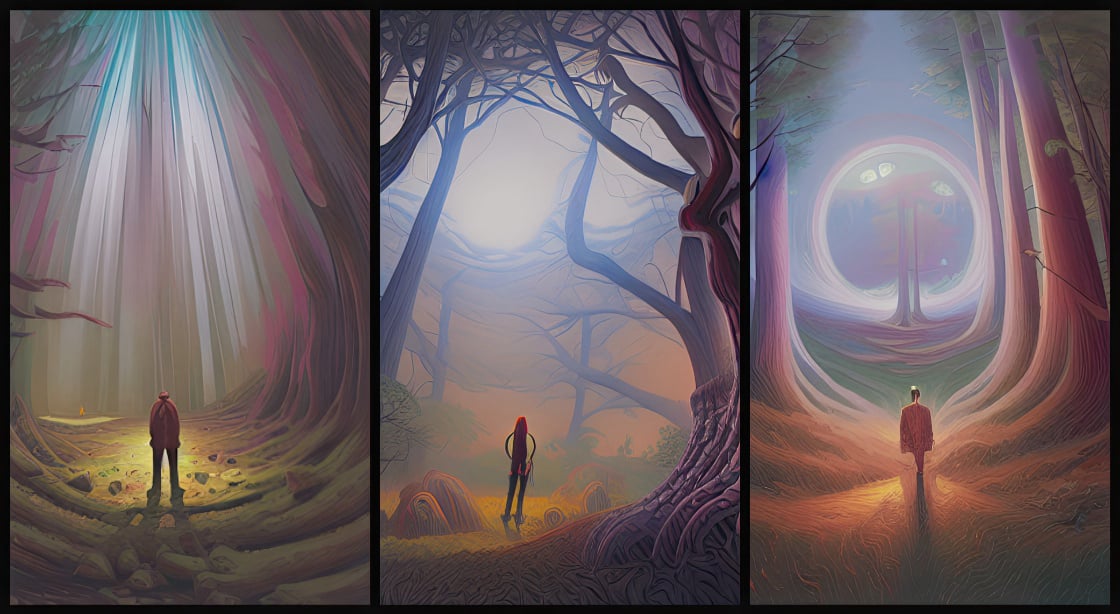
Left panel: "Source of Wisdom"
Central panel: "Eye of Odin"
Right panel: "The Embrace of Solitude"
"In Search of Wisdom" as the title of the triptych clearly focuses on the search for wisdom, which is an eternal theme throughout the history of art, philosophy and spirituality. It is also an attempt to create a harmonious work of art by combining mythological, spiritual and introspective content.
"Source of Wisdom" is the beginning of the journey, and the circle of light in the center of the forest symbolizes the source of wisdom, something deeply rooted in nature and light.
The central part, called "Eye of Odin", brings a mythological dimension to the triptych. Odin, the god of wisdom in Norse mythology, is famous for his sacrifice of an eye in exchange for wisdom.
Finally, "The Embrace of Solitude" represents the end of the spiritual journey, showing the solitary figure of Odin, who, after gaining wisdom, meditates in a solitude that is filled with mystical silence.
Solitude here is not negative, but necessary for a deeper understanding and acceptance of acquired wisdom.
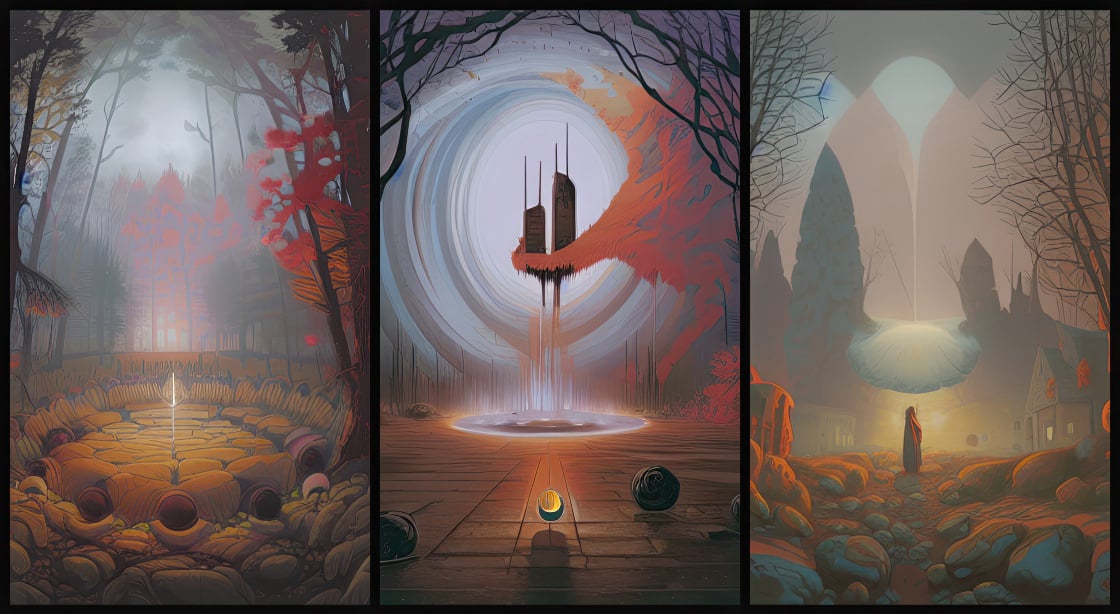
"Secluded Chimeric Place" is one of my favorite works.
Nothing pretentious, I just wanted to achieve a perfect composition of shapes and colors, which would give me a sense of balance, peace and introspection. Something like a portal to another world, a world of dreams and imagination, where you can lose your sense of space and time.
In that other world, elements of nature are combined with futuristic elements, trying to create a unique and surreal environment in which technology and nature will not be in conflict with each other, but combined into a healthy harmonious whole.
Sometimes, when I'm tired and longing for peace, I sit back in the armchair and watch for a long time. And it helps.
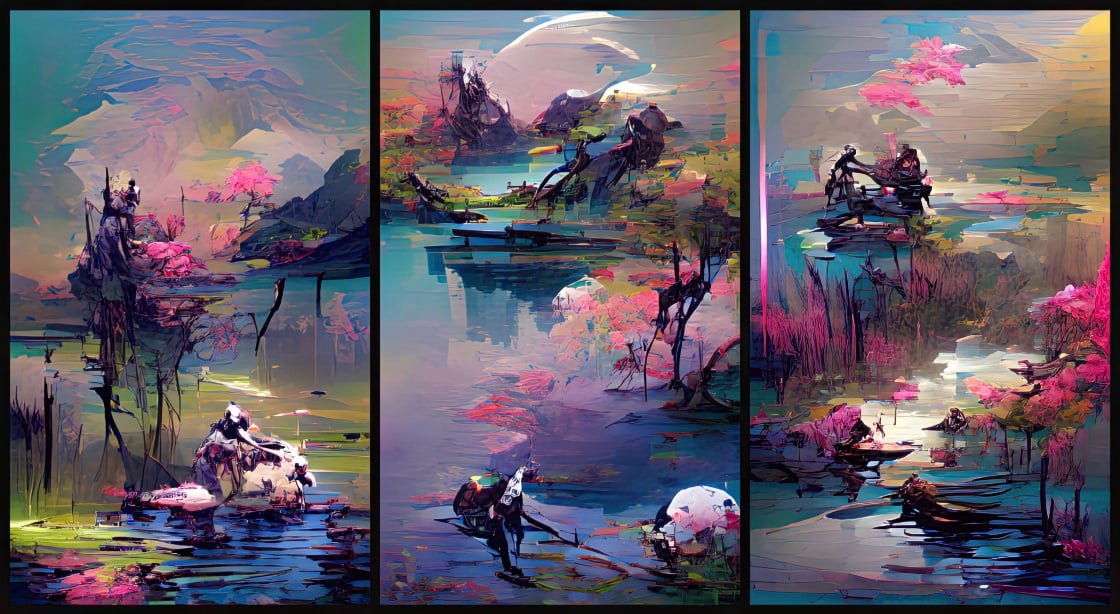
Left panel: "Solitary Down"
Central panel: "Evening Reflection"
Right panel: "Night Departure"
The triptych "The Bad Fog Of Loneliness" is an emotional landscape that tries to capture the monotonous everyday life of a city environment shrouded in fog.
The suggested names of the panels help to focus on the different phases of the day, and what they have in common is a calm and nostalgic introspective atmosphere that exudes deep alienation and loneliness.
Rare figures are isolated and lost in their own thoughts as the world moves swiftly on without them.
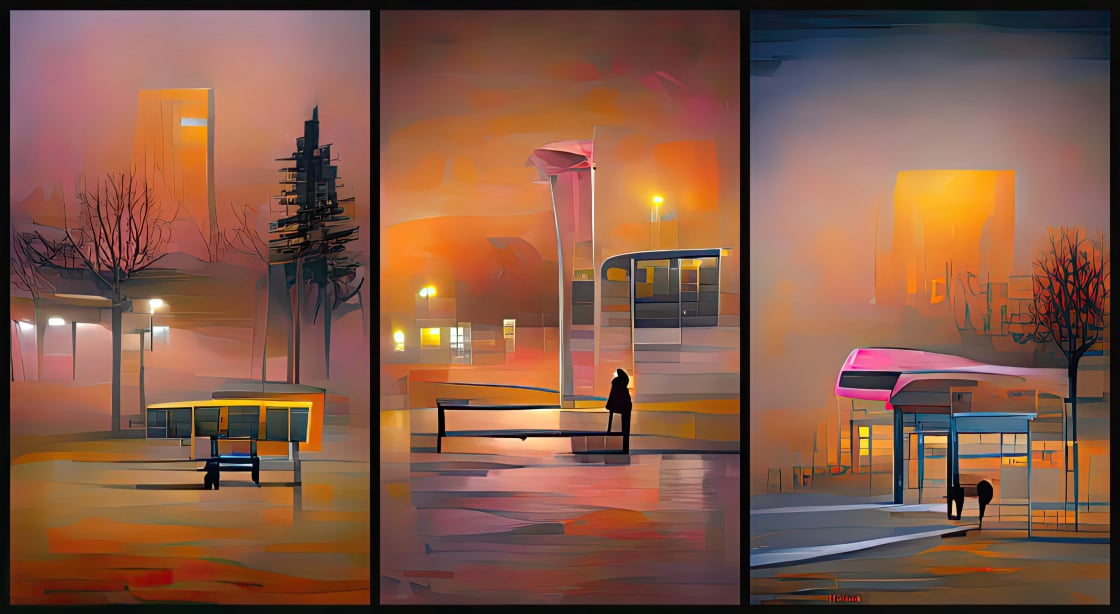
Left panel: "The Appeal Was Rejected"
Central panel: "Prayer In Solitude"
Right panel: "Time is Up, Sir!"
This triptych is inspired by Clive Barker's short story "Dread," in which the author masterfully delves into the theme of human horror. The triptych portrays the dramatic moments in the life of a death row prisoner, from the realization that their final appeal for clemency has been denied, through solitary prayer, to the final execution. This work deeply explores human suffering, the loss of hope, and the confrontation with an inevitable fate, encouraging reflection on themes of remorse, justice, and human suffering.
In order to achieve a complete experience, I suggest you listen to the surreal music of the Swedish composer Peter Andersson: raison d'être - Decay (Version 2)
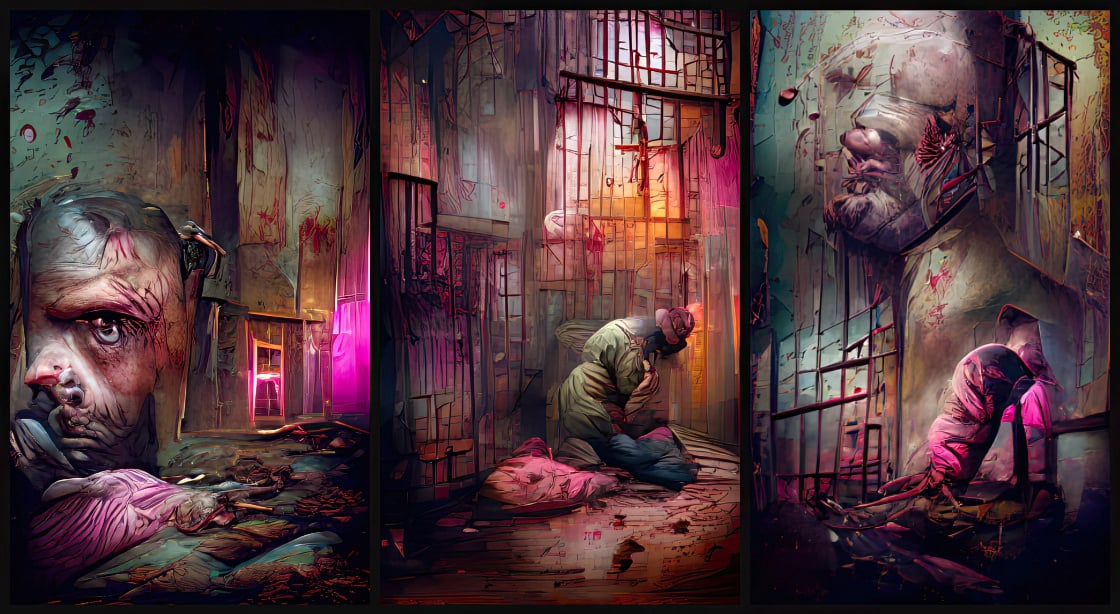
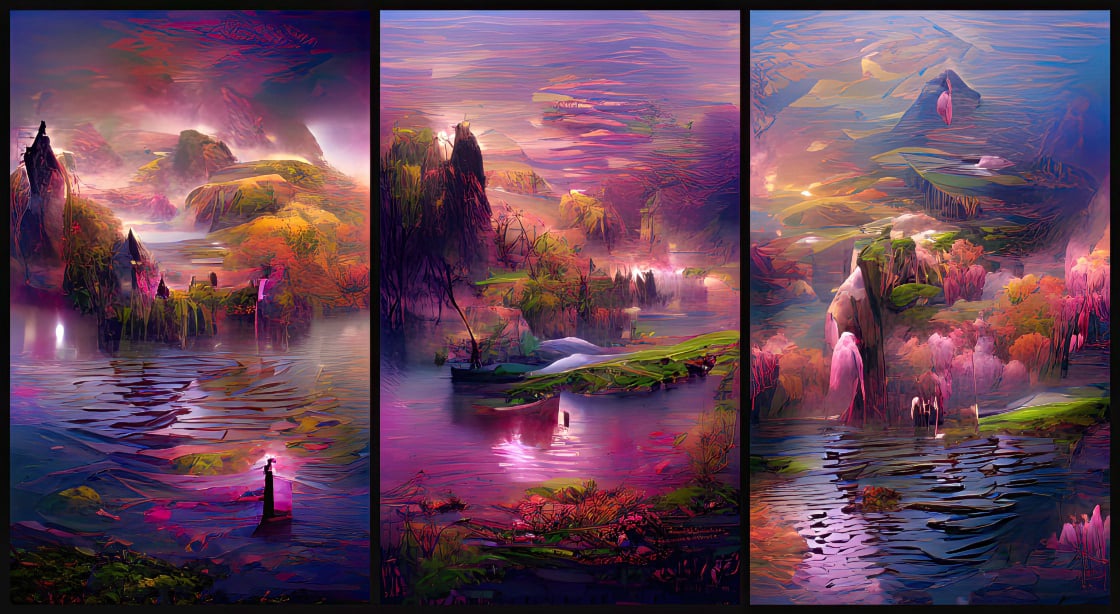
Left panel: "Charon"
Central panel: "Gathering of Souls"
Right panel: "Sigmund's Underworld"
As is known from Greek mythology, Acheron is a "river of pain" located in the underworld of Hades, over which Charon transports the souls of the dead in his boat. The most significant works on this subject were given by Michelangelo, Gustave Dore, as well as many other artists, who all, without distinction, put human figures in the foreground, with the desire to show their suffering and painful emotional state.
In this work, the creative process is completely different. The goal is to create a coherent whole through the combination of mythological, philosophical and psychological elements, and on the other hand to evoke the atmosphere, i.e. the spirit and essence of the river Acheron, with a conscious disregard in the physical and material aspect, which should bring depth and mysticism to the topic being treated.
In this sense Charon is barely visible, the gathering souls are like little whitish clouds, and similarly the enigmatic subconscious creatures are shown in the right panel. It is known that Freud in his seminal work "The Interpretation of Dreams" treated the river Acheron as a psychological underworld located below the conscious mind.
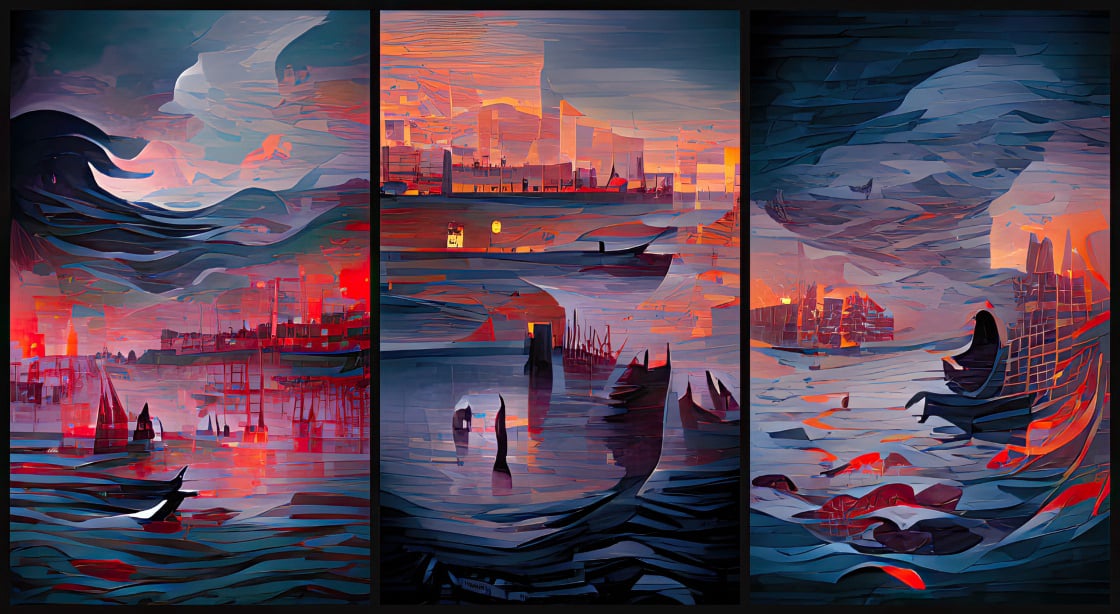
Left panel: "In Deadly Perils"
Central panel: "Before the Storm"
Right panel: "Anxious Dreamer"
When it comes to the triptych as a form of artistic expression, the unwritten rule is to follow the narrative from left to right, not the other way around. "Watching the Bay ..." is an exception in that sense.
The "Anxious Dreamer" emphasizes the ominous aspect of the bay, with a lone figure gazing towards the horizon, aware of impending change, while the urban landscape in the background suggests instability and potential looming danger.
The other two panels serve to complete the overall picture. And while in the "Before the Storm" the city lights still dominate the landscape, optimistically hinting at a peaceful denouement, the dominant ominous waves in the "In Deadly Perils" remove any doubt - the city in the background is not writing anything good!
As always, the aim is to achieve a multi-layered interpretation through rich symbolism, so that the work can be seen as an ordinary urban landscape, but also as a politically colored allegorical representation of the bleak future to come.
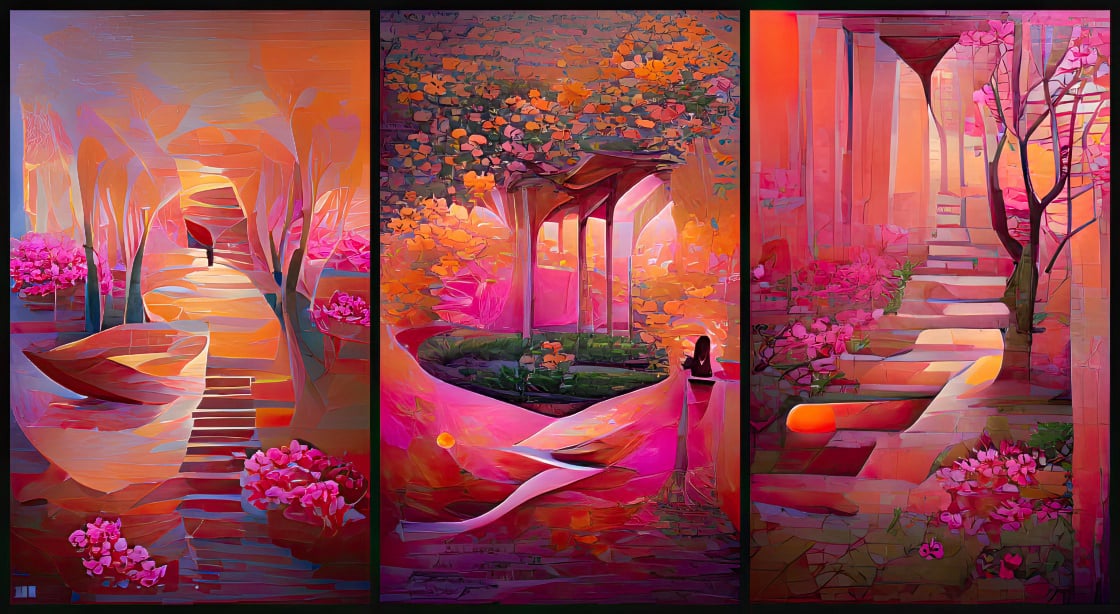
Left panel: "Path of Illusions"
Central panel: "Garden of Choices"
Right panel: "Stairway of Reflections"
"The Harmony of Borges" is a surreal landscape inspired by the labyrinth style narrative of Jorge Luis Borges, which we encounter in his work "The Garden of Forking Paths".
In the left panel, an unseen lone figure stands at the start of a winding path that winds through a surreal forest, contemplating the journey ahead. She is aware that it is not only a journey through physical space, but also through the labyrinth of the mind, where every decision leads to new and unexplored territories.
The central panel shows a magnificent garden in full bloom, with paths stretching in different directions. At the heart of this garden is a pavilion, which symbolizes a place for reflection and decision-making. A lone figure, sitting on the edge of the pavilion, seems to be deep in thought, considering which path to take. This scene captures the essence of Borges's concept of forking paths, where each possible choice creates a new reality, i.e. a new story.
The right panel shows a staircase partially shrouded in shadow breaking through blossoming trees, leading us into the unknown and symbolizing the uncertainty and mystery of the future.
Taken as a whole, the triptych serves as a visual representation of the complex and multi-layered nature of human existence, attempting to evoke in the viewer a sense of wonder and curiosity that should prompt him to reflect on his own life path and decisions.
This is another of the works that continues the exploration of the transcendental, with a focus on the individual journey towards meaning.
Triptych does not have a defined narrative in the sense of: beginning, middle and end. Instead, the panels are conceived as a variation of the same thematic motif, where three people, each for themselves and each from their own angle, are looking for an answer, staring into the luminous depths of human existence.
The use of light as a symbol of a guide through darkness and uncertainty is dominant, and trees and nature, as constant elements, give a sense of connection with the earthly.
If you want to get the full experience, try listening to suitable ambient minimalistic music, for example Toru Takemitsu, Brian Eno or Morton Feldman.
"Hunter of Light" is a work that tries to convey the feeling of traveling through different stages of spiritual awakening and creating an unbreakable connection with the universe.
The left panel depicts a hunter of light, who is in search of something unattainable, with a golden sphere symbolizing the goal of the search.
The center panel is the moment when the hunter finds the light, ascending and achieving a moment of enlightenment.
The right panel is the post-hunting phase, where the hunter manages to integrate the found light into his world. He is filled with contentment and peace, hinting at an age of harmony and renewal.
The symbolism of each panel contributes to the overall narrative and can be viewed through the prism of the basic posthumanist philosophical assumption, which is that we are not alone and that we cannot go on without achieving a harmonious organic connection with nature.
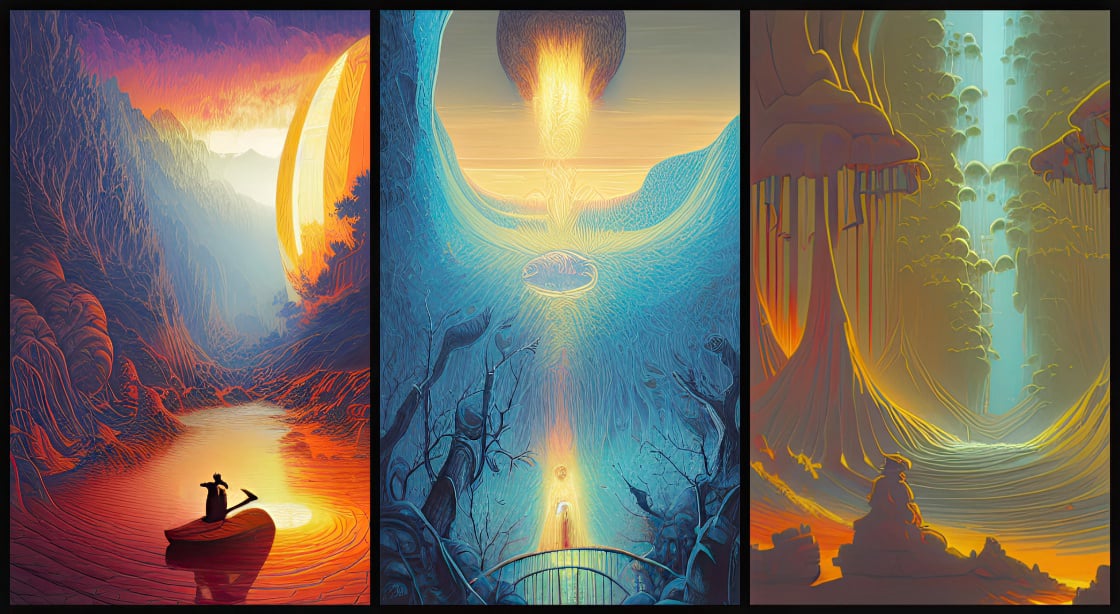
Left panel: "What the Moon Whispered to the Sun"
Central panel: "Master of Balance"
Right panel: "The Observer Effect"
The triptych "Sunset Over the Bay" is conceived as a spiritual philosophical journey that, combining abstract forms with futuristic landscapes, tries to awaken in the viewer a sense of cosmic harmony and merging with the world around him.
The panel "What the Moon Whispered to the Sun" is a little thought puzzle, which wants to encourage the viewer to wonder what level of communication and what secret kind of exchange can exist between these celestial bodies.
The central panel, "Master of Balance", suggests the existence of one or more forces that keep everything in balance, which goes well with the visual symmetry and fluid forms, depicting stability in the midst of chaos.
The observer effect in quantum physics is a scientific principle according to which a change in an observed system can be caused by the very act of observation. In this sense, "The Observer Effect" tries to connect the observer with the cosmic order, pointing out that even observation itself is not passive, but actively shapes reality. This idea that the observer cannot remain separate from what he observes, even in a cosmic context, brings a sense of unity and interconnectedness of all cosmic elements. Even when we act as "observers", we inevitably become actors and participate in the dynamics of the universe.
Taken as a whole, this work attempts to, by combining elements of science fiction, spirituality and landscape art, depict the interplay of cosmic forces, perception and balance, drawing the viewer into thinking about our essence.
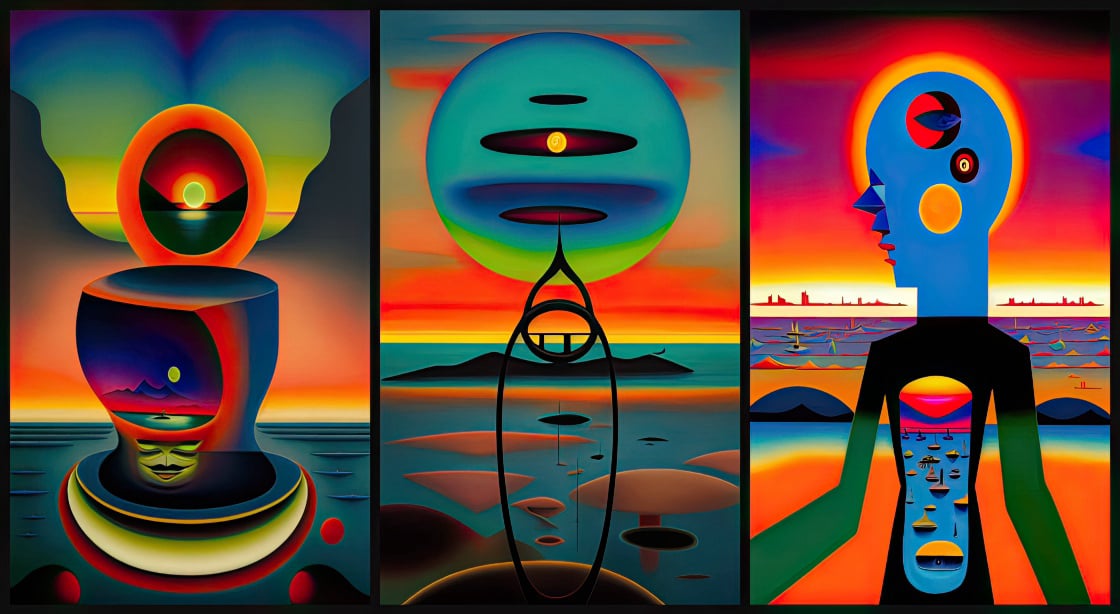
Left panel: "Darmouth Project"
Central panel: "Kurzweil's Dream"
Right panel: "Fear In the Little Man"
The triptych "Machina Sapiens" deals with the complex ideas of the development of artificial intelligence technology, as well as some harmful aspects of its planetary influence, which could be fatal for the further future of humanity.
The "Darmouth Project" is a panel that attempts to show the beginnings of artificial intelligence, alluding to the historical event of 1956, when the Dartmouth conference laid the foundation for AI research. The abstract form, which is in full swing, symbolizes the beginning of that era, filled with great expectation and hope.
The central panel of "Kurzweil's Dream" is related to the futuristic visions of scientist Ray Kurzweil, known for his predictions about the technological singularity, which represents the moment when computer programs become so advanced that they surpass human intelligence. The lightsaber in the painting, rising from the body, is a symbol of that turning point, heralding the coming of a time when man and machine will become one.
The right panel of "Fear In the Little Man" attempts to show the darker side of AI, where a small human figure looks fearfully towards a massive entity, symbolizing humanity's justified but often irrational fears. This should be a warning because of the increasing dominance of machines and technology, where man becomes insignificant and inferior in contact with something he will not be able to control.
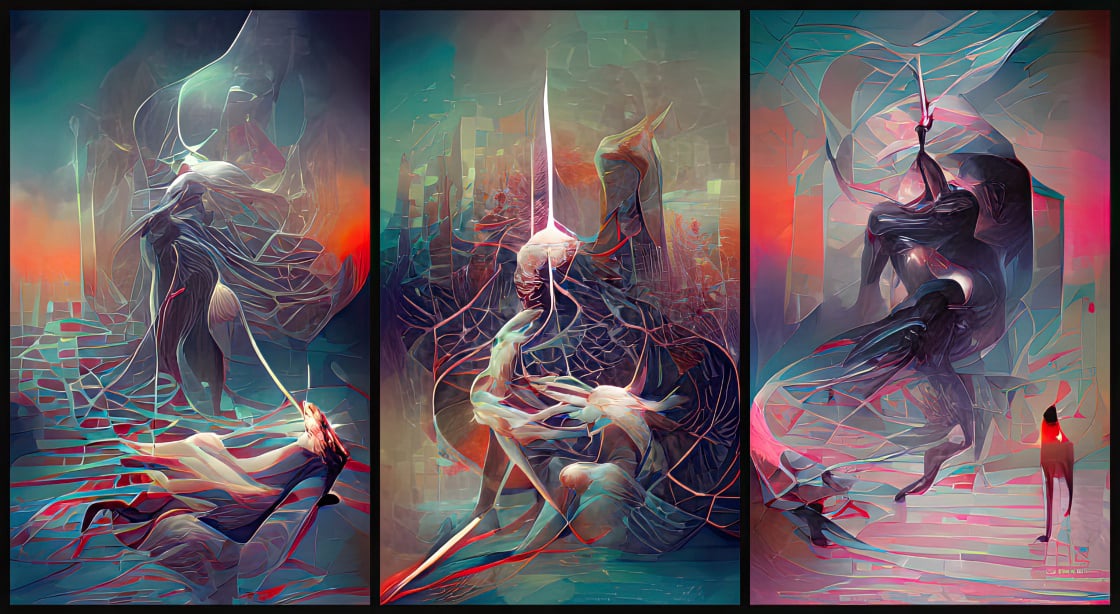
Left panel: "Corsica"
Central panel: "Austerlitz"
Right panel: "Saint Helena "
This work represents an attempt to follow the life journey of Napoleon in an unusual way, through a combination of historical narrative and emotional landscape, from his birth and early years in Corsica, through the peak of power and glory after the Battle of Austerlitz, to his final fall and death in exile on the island of Saint Jelena.
The panel "Corsica" refers to the birthplace of Napoleon. The fog symbolizes his mysterious beginning, and the light suggests the potential and successful future of the young warlord.
The central panel bears the name "Austerlitz", alluding to one of Napoleon's greatest victories. The light that emerges symbolizes triumph and glory, and the warm color conveys the intensity of the battle.
Finally, the right panel shows the island of "Saint Helena", the place where Napoleon spent his last days. The sun's rays are slowly extinguished, symbolizing the end of life's journey, settling accounts with fate and inner peace, after a turbulent life full of ups and downs.
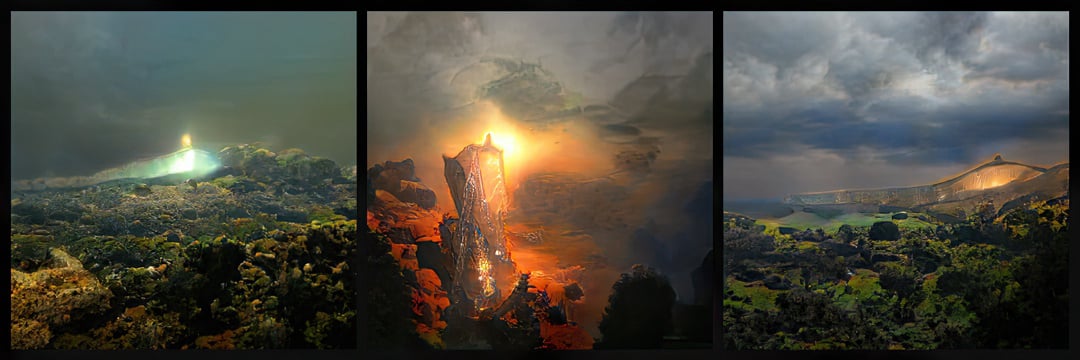
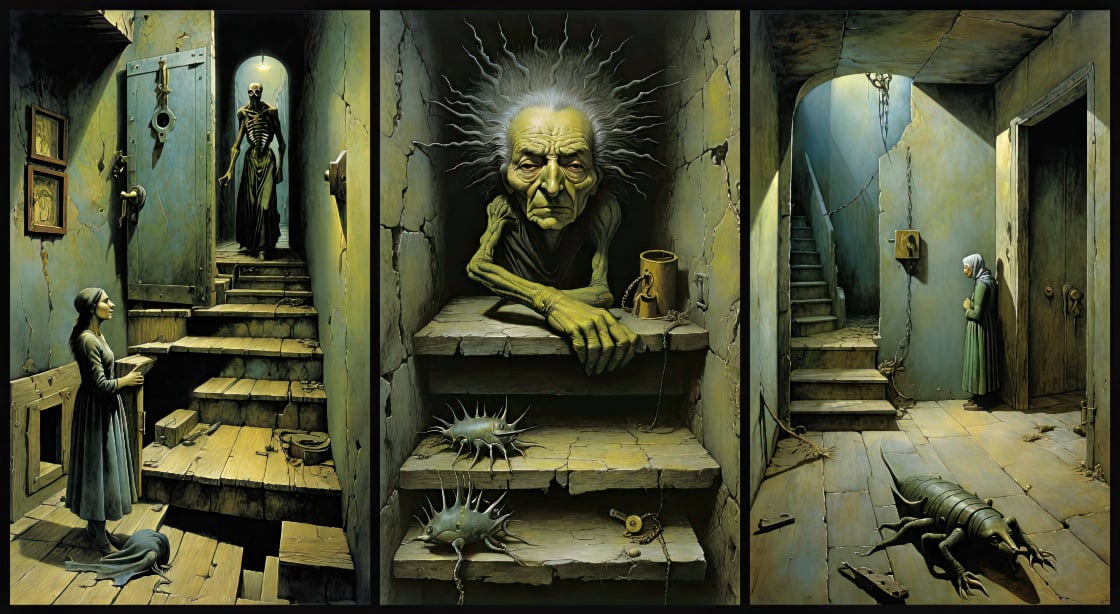
Left panel: "Mors Ante Portas"
Central panel: "Without a Last Wish"
Right panel: "The Silent Farewell"
“The Final Countdown” is an attempt to symbolically depict our journey into inevitability, using a harsh dark visual aesthetic. There are strong thematic elements of death, transience and fatalism.
The left panel shows a girl who, standing at the bottom of the stairs, obediently and as if in a soldier’s attitude, welcomes the ominous master, i.e. the messenger of death.
The central panel is dominated by an elderly woman at the zenith of her life, as a kind of metaphor for the passage of time. Her pose, tired decrepit face and dilapidated body speak of a person who is at the end of her journey. She is resigned to her fate, but she is determined and lives her last moments without fear, even without desire.
The right panel is the end, the old woman standing with fatalistic calm sees off another departure, and the diabolical creature at the bottom of the panel takes care of the remains, symbolizing the notion of nothingness.
Taken as a whole, the panels gradually reveal stages of transition, from the initial confrontation with death in “Mors Ante Portas,” to the sense of resignation in “Without a Last Wish,” to the final, quietly melancholic “The Silent Farewell.”
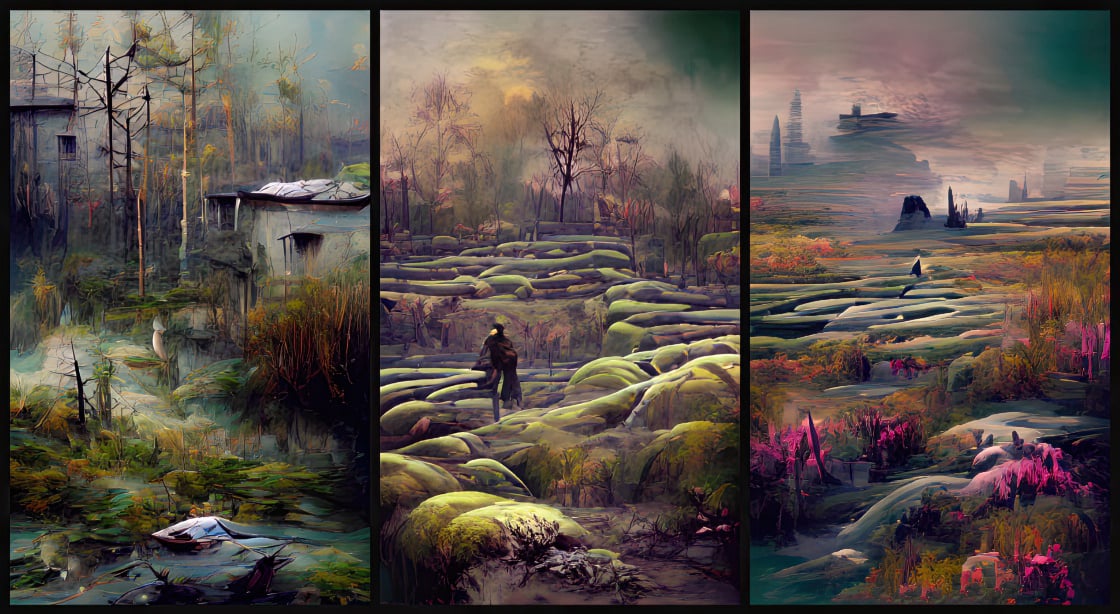
Left panel: "Zone"
Central panel: "Stalker's Travel"
Right panel: "Homecoming"
Triptych "Stalker" is inspired by the famous work of Andrei Tarkovsky - in my opinion one of the five best films of all time.
"Stalker" is a trap film, especially for all those who try to explain it in a rational way. After so many years since its creation (1979), we are still not able to classify it in the appropriate film category. Is it science fiction? Or an engaging critique of the fossil remains of Soviet socialist realism? Perhaps a spiritual-metaphysical drama? Action?
Probably never in the history of cinematography has such a multi-layered and symbolically rich film been seen, which, depending on the imagination of the viewers, can be anything. That's why this triptych tries to do what, in my opinion, only makes sense when it comes to Tarkovsky - to evoke the atmosphere that reigns in the film and to let the viewer transcend himself by listening exclusively to his "inner voice".
The left panel shows a dilapidated, abandoned building surrounded by wet, swampy vegetation, symbolizing the mysterious, abandoned and polluted "Zone", at the center of which is the "Room", where every wish we can imagine is fulfilled.
The central panel of "Stalker's Travel" depicts a lone Stalker, and his journey through a danger that is omnipresent, yet unknown and faceless. The moss-covered landscape symbolizes neglect, but also the vitality of nature that has taken its toll.
Finally, the right panel of "Homecoming" presents a vast landscape, which is almost endless and horizonless in one part. The light slowly breaks through the clouds illuminating the gloomy buildings and symbolizing the return to safety and the awakening of some new hope.

Offline Website Builder