This project, which consists of a cycle of 11 triptychs, is a tribute to the famous work of the same name by Hieronymus Bosch and represents an attempt to modernize the medieval theme with the most modern ideas, especially posthumanism and transhumanism.
Also, a completely new dimension is introduced in the understanding of traditional concepts of sin and eschatological themes, exploring them through the latest concepts such as the ethics of biotechnology, the social consequences of digitization, as well as the philosophical implications that all this has on human nature and destiny.
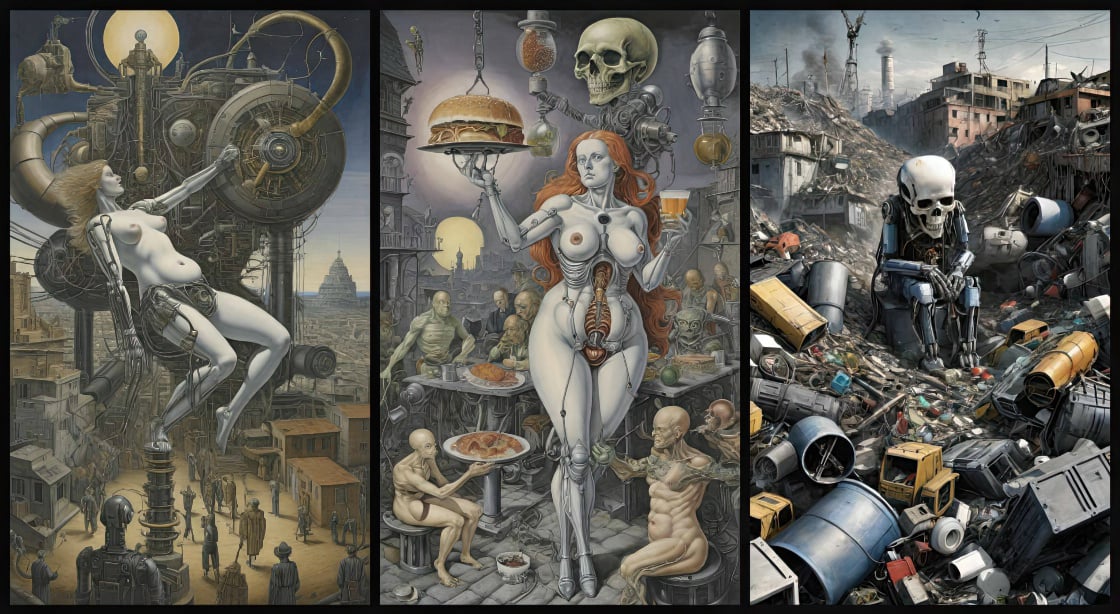
Left panel - "Genesis of the Goddess"
Central panel - "Dopamine Express"
Right panel - "The Wasteland of Excess"
"Gluttony" is an exploration of the vicious cycle of consumerism, addiction, and existential decay in a posthumanist world. The triptych follows the journey from the seductive birth of consumerism to the eventual demise caused by excess.
The first panel, "The Goddess of Consumerism," portrays the allure of excess through a powerful deity, while the second, "Dopamine Express," reveals the hedonistic pleasures offered in exchange for one's soul. The final panel, "The Time of Thanatos," depicts a solitary figure in the aftermath of excess, contemplating the remains of a broken society.
Through these dark visuals, the artwork questions the sustainability of an overindulgent, consumer-driven world."
Left panel - "Liminal Dreams"
Central panel - "Belphegor's Dominion"
Right panel - "Endless Loop"
"Sloth" explores the paralyzing nature of lethargy and how technology, as a tool for escape, leads to the slow death of human will and purpose. The triptych focuses on a social group that, once vibrant, succumbs to a life of passivity and dependency on artificial constructs.
In the first panel, the group is depicted in a dream-like state, disconnected from reality and absorbed in their distractions.
The second panel, symbolizing Belphegor, the demon of sloth, shows the group's emotional and physical degradation as they become more enslaved to their devices and indulgence in empty pleasures.
By the final panel, the group’s ability to act has atrophied, and they are left as hollow versions of themselves, unable to break free from the chains of technological control.
The story offers a dark commentary on the dangers of over-reliance on escapism, presenting a stark vision of a world where human agency is sacrificed for the illusion of comfort.
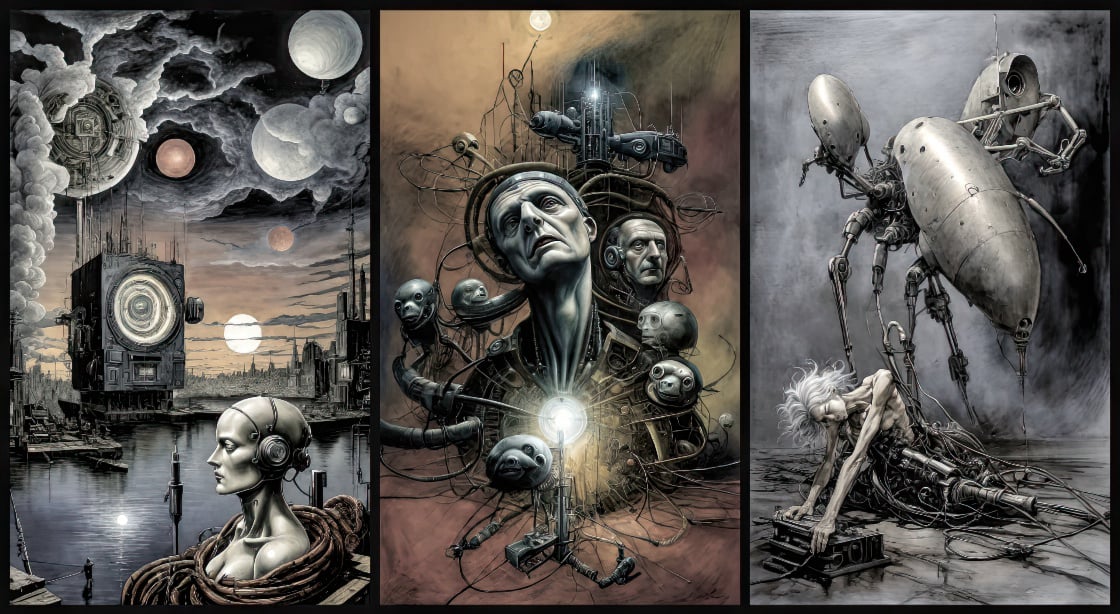
Left panel - "Synthetic Longing"
Central panel - "Digital Euphoria"
Right panel - "Post coitum omne animal triste"
"Lust" is a profound exploration of the intersection between human desire and technology.
The first panel, "Synthetic Longing," depicts a woman bound by the cables of a digital network, separated from her physical reality and immersed in a world of virtual desire.
In "Digital Euphoria," her body and mind become tools for a hedonistic experiment in the virtual realm, where she experiences a perfect, digitalized version of herself.
However, in the final panel, "Post coitum omne animal triste," the effects of this indulgence become clear: the woman is left emotionally and physically exhausted, disconnected from both reality and herself.
This triptych offers a critical commentary on the dangerous allure of virtual realities and the emptiness that follows when human connection is replaced by digital fantasies.
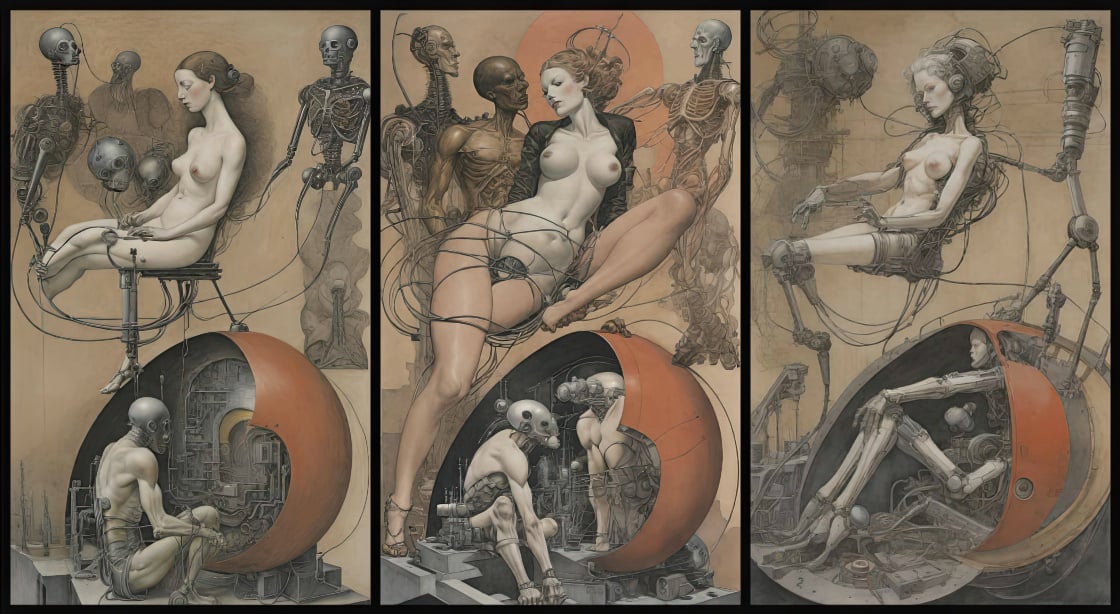
Left panel - "The Merciful Quan"
Central panel - "The Proud Herd"
Right panel - "The Zoo Keeper"
"Pride" is a meditation on the destructive potential of collective pride and blind obedience in a technologically-driven world.
The first panel, "The Merciful Quan," introduces the deity-like figure of the quantum computer, whose omnipotence is revered by a trusting society.
In "The Proud Herd," the people become passive subjects, entranced by the illusion of progress, while the presence of the sphinx in the background serves as a warning.
The final panel, "The Zoo Keeper," presents the future of a society reduced to a controlled zoo, trapped in the cycle of power and technology, devoid of agency or autonomy.
Through this allegory, the artwork warns against the dangers of unchecked pride and technological domination."
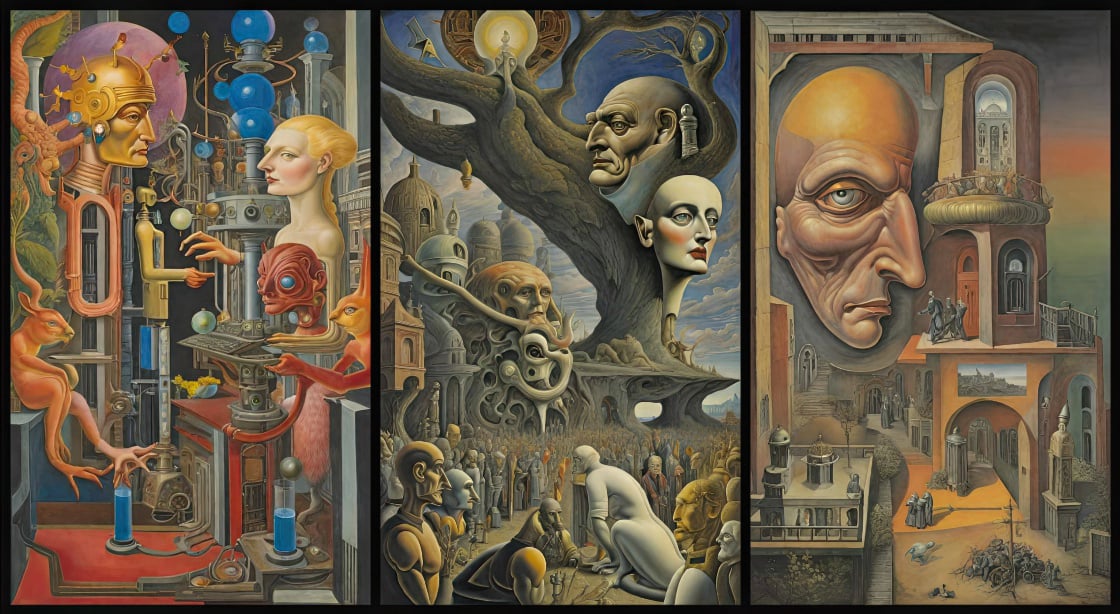
Left panel - "The Rulers"
Central panel - "Inferno Unleashed"
Right panel - "Ashes of Desolation"
"Wrath" delves deep into the explosive power of unchecked rage, depicting the devastating effects of tyrannical rule.
"The Rulers" introduces the figures who sow division and oppression, fueling the anger that permeates society.
As the conflict intensifies, "Inferno Unleashed" shows the eruption of rage, leading to physical chaos and destruction.
In the final panel, "Ashes of Desolation," the consequences of unleashed fury are clear – a desolate world where all are lost.
This triptych serves as a powerful reminder of the destructive path that unchecked anger and authoritarianism can lead to, where in the end, all fall into ruin.
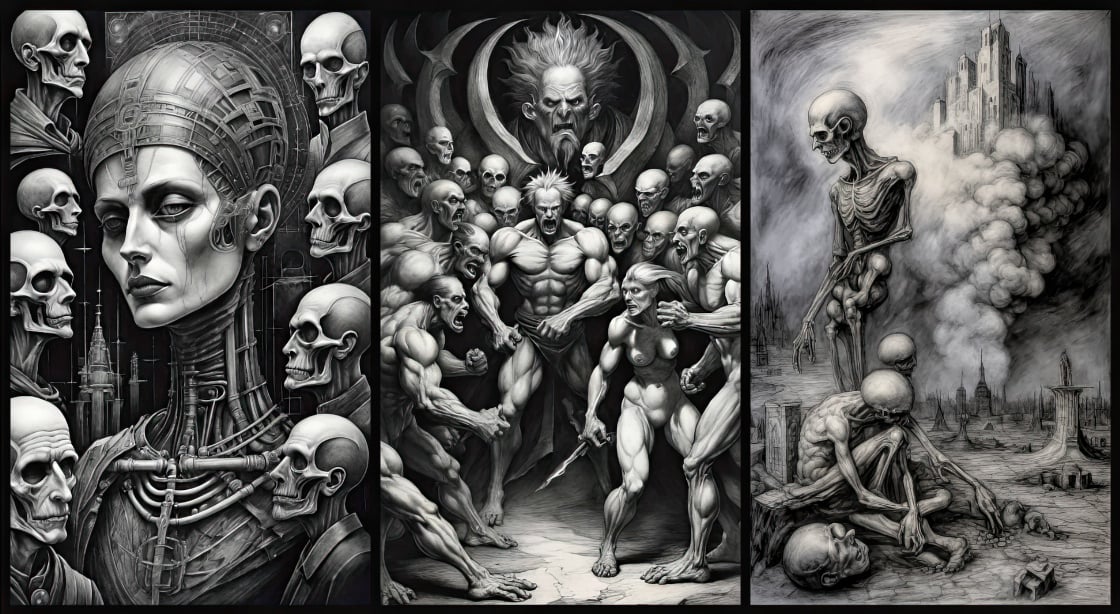
Left panel - "The Birth of Envy"
Central panel - "I Chose Death!"
Right panel - "The Holographic Afterlife"
"Envy" is a triptych that delves deep into the human psyche and explores the destructive force of envy and self-loathing.
The birth of envy in the face of aging, the choice between life and death through the lens of posthumanism, and the emergence of a digital afterlife symbolize the tension between the human soul’s desire for eternity and the inevitable decay of its physical vessel.
A chilling commentary on the lengths one may go to escape mortality, the piece questions if technology can ever replace the essence of human experience.
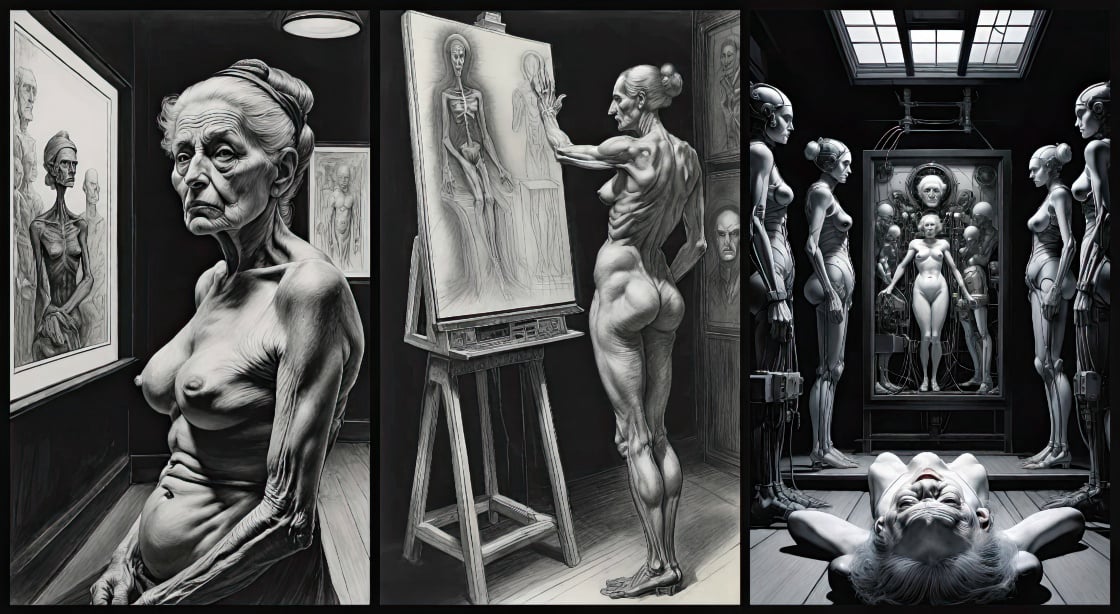
Left panel - "At the Mary Shelley Clinic"
Central panel - "Jellyfish Man"
Right panel - "Eaten Away by Loneliness"
This triptych explores the consequences of greed for immortality, both in a literal and metaphorical sense.
The journey begins at the "Mary Shelley Clinic," where a wealthy man undergoes a dangerous experiment to attain eternal life.
By the second panel, he has transformed into the "Jellyfish Man," an immortal being with no body, bound to the cold, mechanical nature of his new form.
In the final panel, "Eaten Away by Loneliness," we see the dark reality of such a transformation: immortality comes at the cost of human connection and emotional fulfillment.
This triptych delves into the depths of human desire for control over life and death, ultimately revealing the emptiness that accompanies such greed.
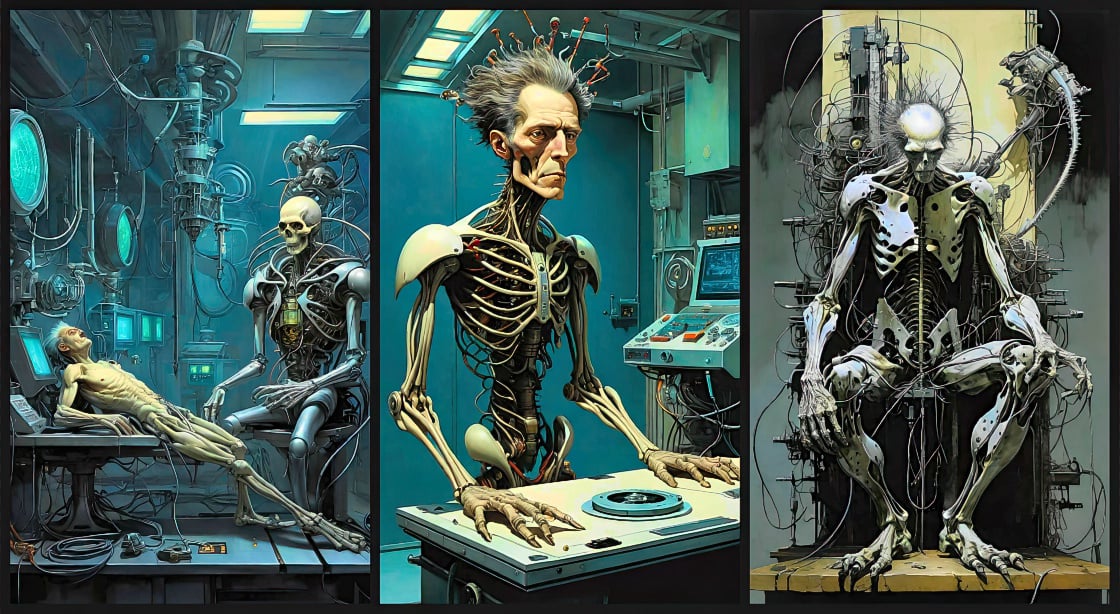
Left panel - "Mocking God"
Central panel - "Samael's Wrath"
Right panel - "Human, All Too Human"
"Identity" delves into one of the most profound and sensitive themes of human existence—the question of identity in the posthuman era. Drawing on philosophical, theological, cultural, and moral dilemmas, this triptych seeks to illuminate, in a surreal and grotesque manner, the conflict between traditional values, the loss of metaphysical belief, and the aspiration for a new, still unclear order.
The left panel portrays a woman symbolizing the ordinary, small person who mocks God, representing the process of the fading of faith.
The central panel features Samael, embodying the wrath of a fallen deity in the face of humanity’s disbelief. His anger is impotent, a shadow of what once was—an echo of divine authority lost to time. This panel reflects the erosion of old beliefs and the realization that the forces that once governed existence can no longer control or punish humanity.
The right panel depicts what remains of humanity. We continue to gaze into the heavens, as our old morality slowly melts away, making room for something new, yet still unknown. Drawing inspiration from Nietzsche’s "Human, All Too Human", the piece raises the question: Are gods and dogmas mere constructs of human fear, or have they always been integral to our consciousness? In the posthuman context, it further asks: How do we redefine human identity and find new purpose in a post-theistic world, when human nature is changing and old values are fading?
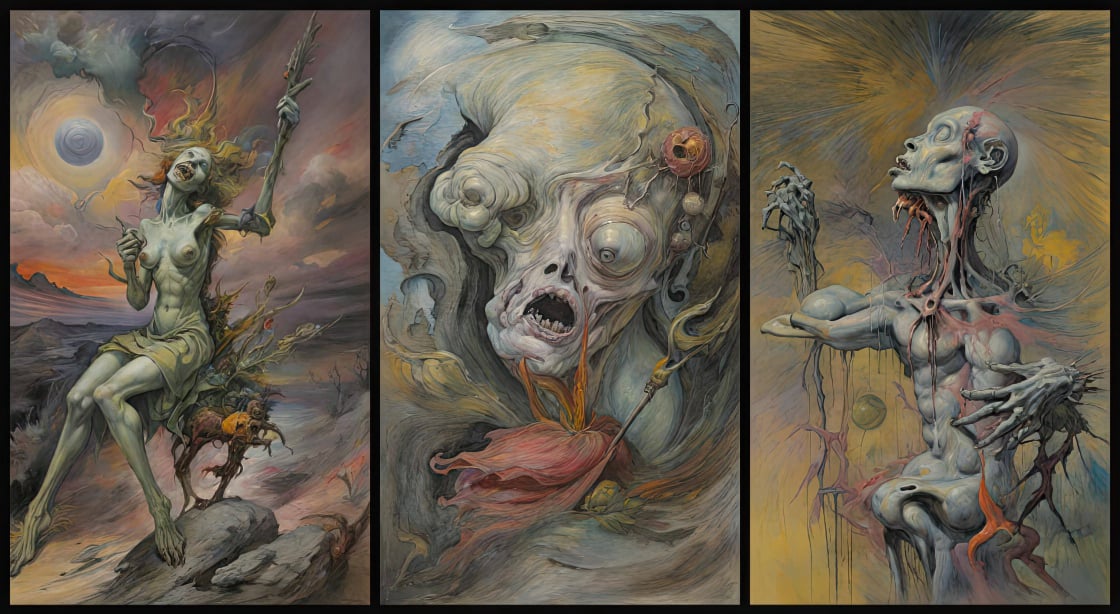
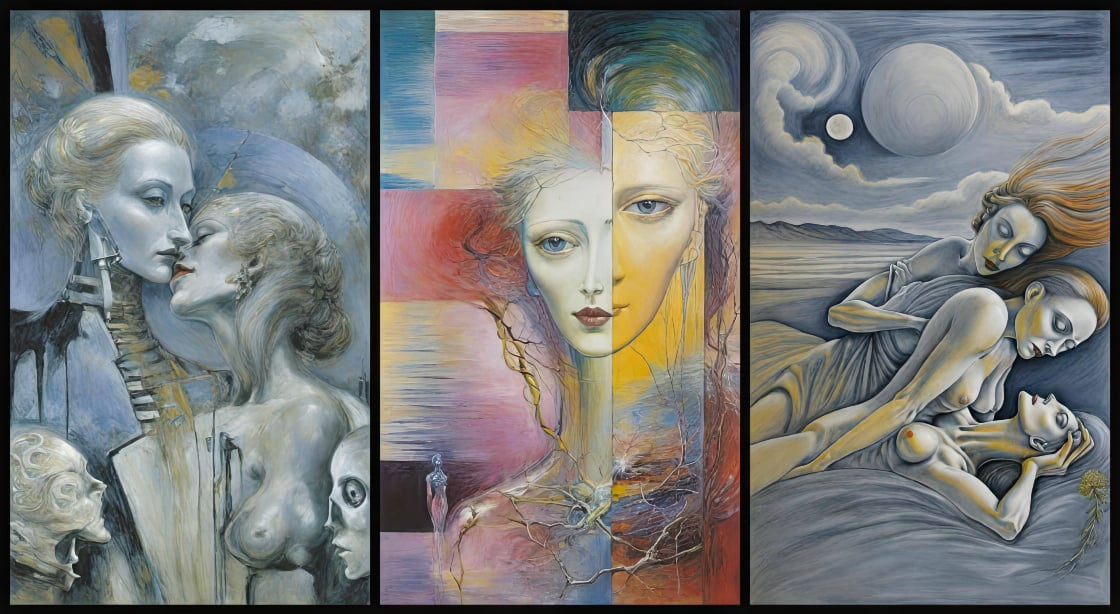
Left panel - "The Android That Loved Me"
Central panel - "Between Freedom and Judgment"
Right panel - "Android's Dream"
"Consciousness" explores one of the most significant questions of the posthuman era—what does it mean to be conscious, and how do we define the boundaries of consciousness and love in an age of technology and androids? The triptych is a deeply narrative exploration, blending existential questions, ethical dilemmas, and emotional conflicts. Through the story of an android in love with a humanoid woman, the work opens a dialogue on love, identity, and acceptance in a future society—reminiscent of the android K in "Blade Runner 2049".
The left panel depicts two women: on the left, the female android, symbolized by her neck, and on the right, her human partner with whom she shares a romantic relationship. The android’s expression is one of concern, aware of the societal judgment surrounding them— a mix of astonishment and condemnation as a defense of traditional values and morals. The humanoid woman, in contrast, is completely immersed in her passionate feelings, blind to the judgment that the android is so acutely aware of.
The central panel represents the humanoid’s internal struggle. She is under societal pressure and begins to question herself. On one side is the sea of freedom, symbolized by the water and distant horizon, while on the other side is societal condemnation, represented by a small human figure at the bottom left of the panel. The humanoid is torn between the two, caught in an unresolved tension, with no clear resolution in sight as the pressure mounts.
The right panel portrays the android's dream, where she makes love to the humanoid. A third woman, symbolizing society’s view, rests her hand on the android’s shoulder in a gesture of understanding and support. In the dream, the android is no longer an android—her neck now suggests she has transformed into a woman. The dream seems to ask the question: "Why do you judge us? I am part of you! I have consciousness, I feel love, joy, and pain just like you!"
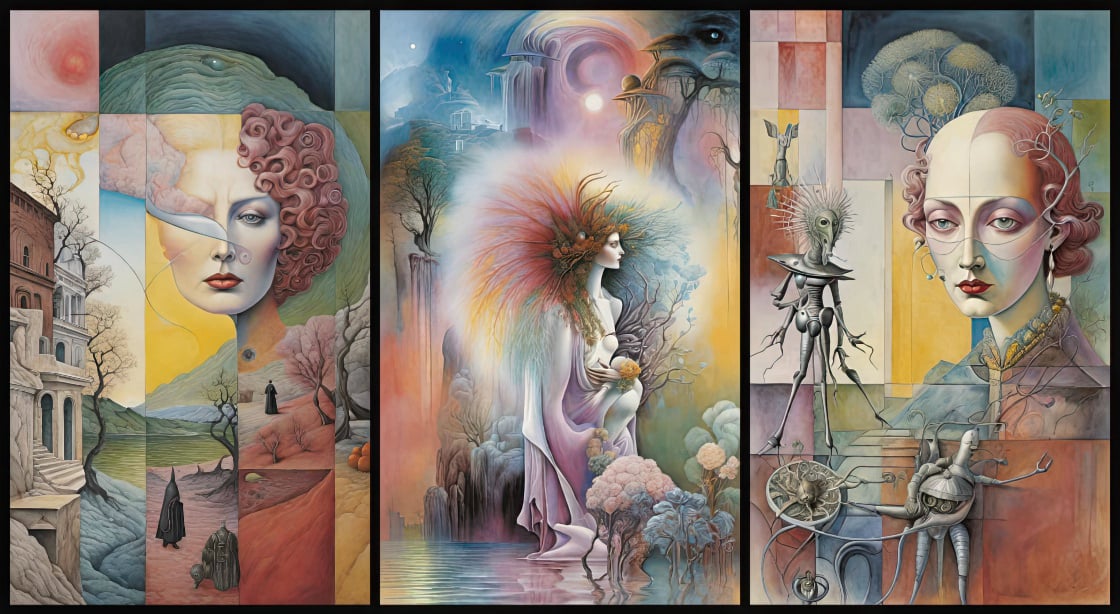
Left panel - "Age of Strength"
Central panel - "Age of Innocence"
Right panel - "Only Anxiety is Eternal"
"Transience" attempts to illustrate the fleeting nature of life through three key phases—youth, maturity, and old age—with a strong transhumanist component. The narrative unfolds not only linearly but also in layers, addressing themes of identity, self-perception, and our relationship to the world in each phase.
The central panel portrays a young woman, a virgin immersed in her dreamlike world, symbolized by her surreal, flowing hair. This representation captures the innocence and boundless possibilities of youth, where the world is still a canvas of potential.
The left panel shows the woman transformed into a fully realized adult and mother. She is aware of her beauty, strength, and fulfillment. The home around her symbolizes safety and permanence, while she calmly observes the people who have entered her life, a sense of peace and acceptance emanating from her as she reflects on her journey.
The right panel depicts an elderly woman, but through a posthuman-transhuman lens. Thanks to advanced technology, she has been rejuvenated and cybernetically enhanced, retaining her beauty, though anxiety about an uncertain future is evident on her face. The presence of mechanical beings in the panel speaks to the transhuman interventions she has undergone in her quest for immortality.
How long will this state endure? Will she remain eternally desirable and beautiful? Does transhumanism truly solve the issue of transience, when emotional questions and anxieties persist?
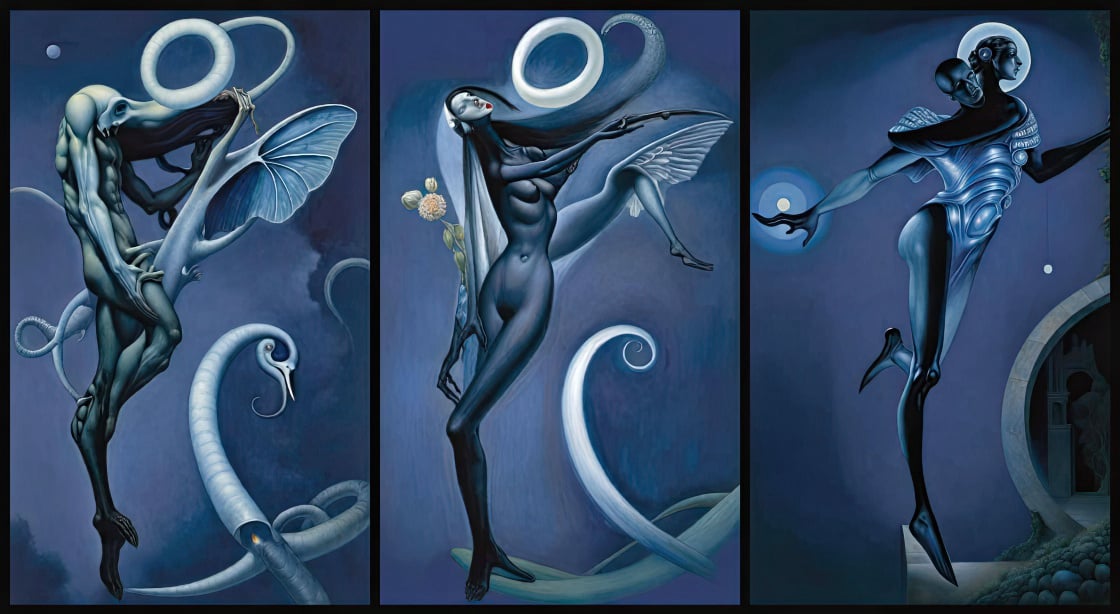
Left panel - "Primordial Harmony"
Central panel - "Ascension of Arrogance"
Right panel - "Echoes in the Void"
"Legacy" offers a deep reflection on humanity's inheritance and its journey from harmony to destruction, portrayed through three phases of human development: innocence, arrogance, and isolation.
The left panel symbolizes an era of innocence, from early humans to about 200 years ago. The human figure is intertwined with plants, its head bowed, symbolizing a connection with nature and the earth. Below it is an imagined creature, resembling a swan, emphasizing the pure, untainted unity with the natural world.
The central panel depicts a figure brimming with self-importance, eyes fixed on the halo it strives to grasp. A human leg emerges from the wings of a vanishing bird, while the swan transforms into an undefined spherical form. This suggests humanity's ambition and arrogance, attempting to reach divinity while severing its connection to nature.
The right panel represents the culmination of this drama, where the sphere has become a concrete structure, surrounded by stones. In the background, two solitary celestial bodies shine, while the bodies of a man and woman merge, crowned with a halo. They ascend in divine isolation, but at what cost? The figure is both human and transcendent, yet utterly alone.
What legacy do we leave for future generations? Can humanity return to a state of "Primordial Harmony", or are we doomed to repeat the mistakes of the past? The question of legacy is not just about what we leave behind, but how we preserve it for future generations. Can we secure a future of harmony, or is our fate sealed in the echoes of our own actions?

AI Website Generator