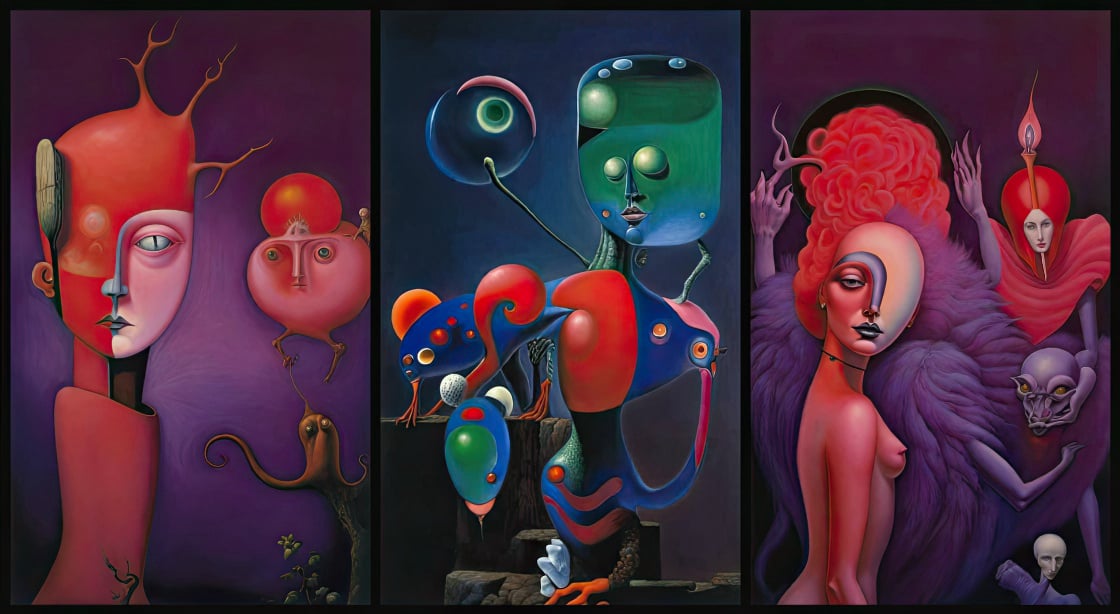
We stand at a pivotal moment in history, a crossroads where humanity, perhaps more than ever before, faces
significant existential challenges. The cycle of 13 triptychs under the title "Crossroads of Humanity" seeks to highlight and spark conversation on the pressing questions of our modern age. See the video about this tryptich serial.
Left panel - "The Quiet Observer"
Central panel - "The Hybrid Genesis"
Right panel - "The Red Oracle"
"The Quiet Observer" symbolizes Earth as a silent witness to the clash of ideas. Its positioning and expression evoke introspection and patience, yet hint at melancholy for an uncertain future. The surreal flora and fauna reflect organic unity and harmony, while the observer figure suggests neutrality and indifference.
"The Hybrid Genesis" represents the conflict and symbiosis between humanity and technology. The posthumanist experiment of merging the natural with the artificial signals the creation of a new life form, raising questions about its purpose and ethics. The panel’s fluid, yet fragmented structure questions whether this fusion is evolution or deviation.
"The Red Oracle" presents a mythological and spiritual alternative to technology. The Red Oracle symbolizes a return to roots, tradition, and a mystical connection to nature, where technology becomes obsolete. Her presence is theatrical, radiating authority and passion. The figures surrounding her appear as followers or witnesses to a ritual, emphasizing the idea of gnostic faith and spiritual return.
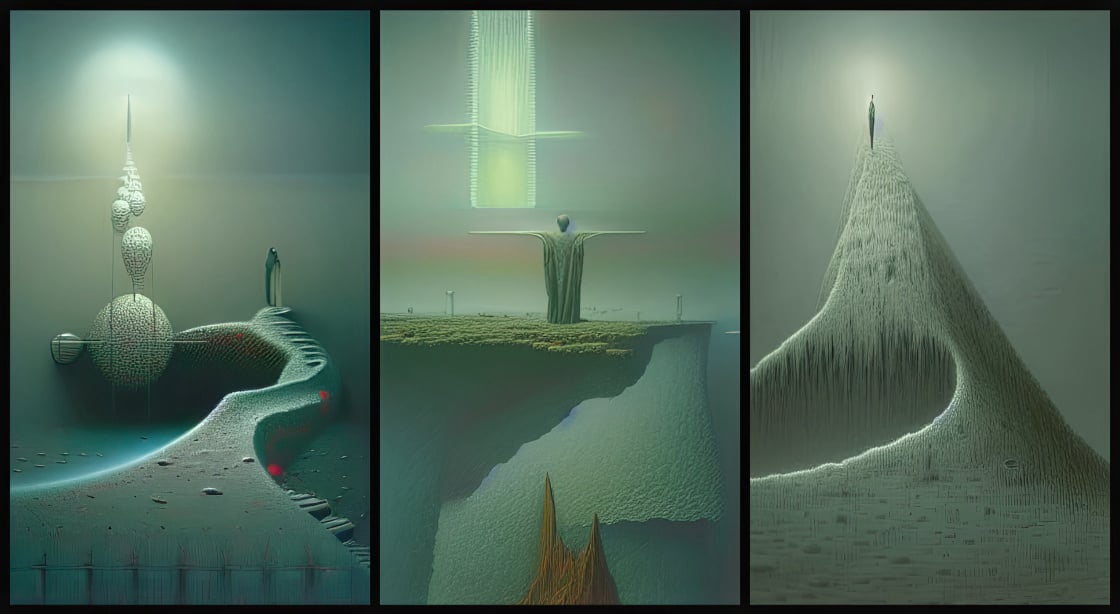
Left panel - "The Road Less Traveled"
Central panel - "Singularity"
Right panel - "And What Now?"
Inspired by Alphonse de Lamartine’s words: “Limited in his nature, infinite in his desires, man is a fallen god who remembers the heavens,” this triptych delves into the contrast between human limitation and boundless ambition.
"The Road Less Traveled" represents the journey of a man torn between his aspirations and the constraints of his nature. The path is uncertain, symbolizing the choices we make in our quest for something greater, yet always constrained by our human fragility.
"Singularity" explores the pursuit of the unattainable — the technological singularity, a moment of divine enlightenment and transcendence. This panel represents the peak of human aspiration, where technology promises to overcome the limitations of the flesh, yet also casts an uncertain shadow over the future.
"And What Now?" confronts the aftermath of ambition realized. Having reached the precipice of transcendence, the figure now faces the question: What comes next? The culmination of human desire is met with the ambiguity of an uncertain future, where the divine is achieved but the next step remains unclear.
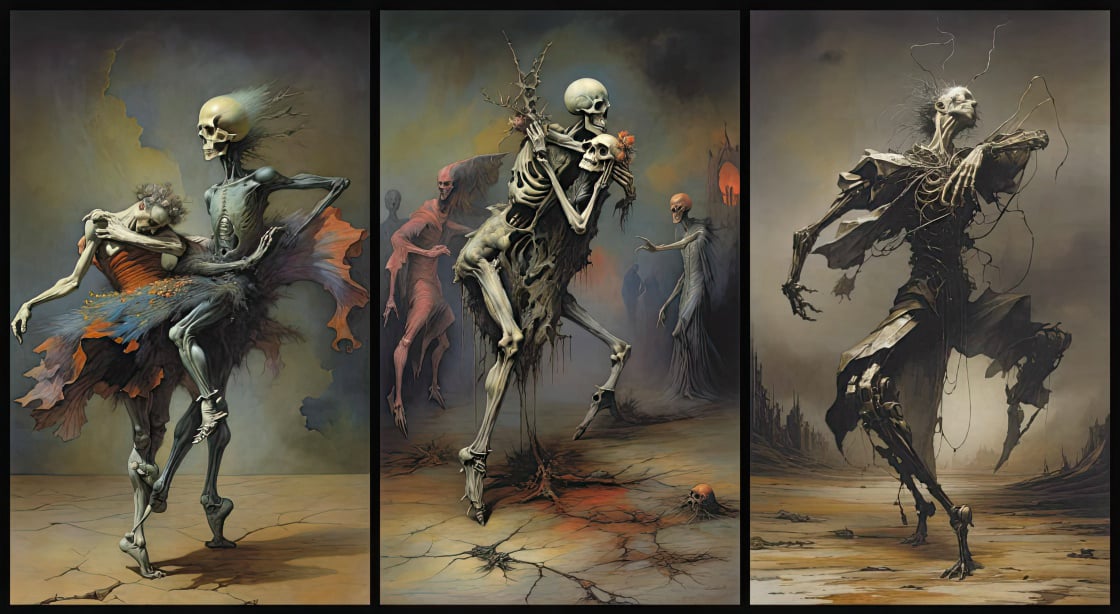
Left panel - "Prelude to Dusk"
Central panel - "Embrace of Shadows"
Right panel - "The Cyborg’s Triumph"
"Dystopian Dance Macabre" reinterprets a classical artistic motif in a contemporary context.
"Prelude to Dusk" visually and emotionally represents the beginning of the dance with death. The female figure appears exhausted, as if resisting the inevitable with her last ounce of strength. Her evident despair and helplessness simultaneously reveal the final spark of the will to live.
"Embrace of Shadows", as the bridge between the beginning and the end, portrays the moment of death and the continuation of the dance in death’s embrace. The transformation of her face into a skull further emphasizes ultimate vulnerability, while the dark, cold tones in the background intensify the atmosphere of hopelessness.
"The Cyborg’s Triumph" marks a pivotal moment in the narrative, steering the story toward an unexpected transhumanist turn. For the first time, life triumphs with the aid of advanced technology. The woman becomes a cyborg, freed from mortality, surrendering to her ecstatic dance in a wave of euphoric liberation.
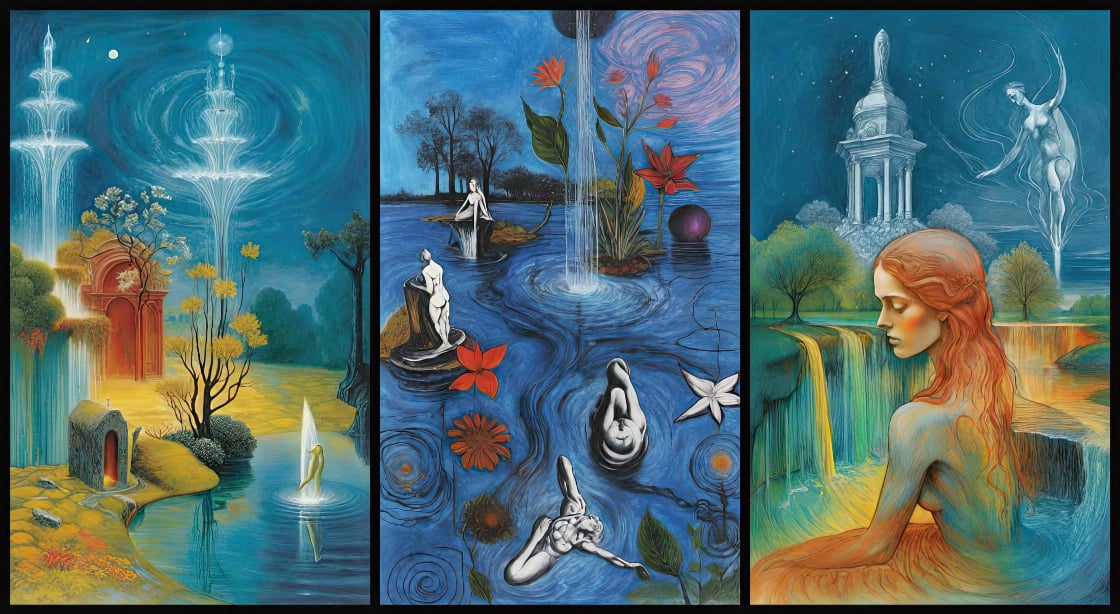
Left panel - "The Quiet Before"
Central panel - "Rebellious Waters"
Right panel - "Harmony of Emptiness?"
Inspired by the poetry and music of John Dowland, this triptych explores the theme of past, present, and future.
"The Quiet Before" represents an idyllic past when humanity was one with nature, but with limitations. The scene is dominated by two fountains, with a delicate female figure bathing in the pure water, symbolizing the brief and fragile nature of life. Despite the peaceful setting, the absence of sunlight hints at the darker side of this past — a time when simple ailments could be fatal.
"Rebellious Waters" depicts the present, where the fountain's waters are turbulent, unhealthy, and chaotic, reflecting the alienation and existential struggle of modern life. The once harmonious connection to nature has turned into a cycle of despair and disillusionment.
"Harmony of Emptiness?" envisions a posthuman future after the technological singularity. A grand structure symbolizes scientific progress, while a goddess figure represents the triumph of order and reason. The young woman, free from suffering, enjoys eternal life in a world where vitality is absent.
Unlike "Dystopian Dance Macabre", which simply acknowledges immortality as achieved, this panel deepens the narrative, exploring the emptiness and melancholy that accompany such a feat. The absence of the sun and the loss of the fountain signify that, despite reaching the pinnacle of existence, the question remains: What is the meaning of life in a world where everything has been achieved?
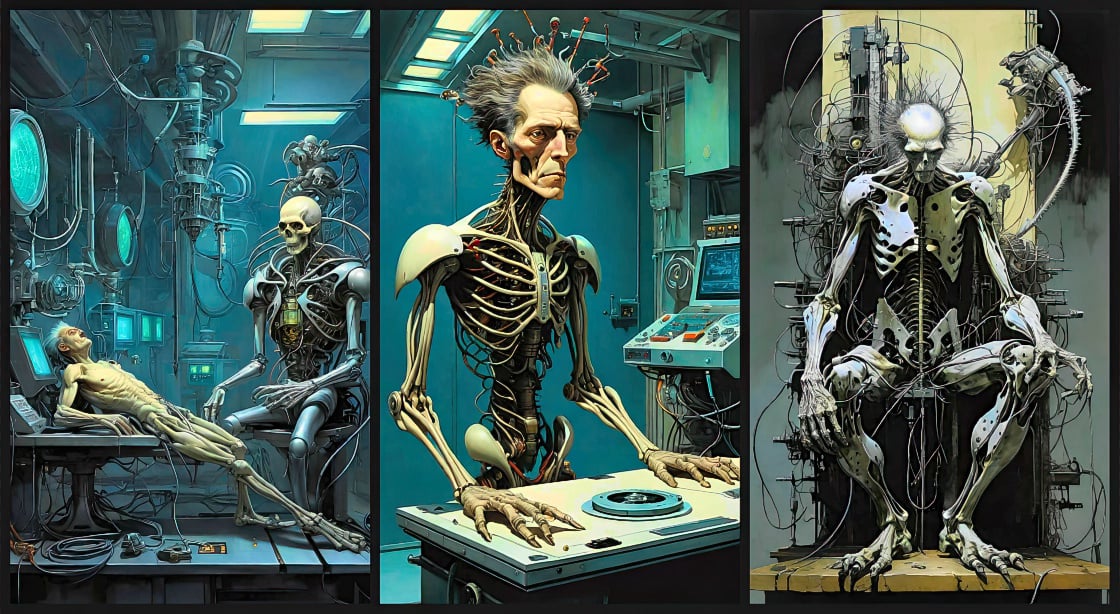
Left panel - "At the Mary Shelley Clinic"
Central panel - "Jellyfish Man"
Right panel - "Eaten Away by Loneliness"
A dying billionaire undergoes an experimental procedure at the Mary Shelley Clinic, surrounded by sterile lab conditions and robotic doctors. His decision to undergo this treatment reflects his ambition to conquer mortality. The clinical environment underscores the sterile, detached nature of his pursuit to defy death.
In the "Jellyfish Man" panel, the operation is a success, and he has achieved immortality, transforming into a creature resembling a jellyfish. His body has become largely mechanical, a cyborg, while his human head remains, carrying an expression of cold, determined resolve. As if staring into a mirror, he whispers to himself, "You are immortal now; you can do anything." Though grotesque, the transformation no longer matters—his ultimate goal has been achieved.
The final panel, "Eaten Away by Loneliness," embodies the true cost of his greed—the inevitable solitude and internal emptiness that come with unchecked ambition and the desire to control nature. Immortality has not granted him peace, only isolation and a profound sense of existential void.
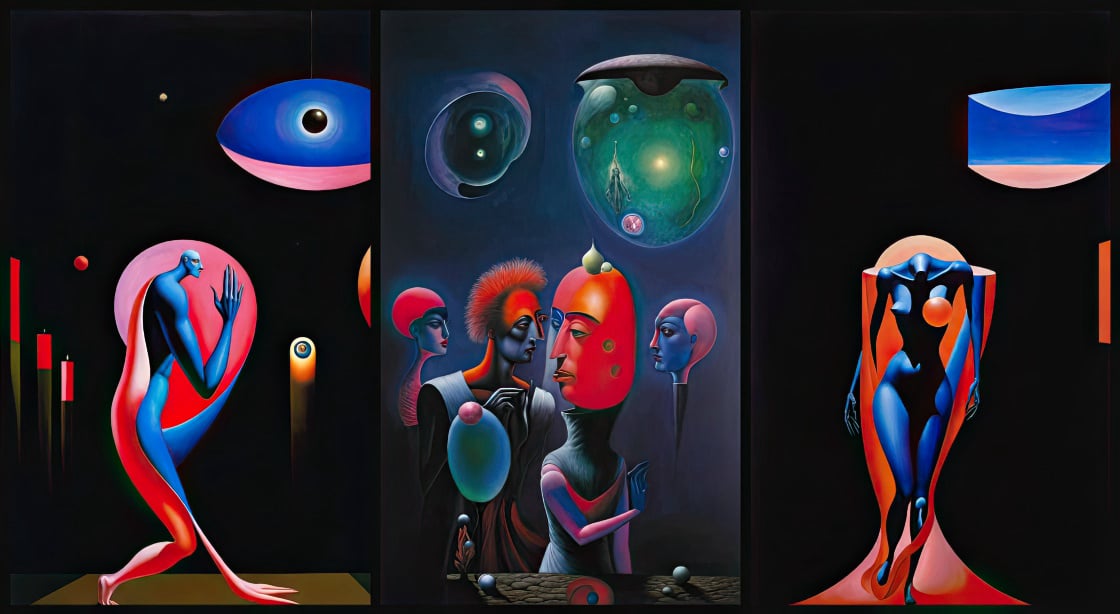
Left panel - "XY Role"
Central panel - "The Grand Simulator"
Right panel - "XX Role"
"A Dream World" explores one of the most profound philosophical questions of our time—the nature of reality—connecting our biological roles to the simulation hypothesis and the philosophical dilemmas it brings.
The left and right panels define the male (XY) and female (XX) roles, representing the biological foundations of identity.
The central panel depicts a vast simulator with its advisors, a hub of decision-making and control. In the upper-right corner, our "vessel" is shown, where the imagined scenario of the simulator plays out, but other worlds exist above the head of the simulator. This suggests that we are not alone in a Matrix-like reality. The connection to Nick Bostrom's simulation hypothesis is evident, as the idea that we might live in a simulated world extends beyond our individual existence.
In one iconic moment, Morpheus answers the question, "What is the Matrix?" by saying, "Matrix is a dream world." This idea informs the title of the triptych. However, Morpheus is not the creator of dreams but rather a messenger, a conduit between the "outside" (the simulation, the real world, higher realities) and the "inside" (dreams, illusions, perception). Similarly, the male (XY) and female (XX) figures carry biological and social messages that are deeply embedded in our "program."
The "Grand Simulator" serves as a metaphorical version of Morpheus—a force that shapes and transmits reality but is not its ultimate origin. The spherical worlds above the simulator emphasize that our world is not unique but part of a larger cosmic "dream."
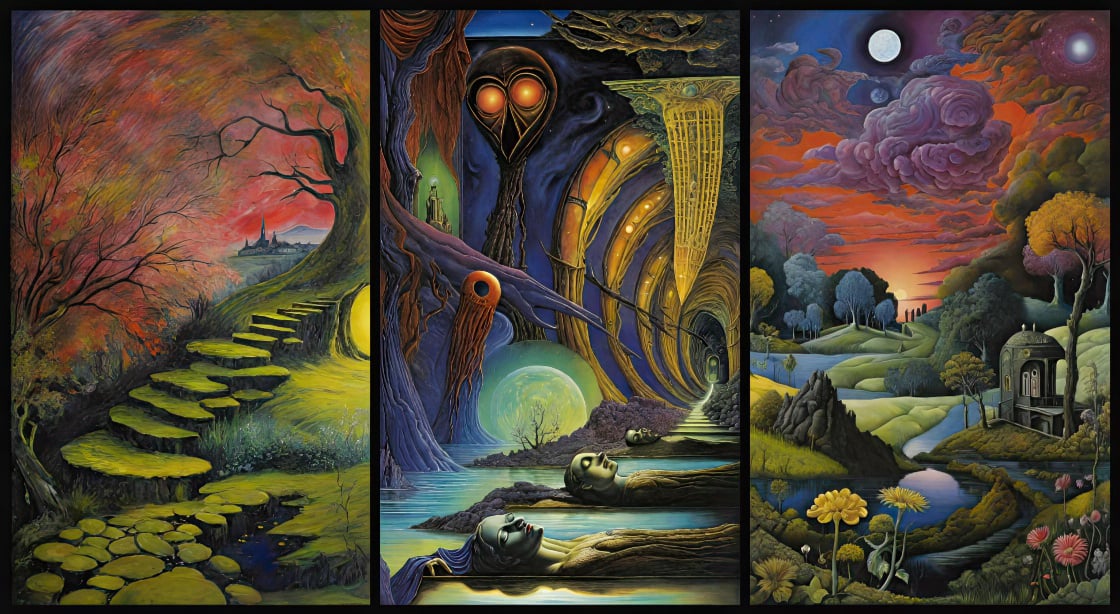
Left panel - "The Seductive Path"
Central panel - "The Dream Keeper"
Right panel - "Utopian Mirage"
"The Cave of Dreams" explores the relationship between reality and virtual reality, reflecting the growing influence of technology in our lives. The concept of retreating into a "cave" to find an escape from daily reality, seeking an idealized and passive dream, resonates deeply with today’s society, where technology increasingly dominates our existence.
The left panel depicts a mysterious, winding path leading to the cave—a metaphorical entrance into escapism. This path symbolizes the journey into a collective digital dream, akin to entering the Matrix or a virtual reality that promises to replace the complexities of real life.
The central panel shows this place, where individuals lie motionless under the watchful presence of a giant "Watcher." Their minds have clearly wandered, merging with something far greater. The dominant "Watcher" figure emphasizes the passive role of the people, who surrender themselves to the virtual dreams. The Watcher symbolizes the system that enables this reality, where technology and algorithms have become so powerful that they almost take on the role of a digital "god."
Finally, the right panel portrays the idealized dreams of the dreamers, painted in a deliberately naive, almost whimsical style. This choice highlights the fairy-tale quality and unreality of the dreamscape—the passive existence many people already live in, immersed in a matrix-like life. The fantastical landscapes and surreal elements suggest temporary comfort, yet also the loss of connection to the real world.
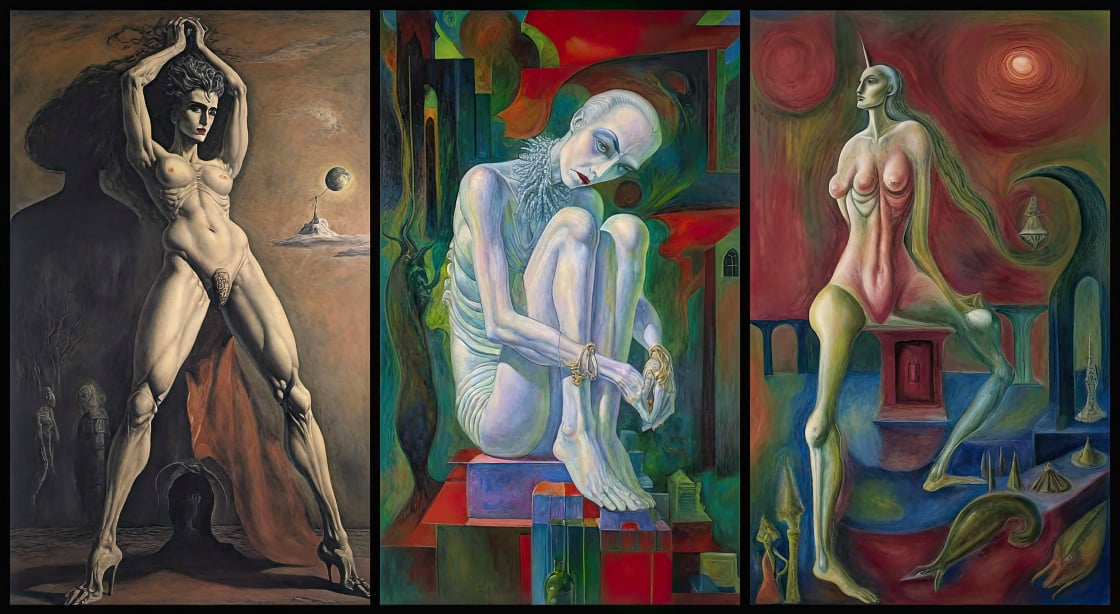
Left panel - "Proud"
Central panel - "Ostracized"
Right panel - "Self-possessed"
"More Than Two" carries deep symbolism, representing not just a declaration of support for the LGBTQ+ community but also for all forms of individuality and diversity, both present and future. Each panel portrays different aspects of this journey, from pride and liberation, through isolation, to achieving inner harmony.
The left panel features a figure whose gender is not immediately clear, embodying a carefully nurtured body and a strong, self-assured gaze that reflects pride—one of the core qualities of this community. The figure exudes confidence, symbolizing a sense of self-empowerment and the freedom to exist beyond societal expectations.
The central panel depicts a transgender individual who is clearly ostracized and rejected, embodying the pain of being condemned and isolated. Their posture conveys introspection, a search for meaning within their own solitude. This panel reflects the reality faced by many, particularly in places where such individuals not only face mockery but are often subjected to violence or persecution.
The right panel shows a being that is physically altered and transhuman, with three breasts, a horn on their head, and a body shaped by transformative surgeries. This figure defies traditional gender categories—neither "He" nor "She," but simply "It." At peace and self-sufficient, this figure represents victory over societal norms and celebrates the uniqueness of the self. Their identity as a unicorn further underscores the triumph of individuality, embracing freedom from the confines of conventional labels.
Left panel - "The Bystanders"
Central panel - "The Fragile New"
Right panel - "The Inquisitors"
"The Trial of Difference" is a natural progression from "More Than Two", which merely acknowledged differences, offered support, and concluded that all should be treated equally. It seeks to comment introspectively on our current era, where the boundaries between people, machines, and identity are increasingly blurred, and society responds with fear, condemnation, and misunderstanding.
As we move toward the age of posthumanism, where many of us will become cyborgs (with Brain-Computer Interfaces, the implantation of new senses, and extremities), and when we might become "IT," the central panel portrays one such being. This figure evokes the transition from human to posthuman existence, representing fragility yet also potential. The "IT" is aware of the impression it leaves on its surroundings, struggling to survive in a world where its existence is revolutionary, fragile, and uncertain.
The left panel depicts figures symbolizing those who harbor a mixture of awe and fear toward the new. These are the traditionalists who view the world as decadent, spiraling toward inevitable destruction. However, these are passive individuals, more concerned with their own lives and not dangerous. Abstract forms in the background suggest upheavals and changes in the external world that they do not comprehend, while their facial expressions carry a mix of bewilderment and helplessness.
The right panel shows the "rational" ones, armed with condemnation and cold hatred, determined to fight against the "disease" at its very inception. These are conspiracy theorists, anti-abortion activists—modern-day inquisitors whose "rationality" is weaponized with prejudice and fanaticism. Their gaze is firmly directed toward the "IT"—the gaze of a judge, a keeper of "order," threatening the destruction of anything they cannot understand.
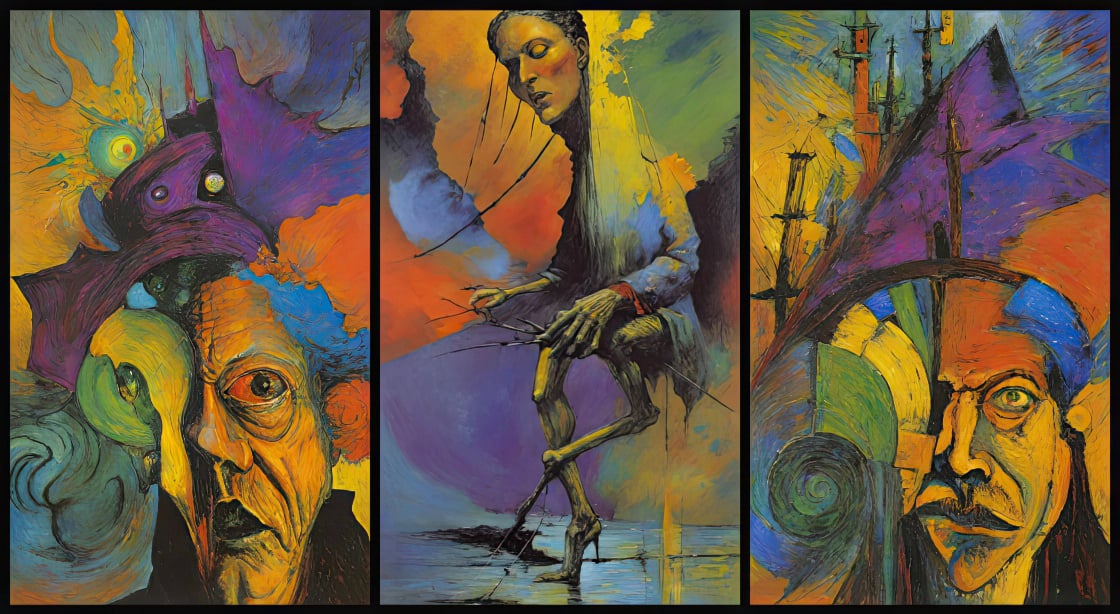
Left panel - "Mocking God"
Central panel - "Samael's Wrath"
Right panel - "Human, All Too Human"
"Identity" delves into one of the most profound and sensitive themes of human existence—the question of identity in the posthuman era. Drawing on philosophical, theological, cultural, and moral dilemmas, this triptych seeks to illuminate, in a surreal and grotesque manner, the conflict between traditional values, the loss of metaphysical belief, and the aspiration for a new, still unclear order.
The left panel portrays a woman symbolizing the ordinary, small person who mocks God, representing the process of the fading of faith.
The central panel features Samael, embodying the wrath of a fallen deity in the face of humanity’s disbelief. His anger is impotent, a shadow of what once was—an echo of divine authority lost to time. This panel reflects the erosion of old beliefs and the realization that the forces that once governed existence can no longer control or punish humanity.
The right panel depicts what remains of humanity. We continue to gaze into the heavens, as our old morality slowly melts away, making room for something new, yet still unknown. Drawing inspiration from Nietzsche’s "Human, All Too Human", the piece raises the question: Are gods and dogmas mere constructs of human fear, or have they always been integral to our consciousness? In the posthuman context, it further asks: How do we redefine human identity and find new purpose in a post-theistic world, when human nature is changing and old values are fading?
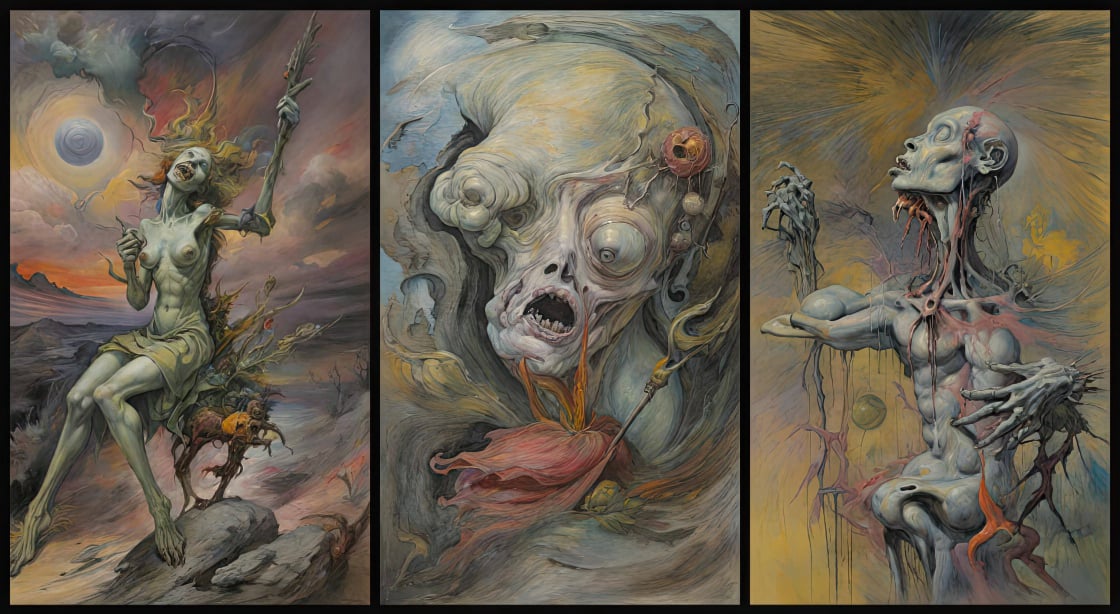
Left panel - "The Android That Loved Me"
Central panel - "Between Freedom and Judgment"
Right panel - "Android's Dream"
"Consciousness" explores one of the most significant questions of the posthuman era—what does it mean to be conscious, and how do we define the boundaries of consciousness and love in an age of technology and androids? The triptych is a deeply narrative exploration, blending existential questions, ethical dilemmas, and emotional conflicts. Through the story of an android in love with a humanoid woman, the work opens a dialogue on love, identity, and acceptance in a future society—reminiscent of the android K in "Blade Runner 2049".
The left panel depicts two women: on the left, the female android, symbolized by her neck, and on the right, her human partner with whom she shares a romantic relationship. The android’s expression is one of concern, aware of the societal judgment surrounding them— a mix of astonishment and condemnation as a defense of traditional values and morals. The humanoid woman, in contrast, is completely immersed in her passionate feelings, blind to the judgment that the android is so acutely aware of.
The central panel represents the humanoid’s internal struggle. She is under societal pressure and begins to question herself. On one side is the sea of freedom, symbolized by the water and distant horizon, while on the other side is societal condemnation, represented by a small human figure at the bottom left of the panel. The humanoid is torn between the two, caught in an unresolved tension, with no clear resolution in sight as the pressure mounts.
The right panel portrays the android's dream, where she makes love to the humanoid. A third woman, symbolizing society’s view, rests her hand on the android’s shoulder in a gesture of understanding and support. In the dream, the android is no longer an android—her neck now suggests she has transformed into a woman. The dream seems to ask the question: "Why do you judge us? I am part of you! I have consciousness, I feel love, joy, and pain just like you!"
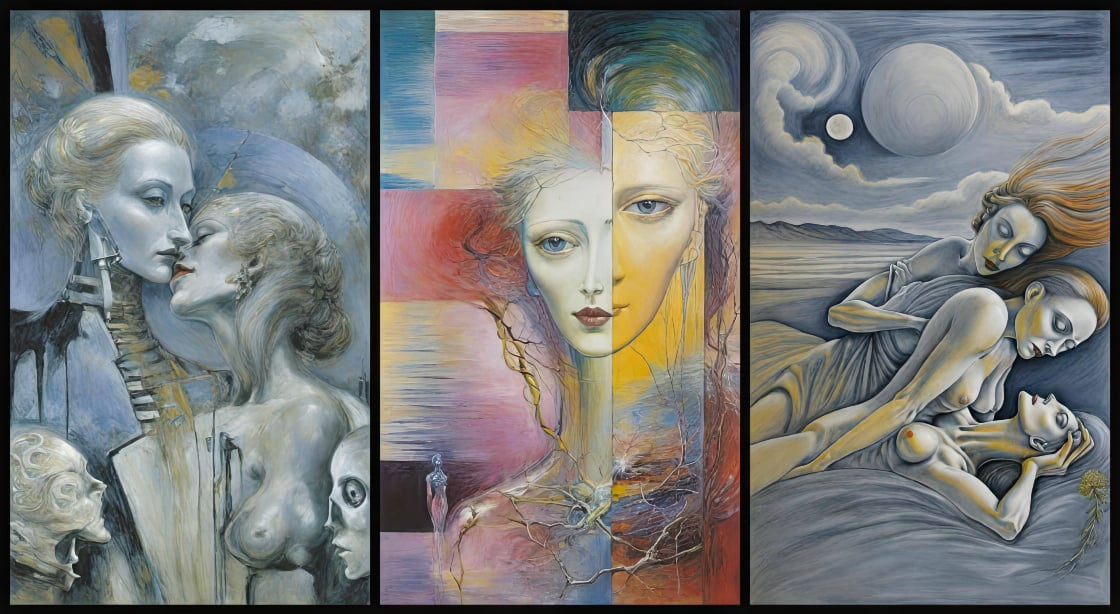
Left panel - "Age of Strength"
Central panel - "Age of Innocence"
Right panel - "Only Anxiety is Eternal"
"Transience" attempts to illustrate the fleeting nature of life through three key phases—youth, maturity, and old age—with a strong transhumanist component. The narrative unfolds not only linearly but also in layers, addressing themes of identity, self-perception, and our relationship to the world in each phase.
The central panel portrays a young woman, a virgin immersed in her dreamlike world, symbolized by her surreal, flowing hair. This representation captures the innocence and boundless possibilities of youth, where the world is still a canvas of potential.
The left panel shows the woman transformed into a fully realized adult and mother. She is aware of her beauty, strength, and fulfillment. The home around her symbolizes safety and permanence, while she calmly observes the people who have entered her life, a sense of peace and acceptance emanating from her as she reflects on her journey.
The right panel depicts an elderly woman, but through a posthuman-transhuman lens. Thanks to advanced technology, she has been rejuvenated and cybernetically enhanced, retaining her beauty, though anxiety about an uncertain future is evident on her face. The presence of mechanical beings in the panel speaks to the transhuman interventions she has undergone in her quest for immortality.
How long will this state endure? Will she remain eternally desirable and beautiful? Does transhumanism truly solve the issue of transience, when emotional questions and anxieties persist?
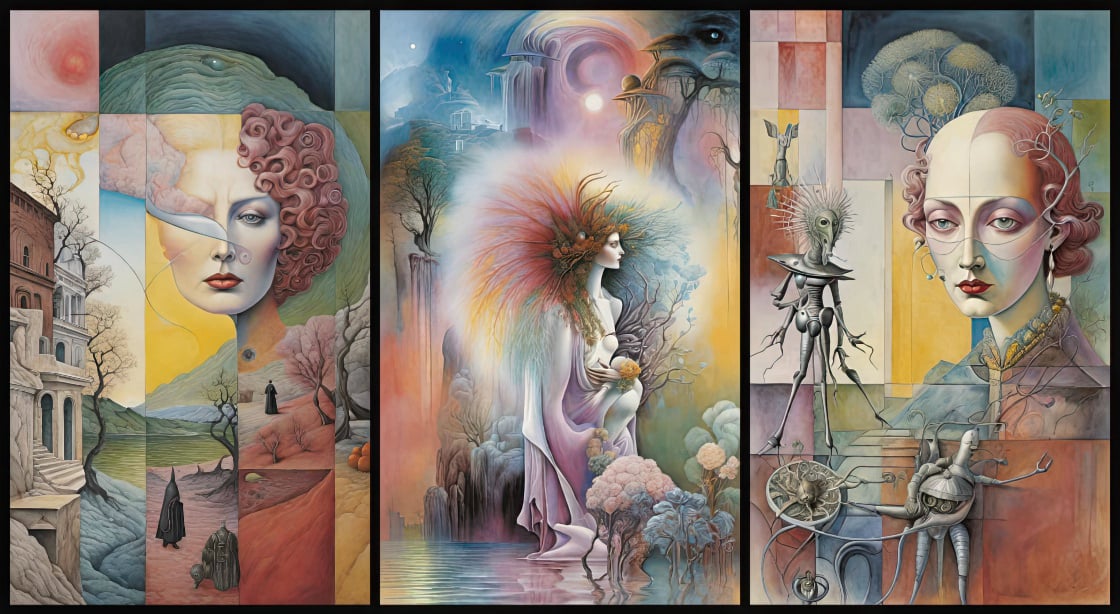
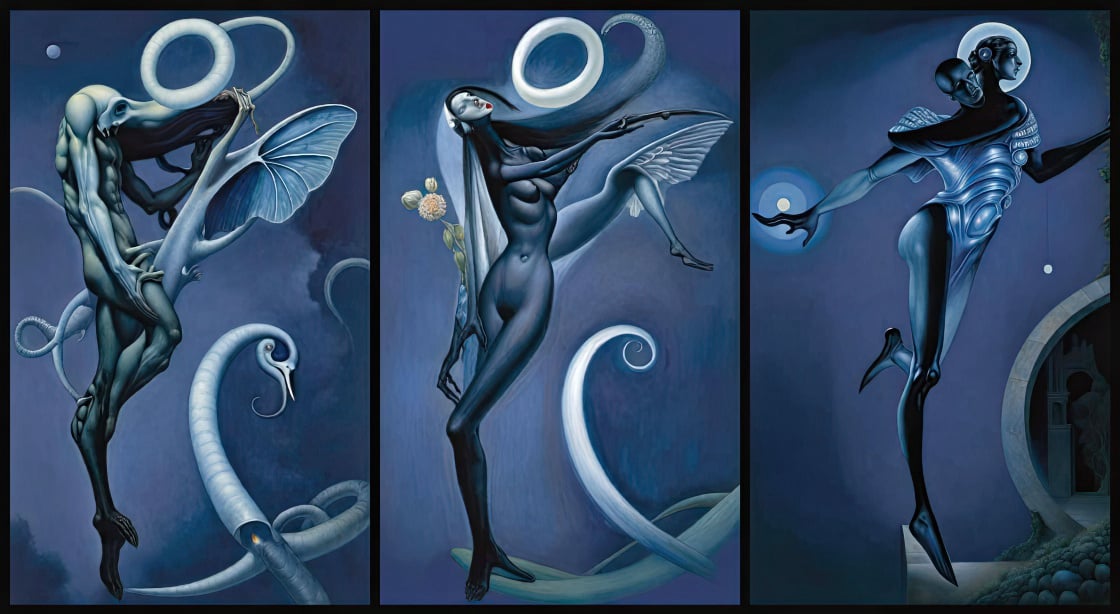
Left panel - "Primordial Harmony"
Central panel - "Ascension of Arrogance"
Right panel - "Echoes in the Void"
"Legacy" offers a deep reflection on humanity's inheritance and its journey from harmony to destruction, portrayed through three phases of human development: innocence, arrogance, and isolation.
The left panel symbolizes an era of innocence, from early humans to about 200 years ago. The human figure is intertwined with plants, its head bowed, symbolizing a connection with nature and the earth. Below it is an imagined creature, resembling a swan, emphasizing the pure, untainted unity with the natural world.
The central panel depicts a figure brimming with self-importance, eyes fixed on the halo it strives to grasp. A human leg emerges from the wings of a vanishing bird, while the swan transforms into an undefined spherical form. This suggests humanity's ambition and arrogance, attempting to reach divinity while severing its connection to nature.
The right panel represents the culmination of this drama, where the sphere has become a concrete structure, surrounded by stones. In the background, two solitary celestial bodies shine, while the bodies of a man and woman merge, crowned with a halo. They ascend in divine isolation, but at what cost? The figure is both human and transcendent, yet utterly alone.
What legacy do we leave for future generations? Can humanity return to a state of "Primordial Harmony", or are we doomed to repeat the mistakes of the past? The question of legacy is not just about what we leave behind, but how we preserve it for future generations. Can we secure a future of harmony, or is our fate sealed in the echoes of our own actions?

AI Website Maker