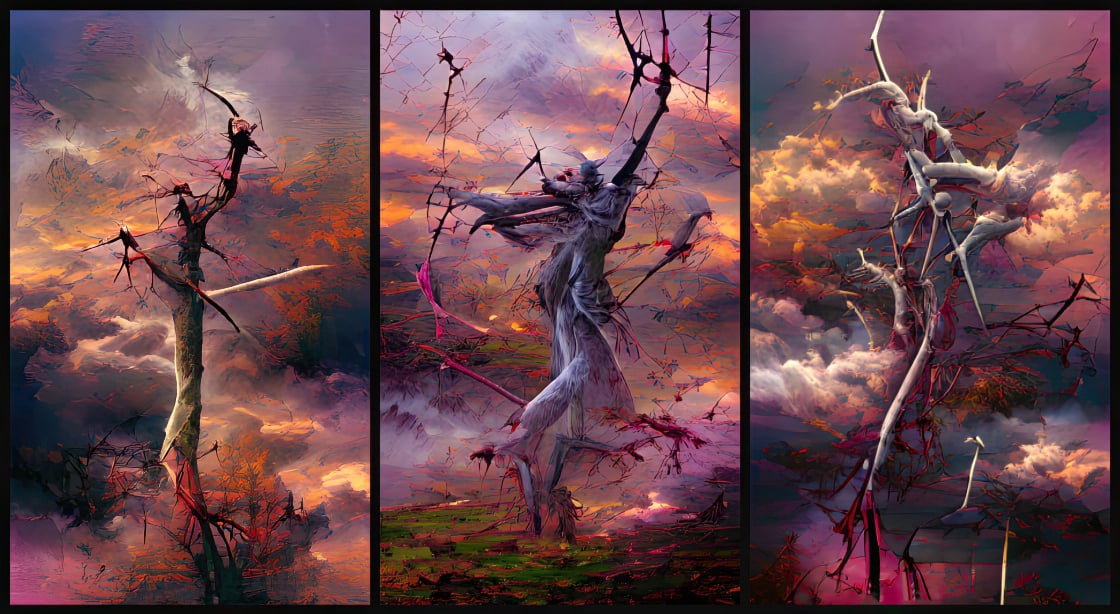
This is a cycle of works that explores the most hidden human secrets. It is an attempt to discover our position in the world, our aspirations and ambitions, but also our highest mountains and deepest swamps. A mixture of struggle, joy and pain, accompanied by existential fear of an uncertain future.
Left panel - "Giordano Bruno"
Central panel - "Insane Tyrant"
Right panel - "Creative Torment "
The triptych "Dead Branches ..." is a complex emotional story that explores human nature, as well as our position in the world, building the narrative on the emphasized contrast between the pursuit of knowledge, destructive power and creative suffering.
The left panel shows a figure stretching towards the sky, reminding us of the philosopher and scientist Giordano Bruno, who was burned for his heretical views, consciously sacrificing himself in the fight for the victory of knowledge, truth and scientific enlightenment.
"Insane Tyrant" with its grotesque forms and figure that dominates the dramatic environment, tries to explore the themes of destructive power, showing the madness and violence of absolute power as the darkest feature of human nature.
Finally, "Creative Torment" depicts a figure made of intertwined branches that appears to be in agony, symbolizing artists and creators who often go through dramatic personal struggles in order to create something meaningful and unique.
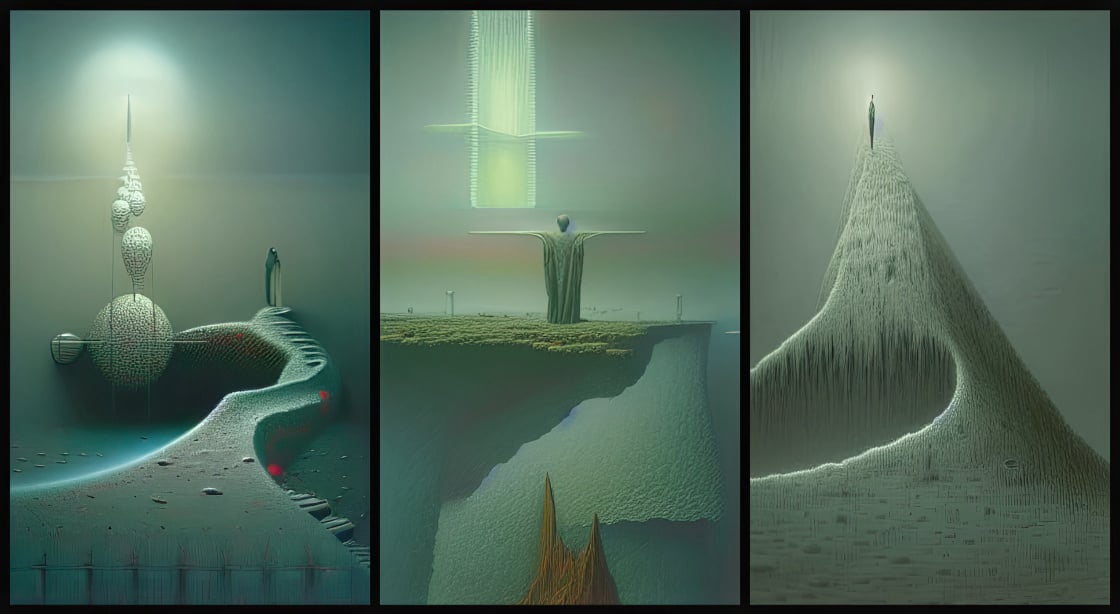
Left panel - "The Road Less Traveled"
Central panel - "Singularity"
Right panel - "And What Now?"
Inspired by Alphonse de Lamartine’s words: "Limited in his nature, infinite in his desires, man is a fallen god who remembers the heavens", this triptych explores the contrast between human limitation and infinite desires. It depicts the journey of a man through the choices he makes, the pursuit of singularity, and ultimately, the confrontation with the question: "What now?". The work reflects on human nature, ambition, and the consequences of achieved goals.
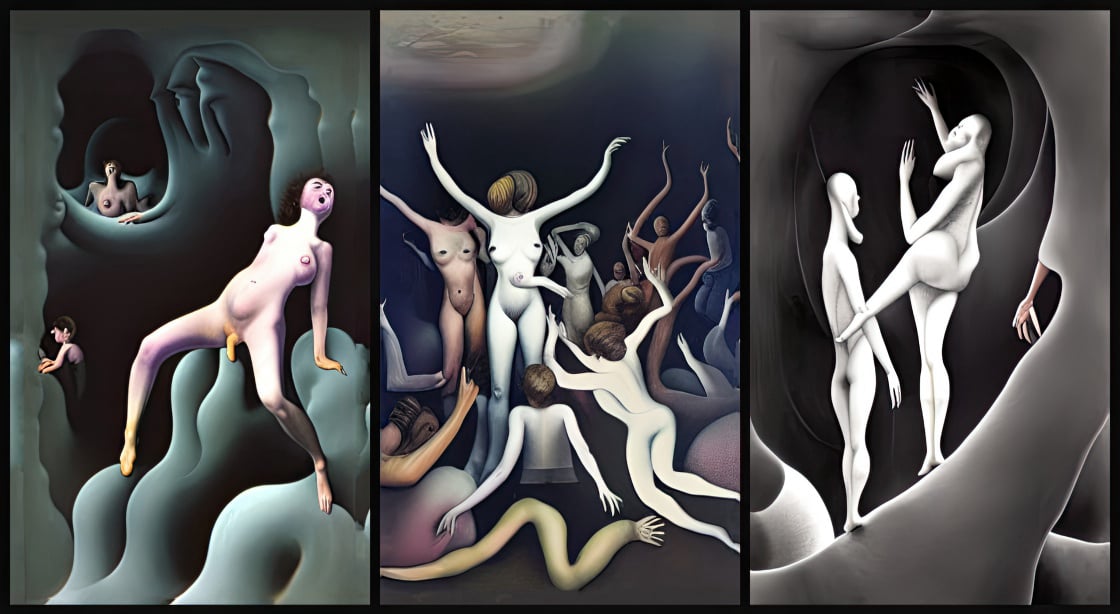
“The Hanged’s Rebellion” through three panels shows the development of the rebellion against social injustices, social conformity and passivity of the individual.
The left panel represents the beginning of the Hanged Man’s Rebellion, where each character fights against the invisible shackles that hold them. Their collective suffering and body expressions reflect a deep sense of despair.
The middle panel illuminates the moment when everyone decided to “pretend to be blind”. The screaming figure is a lone rebel who loudly expresses his pain and represents someone who has dared to say what others cannot.
The right panel shows the crowd’s reaction and indifference to the riot. While some try to connect and support the rebellion, others remain isolated and neutral. “Just one stray cry could be heard” portrays the lone voice of truth amidst collective silence and indifference. Human figures are exposed in their hypocrisy and selfishness, which represents a merciless critique of the very foundations of human nature and, through emphasizing the sense of urgency and inevitability of change if we want to survive as a society.
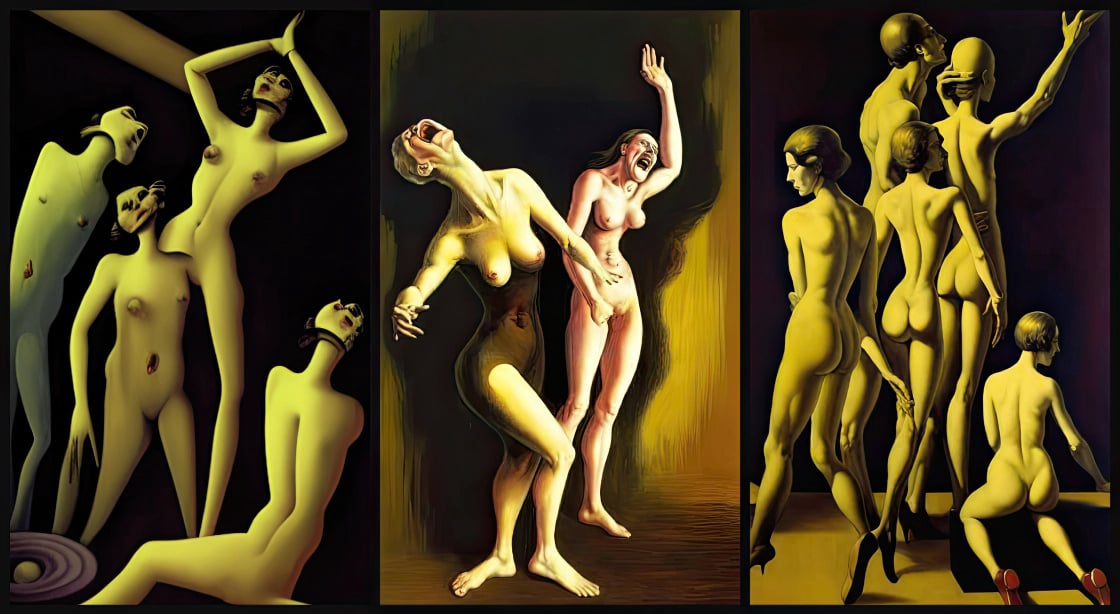
Left panel - "Solitary Pleasures"
Central panel - "Collective Eros"
Right panel - "Intimate Bonds"
"Erotic Feast" is a provocative work that uses erotic scenes as symbolism to explore the deepest and most complex aspects of human sexuality. At the same time, it is an attempt to evoke strong emotions in the viewer, through the depiction of introspective loneliness, to euphoric union and intimate closeness between two. Each panel conveys a different aspect of human intimacy, making the triptych layered and rich in meaning.
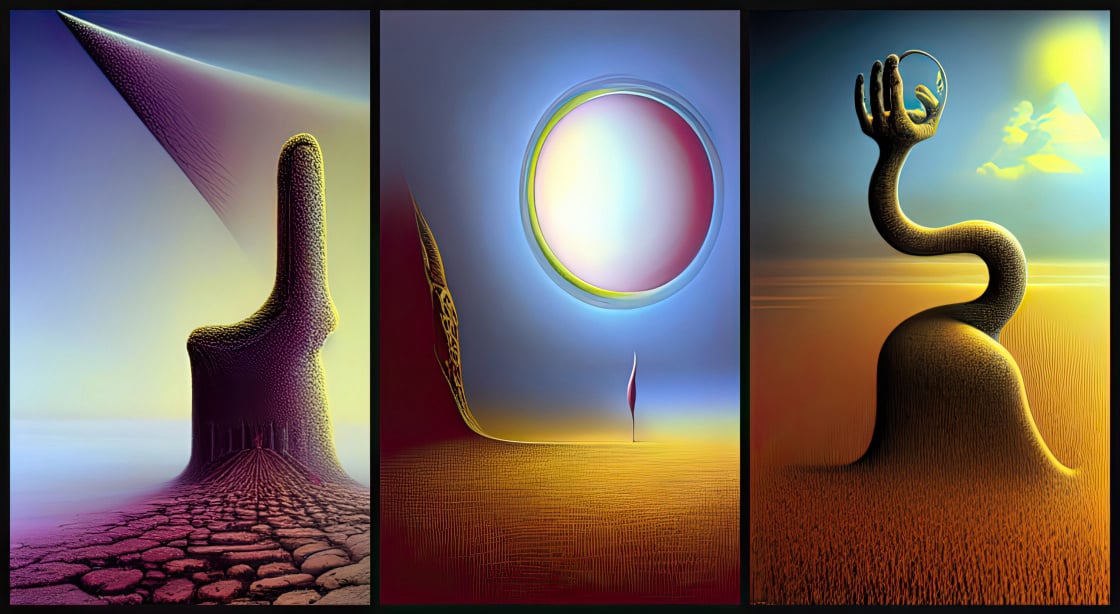
Left panel - "Great Acceleration"
Central panel - "Aware But Indifferent"
Right panel - "And Who Survived?"
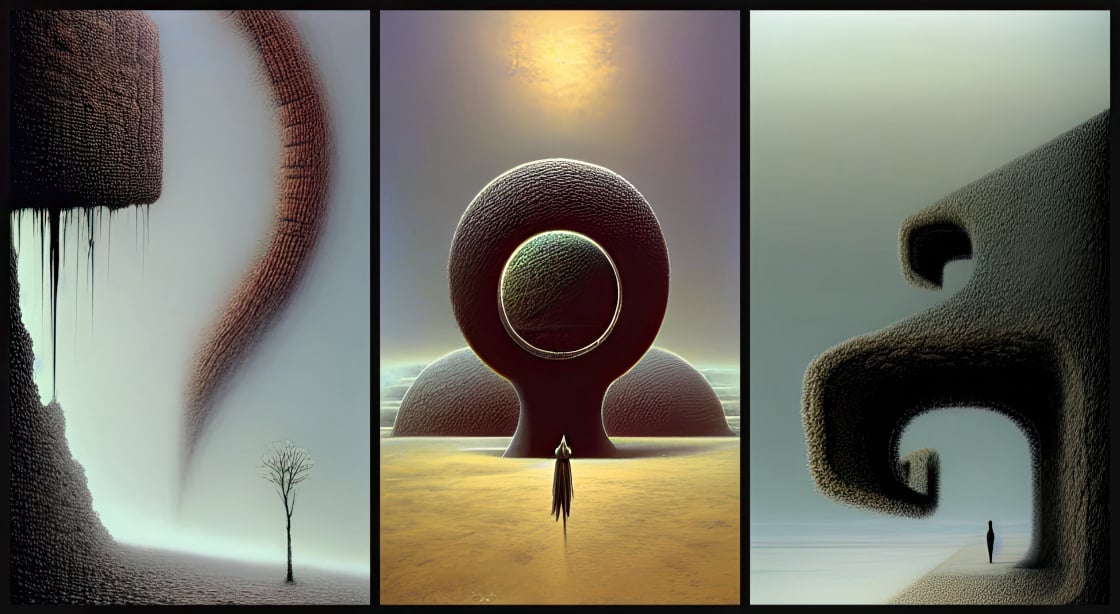
The inspiration for this work is the 21st century, the century of knowledge and great scientific breakthroughs (left panel), but also a hint of self-destruction (central panel), through the danger of global warming and environmental pollution. Finally, there is the right panel, which depicts a lone snake-like creature emerging from the ground in a desolate landscape, illuminated by a morbid glow from the sun.
Each panel has its own unique character, but they share an abstract aesthetic and a minimalist composition, which serves to expose as explicitly as possible human activity, which represents an ever-increasing danger to the planet.
The key element of the triptych is the use of light, which tries to connect all the elements into one whole, creating a mystical sense of impending doom.
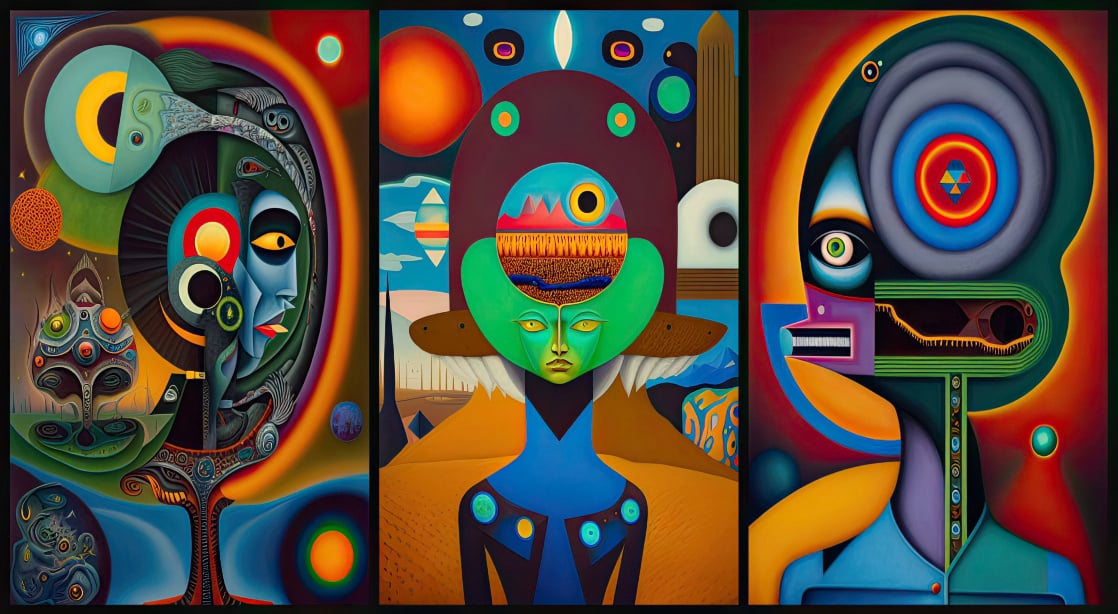
Left panel - "Salieri Syndrome"
Central panel - "A Sorrow's Child"
Right panel - "Blissful Ignorance"
John Adams once said: "Genius is sorrow's child", let's just remember the fate of Tesla, Mozart, Van Gogh, Spinoza and many other outstanding creators who died in extreme poverty and loneliness. This triptych is an attempt to address the subject of envy, as one of the most negative human traits, through the fate of geniuses.
The "Salieri Syndrome" panel depicts a person who is full of envy, and that evil, Salieriian envy. He is also a creator, but a creator who is aware that he has no "height". He knows he will never become Mozart. His personality is complex, and his thoughts are complex and dark and full of an inner struggle that tears him apart.
On the other hand, "Blissful Ignorance" depicts the simple-minded envy of a small man. He is amazed because he does not understand. His envy is not accompanied by hatred, he only rejects what he cannot understand. His head is big but empty. The most complex organs in his organism are the organs for processing food. The spirit of mediocrity as the measure of all things is prevalent, and when a foreign body of art and lofty thought appears, he unfailingly rejects it. In short: a good-natured philistine.
The central panel shows the sublimity and focus of the genius creator. He is aware that he is a man with a mission, and therefore isolated in his world, indifferent to his surroundings and determined to fulfill his lofty goals.
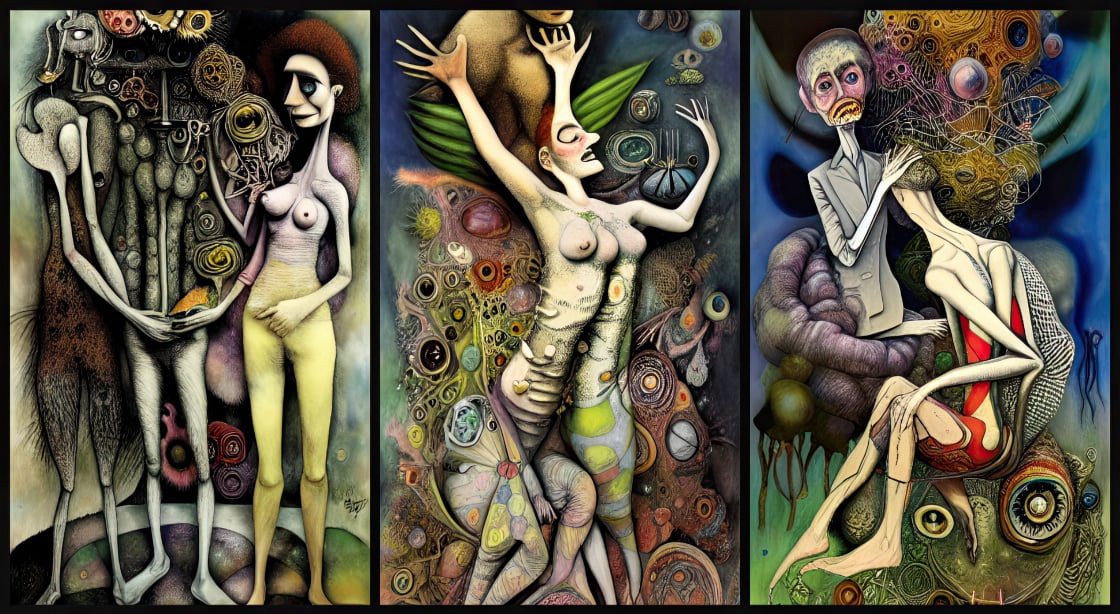
Left panel - "Coming to the Party"
Central panel - "Ecstatic Dance"
Right panel - "Words of Comfort"
This triptych offers an allegorical portrayal of our lives, with roles we play until the very end. The work explores the theatricality of existence, from our entrance onto the stage of life, through the ecstatic dance of daily events, to the words of comfort we receive at the conclusion. The triptych invites reflection on transience, fate, and finality.
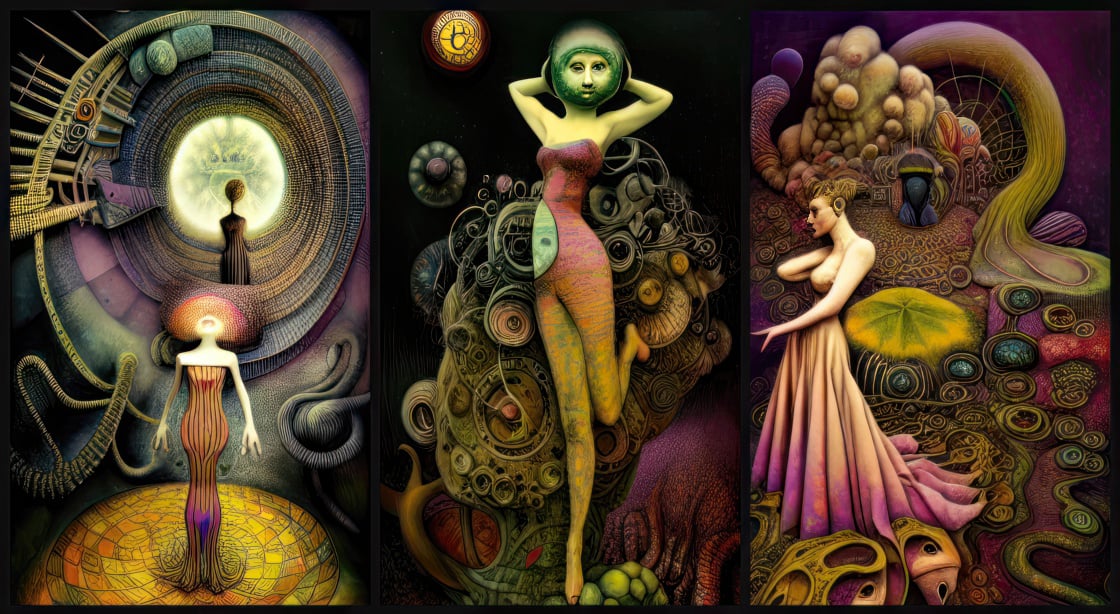
Left panel - "Gateway to Enlightenment"
Central panel - "Under the Stage Lights"
Right panel - "Enigmatic Ordinariness"
The title of the work "Each in His Own World" reflects the individual journeys of each depicted figure within their worlds of consciousness. Some of us are travelers into the unknown, gifted with the ability to conquer the most inaccessible regions of knowledge, art and creativity of all kinds. Some are selfish glory-loving entertainers and politicians unable to live beyond the light of the stage. Finally, there is the enigmatic ordinariness of little people who have chosen to be observers rather than participants on life's stage. And that's our world, and that's who we are.
The work “Once he will be touched…” explores the themes of fate, introspection, isolation and transcending towards unconquerable peaks of thought through the accompanying haiku verses. A lone figure interacting with an overpowering destiny and divine forces, represents the journey of the “chosen one” through uncertainty, solitude and challenges to reach a higher meaning or enlightenment. This triptych tries to create a artwork that invites the viewer to contemplate and think about his own life path, as well as the challenges and obstacles that accompany him on that path.

Drag and Drop Website Builder