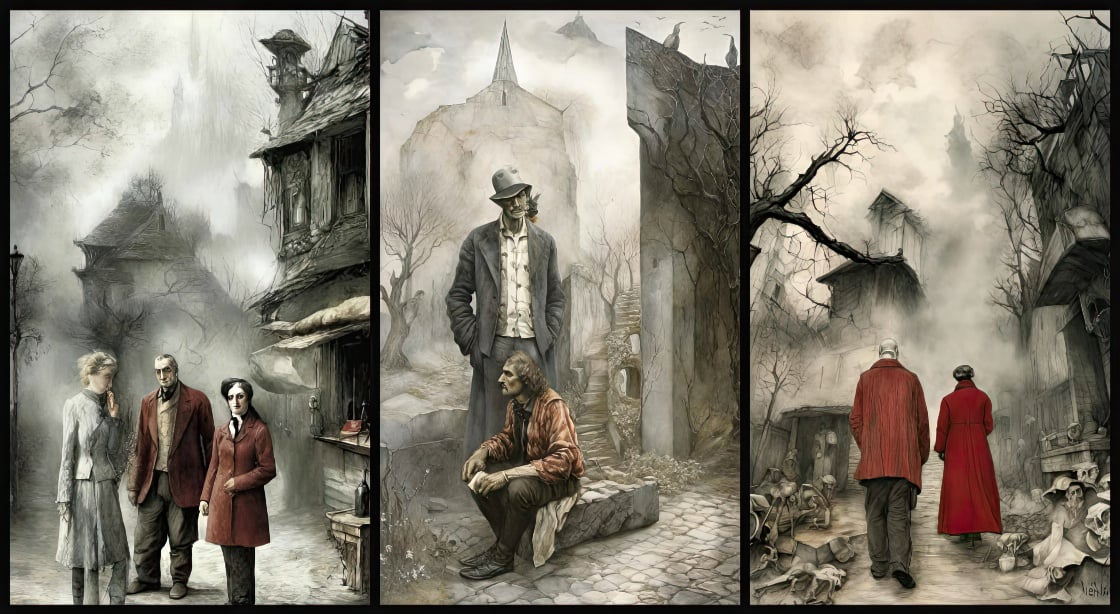
As is known, Sargasso Sea is the only one in the world that has no land border. And like the Sargasso Sea, which is forever in search of its non-existent shores, so modern humanity floats and unsuccessfully searches for certainties to which it tries to cling.
Left panel - "Standing Still"
Central panel - "Waiting in Ruins"
Right panel - "Into the Fog"
The Forgotten Ones" is a triptych that explores themes of isolation, stagnation, and the ambiguous nature of movement within a decaying living environment. The work presents a sequence of scenes that depict human figures caught between stillness and departure, set against a backdrop of desolation and ruin.
The left panel, "Standing Still", portrays several isolated figures scattered across a barren, crumbling landscape. Their static positions and distant gazes suggest a deep sense of disconnection, both from their surroundings and from each other. The subdued palette of gray and brown tones enhances the impression of lifelessness and suspended time, emphasizing a state of collective inertia.
The central panel, "Waiting in Ruins", depicts two figures—one seated and one standing—situated within the remains of a dilapidated structure. Their presence references existential themes of waiting and uncertainty. The ruined architecture and sparse setting highlight an atmosphere of abandonment and a persistent sense of unresolved expectation, where waiting becomes an integral part of existence.
The right panel, "Into the Fog", introduces two figures dressed in red coats, shown in the act of leaving the devastated scene. As they move into a dense and undefined mist, their departure suggests a transition or an attempt to escape. The vivid red stands out against the muted background, creating a subtle indication of movement and potential change, though the destination remains hidden and uncertain.
The triptych, through its three distinct yet connected scenes, investigates the tension between passivity and action, the weight of solitude, and the human inclination toward seeking resolution—even when the path forward is obscured.
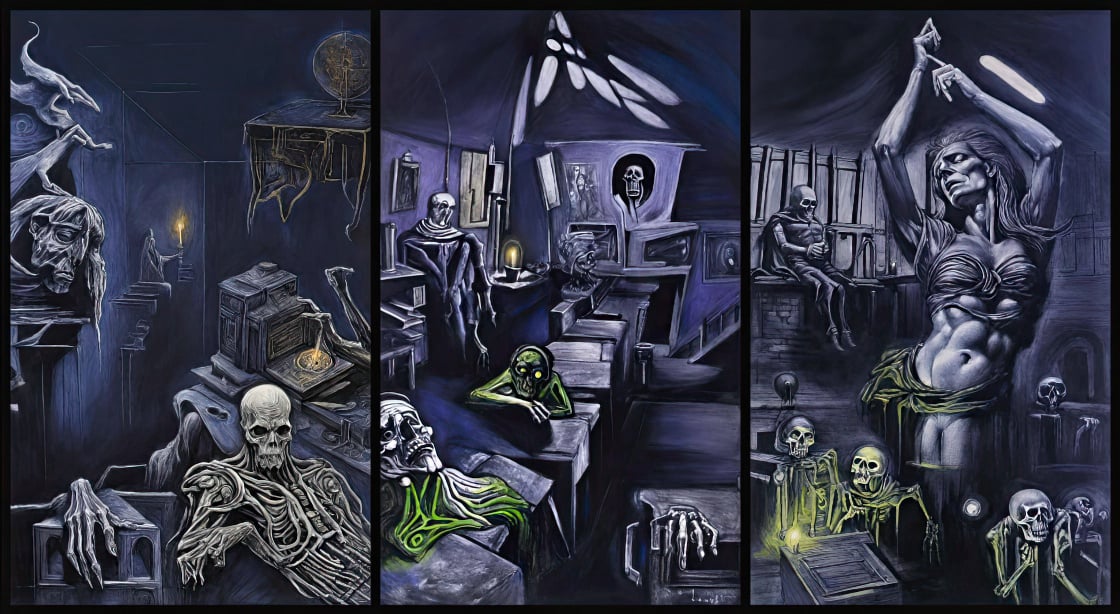
Left panel - "The Jukebox Ritual"
Central panel - "Gathering of Shadows"
Right panel - "Despair in Motion"
Life on Hold Cafe" presents a visual exploration of emotional stagnation and existential weariness, set within the familiar yet unsettling environment of a bar that serves as a metaphorical waiting room for lost souls. The triptych examines routine, isolation, and fleeting moments of expression within a space suspended between past and present.
The left panel, "The Jukebox Ritual", depicts a skeletal figure in the act of selecting a song on a jukebox, pressing the familiar A4 button. This recurring action evokes a sense of nostalgic repetition, as the character returns night after night to relive a memory or escape the present. The dim lighting and muted colors reinforce the monotony of the scene, suggesting a life caught in a loop of unresolved longing.
The central panel, "Gathering of Shadows", shifts the focus to the larger interior of the bar, where multiple skeletal patrons are seated, each absorbed in their own silent reveries. The figures, blurred and indistinct, appear more as shadows than solid forms, evoking a sense of lifelessness and detachment. The subdued palette and the sparse, cold atmosphere emphasize the bar as a place of quiet resignation, where individuals linger without clear purpose or connection.
The right panel, "Despair in Motion", introduces a solitary female figure, distinct from the others, captured mid-dance. Her movement contrasts with the static presence of the other patrons, offering a brief moment of expression and vitality within the otherwise inert space. Her dance, both graceful and somber, appears to be a personal act of release, symbolizing the human desire to find meaning or catharsis, even in the bleakest circumstances.
Together, the panels of "Life on Hold Cafe" portray a world of emotional suspension, where characters navigate the liminal space between memory, habit, and the elusive possibility of renewal.
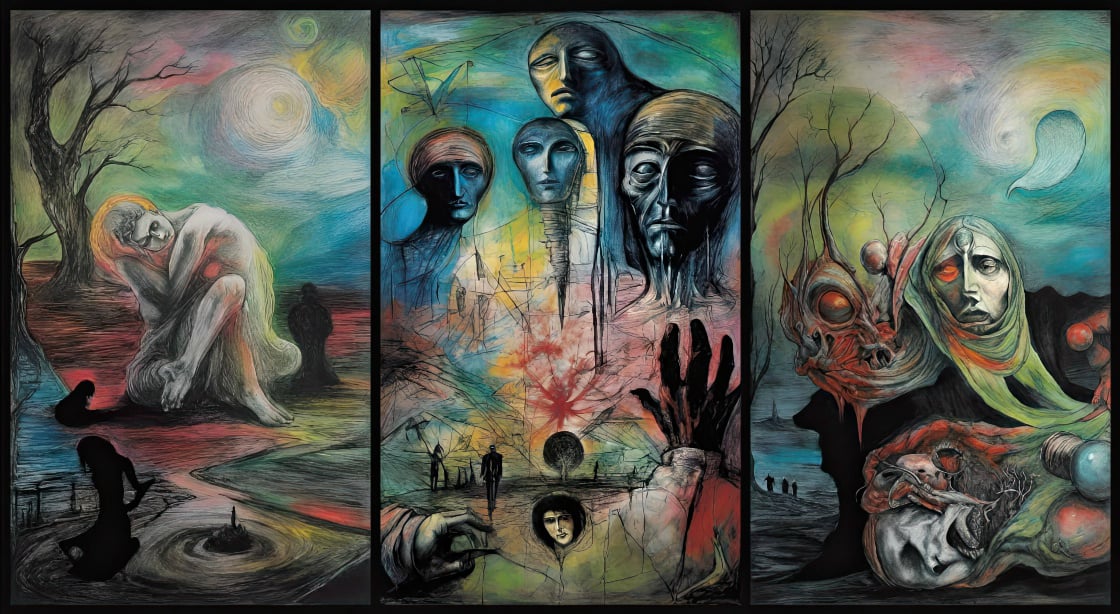
Left panel - "Solitude’s Grip"
Central panel - "The Burden of Society"
Right panel - "Embrace of Fate"
"The Weight of Existence" examines the human journey through solitude, collective experience, and the acceptance of inevitable fate. The triptych presents a layered narrative that moves from introspection to societal entanglement and, finally, to a confrontation with destiny.
The left panel, "Solitude’s Grip", features a solitary figure bent forward in a posture of introspection, surrounded by a barren, darkened landscape. The setting emphasizes the pervasive nature of solitude—an ever-present condition that accompanies every individual from the beginning to the end of life. The sparse composition and muted tones highlight a quiet yet inescapable sense of isolation.
The central panel, "The Burden of Society", expands the narrative to include multiple figures, engaged in a tense, almost ritualistic arrangement. Abstract elements and distorted forms weave through the composition, reflecting the complex interplay between personal identity and collective existence. A looming, indistinct hand in the foreground introduces the notion of fate or unseen forces, underscoring the limited control individuals hold over their own paths.
The right panel, "Embrace of Fate", brings the journey to its conclusion. Grotesque, distorted figures appear enveloped in shadow and murk, symbolizing the acceptance—or resignation—to the immutable nature of destiny. The dark palette and blurred forms convey a mood of finality, as the characters seem to dissolve into the inevitable end.
Through these three interconnected scenes, "The Weight of Existence" explores the tension between autonomy and inevitability, tracing the arc of human life from inner solitude through societal entanglement to the ultimate submission to fate.
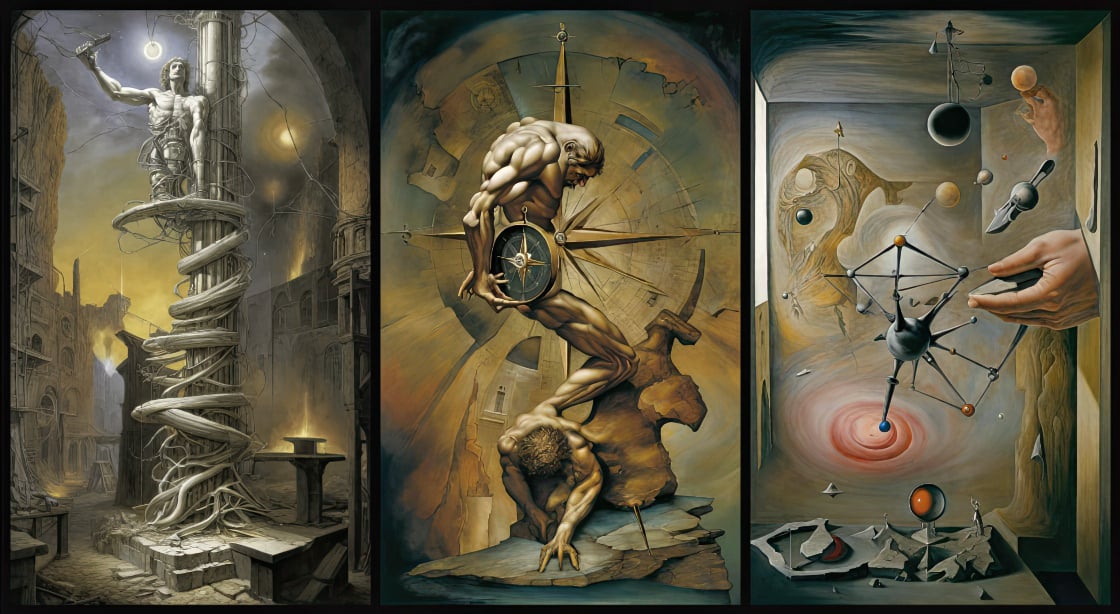
Left panel - "The Crumbling Pillar"
Central panel - "The Broken Compass"
Right panel - "The Floating Echoes"
"Illusions of Certainty" explores the fragile nature of human beliefs and the shifting foundations upon which individuals seek to build understanding and stability. The triptych presents a visual narrative that moves from collapse to disorientation and, finally, to a dissolution into abstraction.
The left panel, "The Crumbling Pillar", depicts a monumental column in the process of disintegration. Once a symbol of strength and permanence, the pillar now fractures and crumbles, illustrating the instability of systems and truths that were once perceived as unshakable. The subdued tones and stark composition reinforce the sense of decay and erosion.
The central panel, "The Broken Compass", introduces a symbolic navigation device, fractured and dysfunctional, lying amidst an ambiguous landscape. Figures in the scene appear directionless, evoking feelings of confusion and loss of orientation. The muted palette, combined with scattered, indistinct landmarks, suggests a world where familiar signposts have lost their meaning.
The right panel, "The Floating Echoes", drifts into abstraction, presenting fragmented shapes and ethereal forms suspended in a featureless space. These elements seem to hover without anchor, representing the lingering remnants of ideas and convictions that no longer hold coherence. The light, airy tones contrast with the denser imagery of the other panels, emphasizing a sense of dissipation and unresolved aftermath.
Together, the panels of "Illusions of Certainty" investigate the tension between the human need for stability and the ever-present reality of change, questioning the permanence of knowledge, direction, and belief.
Left panel - "Life Stripped Bare"
Central panel - "The Living's Envy of the Dead"
Right panel - "Come to Your Senses!"
The triptych "The Human Swamp" is an attempt to create an allegorical study of human dehumanization, moral collapse and existential despair and decay, relying on brutal symbolism and raw emotions, as the main determinants of the modern age, regardless of the unreal technological development of all segments of society.
The left panel shows a chaotic crowd of deformed human figures, intertwined in convulsive movements. The name "Life Stripped Bare" alludes to the concept of human life reduced to biological existence, deprived of dignity, freedom and meaning. After the failed planetary globalization, the world has been reduced to mass dehumanization and a convulsive struggle for survival in which only one rule applies - all against all!
The central panel is the most dynamic, depicting scenes of mass agony in an underground, dystopian space. Human figures are piled up, many already dead, while the survivors try to escape or surrender in despair to their fate. Light comes from a tunnel in the background, suggesting a potential exit, but it is far and out of reach. The title "The Living's Envy of the Dead" evokes a deep existential despair – the moment when the dead are favored over the living, and survival loses all meaning except as mere duration.
After a progression from chaos (left panel), through complete despair (center panel), the right panel raises hope for human awareness and redemption, although it is neither entirely clear nor guaranteed. Title "Come to Your Senses!" it indicates a call for mutual understanding, suggesting the last chance for change and getting out of the existential quagmire. Intertwining with nature suggests the choice of a posthumanist path through a return to the primordial and an escape from civilizational decadence.
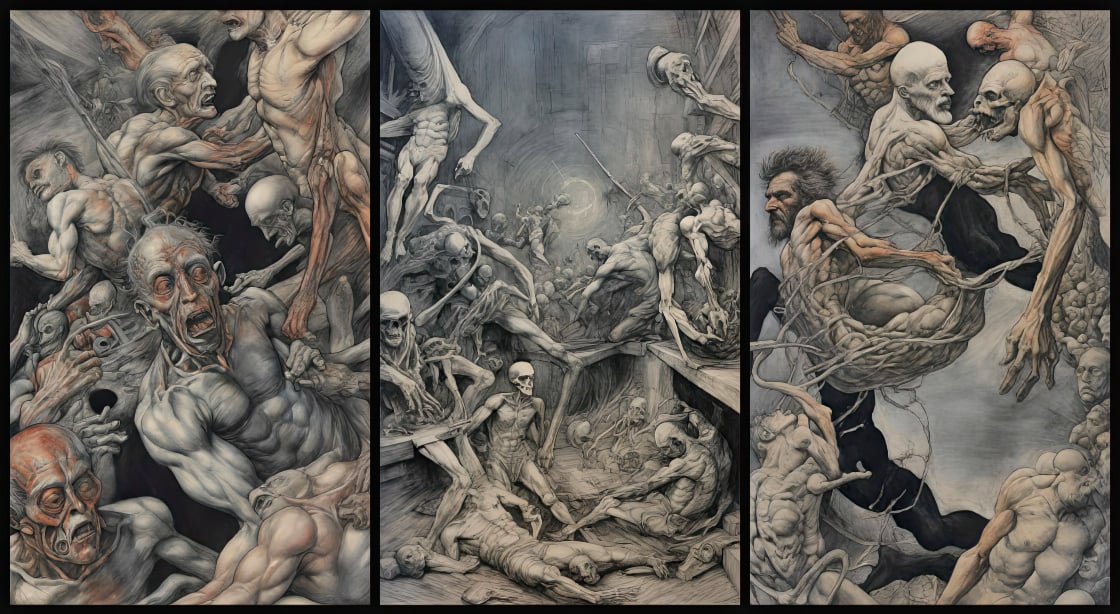
Left panel - "Tradition and Deception"
Central panel - "Rapture"
Right panel - "Mask and Secret Life"
"Intimacy Unleashed" explores the layered and often contradictory dimensions of modern intimacy. The triptych presents a nonlinear journey through social expectation, personal liberation, and hidden identity.
The left panel, “Tradition and Deception,” portrays a tense standoff among three figures arranged in a love triangle. While the composition hints at order and structure—evoking familial or cultural frameworks—subtle expressions and positioning suggest betrayal, denial, and emotional separation beneath the surface.
The central panel, “Rapture,” immerses the viewer in a scene of sensual release. Three intertwined female figures dissolve into a moment of ecstatic abandon, where desire becomes its own truth. Warm tones and fluid movement emphasize intimacy decoupled from social constraints or identity labels.
The right panel, “Mask and Secret Life,” turns to a solitary man navigating a dual existence. Outwardly committed to a heteronormative life, he remains emotionally entangled in a hidden same-sex relationship. The composition, marked by shadows and partially obscured forms, reflects internal conflict, secrecy, and the psychological toll of division.
Together, the panels suggest that intimacy today is not a fixed truth but a shifting constellation of choices, fears, and fleeting clarity. "Intimacy Unleashed" rejects moral judgments, inviting the viewer instead to witness the contradictions of closeness in a world where identity and desire rarely align in straight lines.
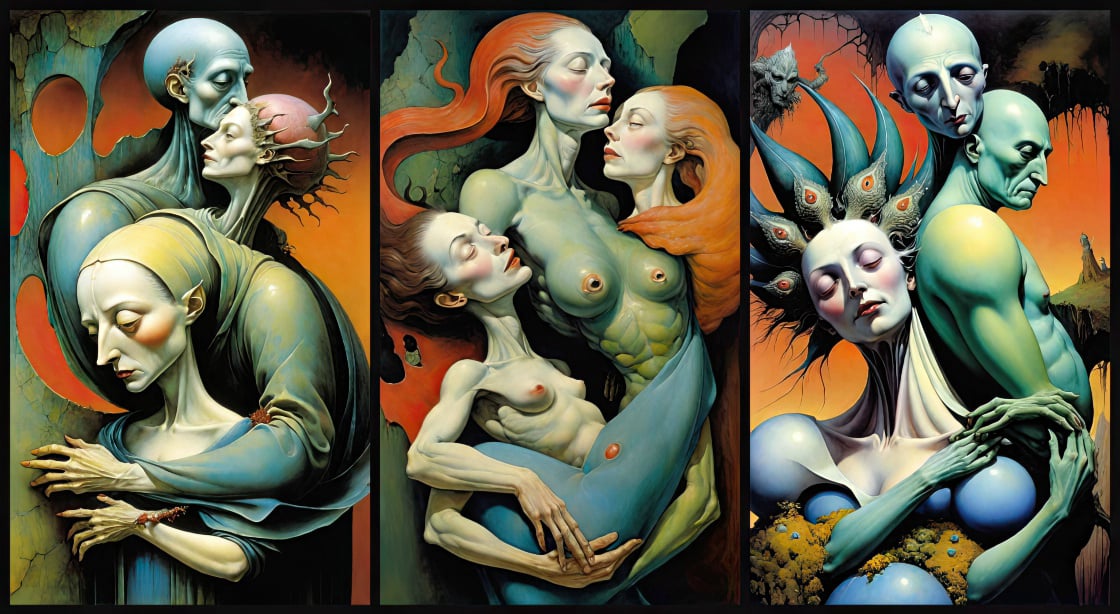
Left panel - "Fate"
Central panel - "Chasing"
Right panel - "Resignation"
This triptych offers a stark meditation on the arc of human existence—mortality, desire, and surrender. Each panel stands as a moment in an inner, existential cycle: we are born into Fate, strive endlessly in Chasing, and ultimately arrive at Resignation—not with peace, but with the quiet weight of inevitability.
In "Fate", a twisted figure clings to a barren limb under a chaotic sky, confronting the unchangeable truth of death.
In "Chasing", a lone figure gazes toward unreachable light, surrounded by vibrant, shifting nature—symbolizing yearning and the mirage of fulfillment.
In "Resignation", two figures embrace under a fractured cosmos, not in comfort, but in shared vulnerability—a final gesture of fragile togetherness in the face of the unknown.
"Three Final Words" is a visual elegy—emotional, philosophical, and deeply human. It does not offer resolution, only reflection.
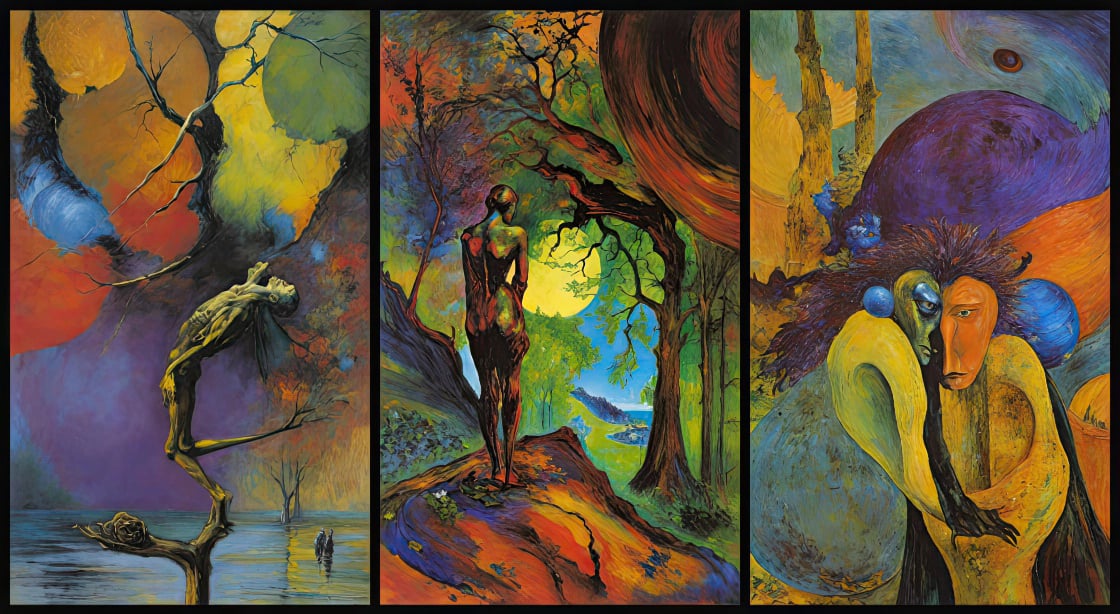
"Flame forgets to burn,
we watch and call it habit—
death rehearses us."
"A Matter of Habit" is a triptych that reflects on the slow internalization of death as a quiet certainty—no longer an abrupt event, but a presence rehearsed through age, memory, and observation. The work moves beyond dramatization, offering instead a meditative tableau on the emotional architecture of mortality.
At the center lies a deathbed scene: a figure suspended in the final moments of life, surrounded by loved ones whose expressions speak not of panic, but of silent expectation. Their gathered presence suggests not despair, but familiarity—the practiced acceptance of an inevitable conclusion.
Flanking this moment are two introspective portraits: aging individuals, one male, one female, each observing the central scene with solemn recognition. Their eyes do not merely witness death—they acknowledge it. Their bodies bear the visual weight of time; their faces reflect inner landscapes shaped by years of quiet reckoning. Through anatomical openness and layered symbolism, they embody the psychological strain of approaching finality.
Rendered in muted tones of gray, ochre, and bone-white, the triptych try to replace pathos with lucidity. It is not death that terrifies—but its gradual normalization, the way it settles into our routines, unannounced but always present. The title, A Matter of Habit, underscores this process: death is not sudden—it is learned, lived with, and eventually welcomed as part of the familiar.
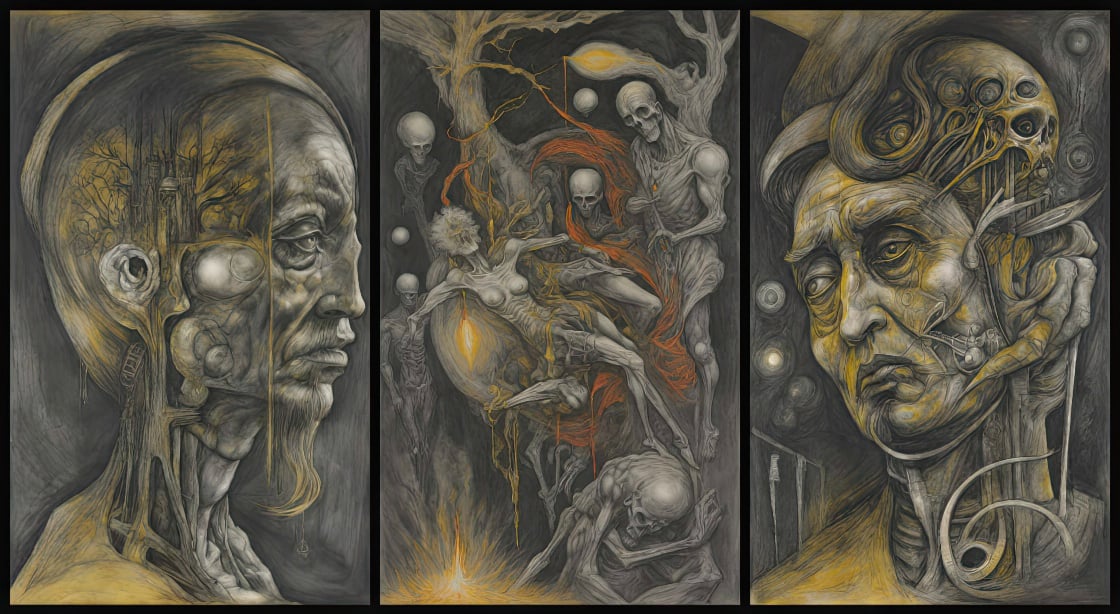
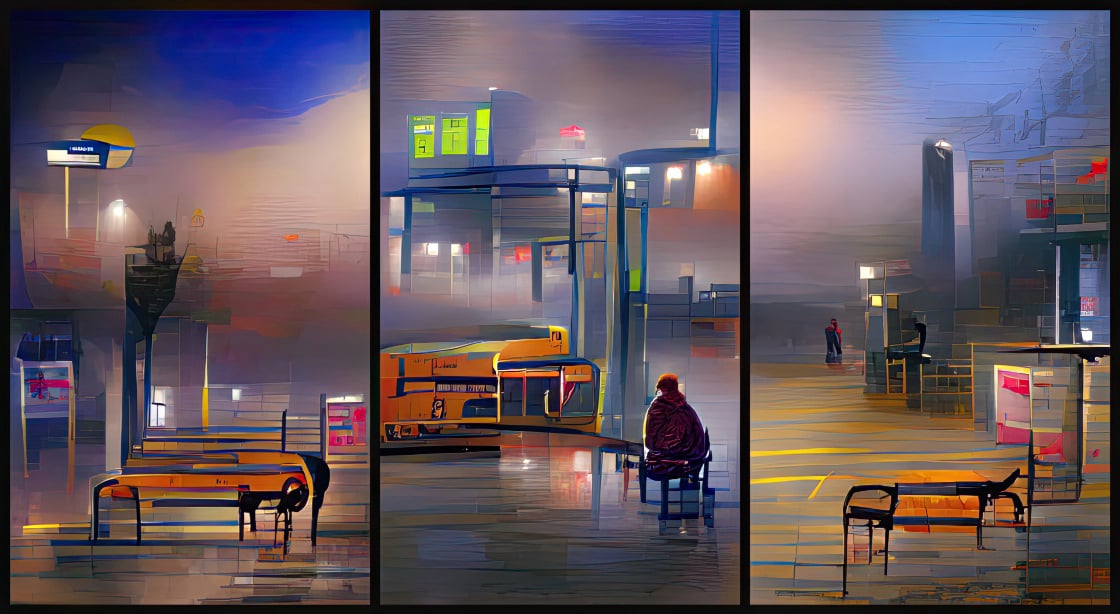
"The station breathes in silence,
Only a shadow remains, bagless,
Even the lights have left."
This triptych speaks of departure without movement, and silence without peace. Once envisioned as a political commentary, "The Last Ride" has since transformed into a quiet meditation on missed chances, fading momentum, and the emotional residue of staying behind.
Through its dimly lit station, an empty bus, and a vanishing figure, the piece suggests not just the end of a journey — but the absence of one. It becomes a visual elegy for those who watched opportunities pass, uncertain whether they were ever ready to leave.
Now part of the ongoing "Sargasso Sea" series — a visual exploration of disoriented humanity adrift in a borderless world — "The Last Ride" captures the quiet weight of finality, where even the light has decided to go.
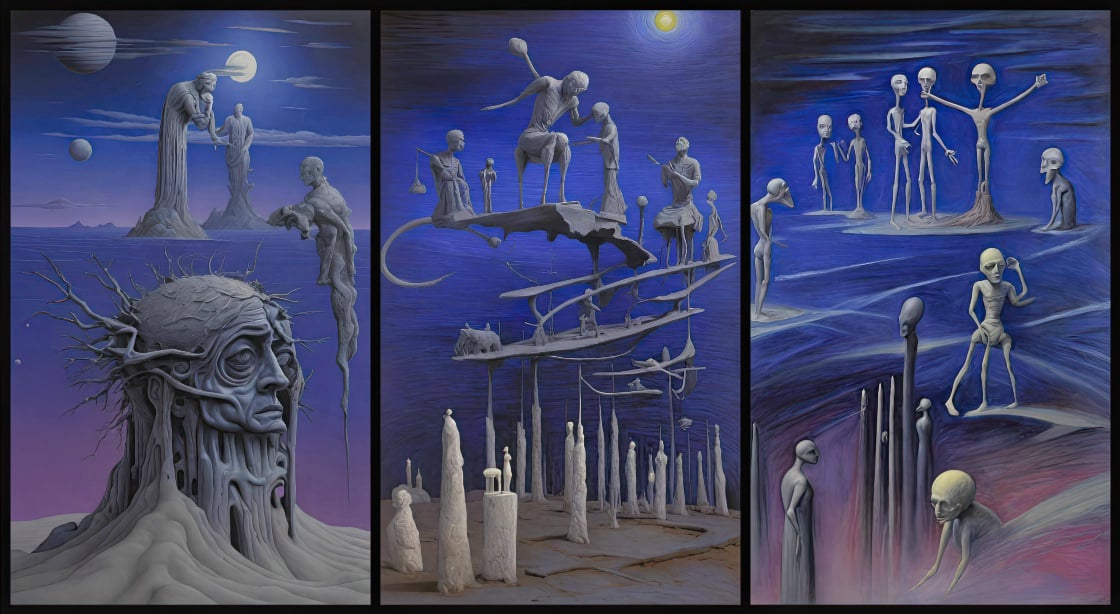
Left panel - "Faiths Adrift"
Central panel - "The Fragile Throne"
Right panel - "Anatomy of Stagnation"
"Eternal Return" is a triptych that explores the perpetual cycle of human mistakes and political systems. In this piece, the artist reflects on the humanly imperfect search for meaning and stability. The central idea of the work is that no power, religious system, or social order can be based on a lasting foundation, as all of them are, in their essence, infertile.
In the left panel, the gods are shown, as representatives of theological systems, which have retained only their political role, in order to enable the easiest possible rule. They are still powerful, but also increasingly lonely and alienated from humans, so their influence fades more and more.
The central panel depicts figures of rulers placed on fragile foundations of power, relying on an entire system of subjects to support them, yet doomed to fall. This panel shows the unbroken cycle of changing powers, but with no real change in state, as the new rulers are merely a continuation of the old.
The right panel depicts the people in various states of reaction — from passivity to unconscious alignment with authority. The rebellious figure with raised hands, people engaging in conversation, or simply staring blankly, represent individuals trapped in the cycle of stagnation, unable to recognize an escape, because they are unwilling to find one. Stagnation is a choice, and it continues year after year.
This triptych is a cold reflection on human society, not a condemnation of specific regimes, but rather a meditation on how we all continue to make the same mistakes, searching for answers in the wrong places. And how much is humanity truly capable of achieving something lasting and meaningful?
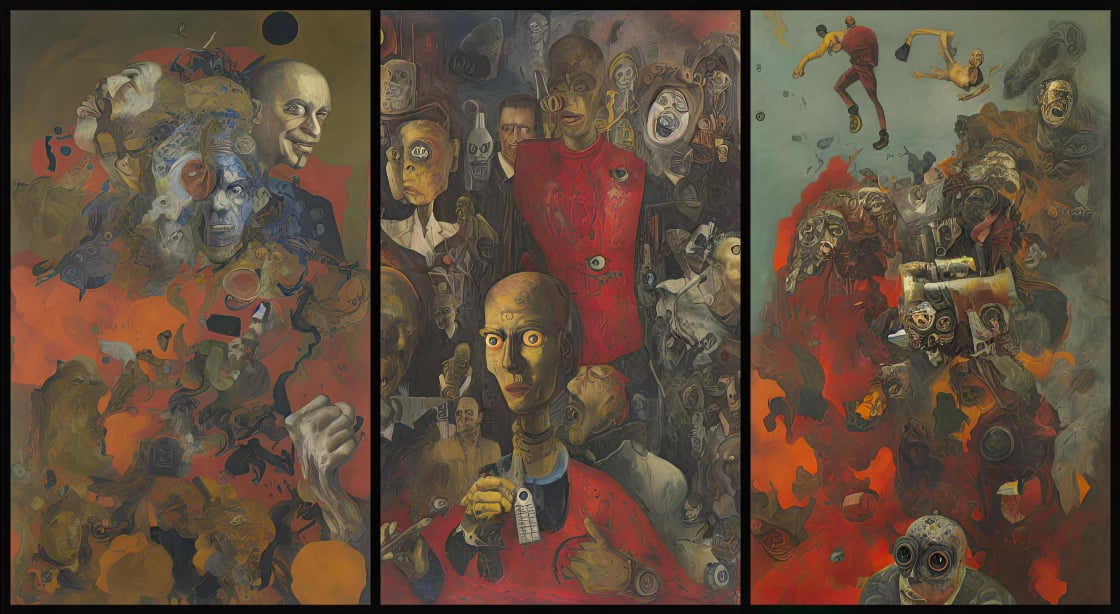
Left panel - "Time of Hatred"
Central panel - "Time of Descent"
Right panel - "Time of Decay"
"Latest Objectivity" is a powerful triptych exploring the collapse of society through the lens of human aggression, moral decay, and systemic failure. Drawing influence from the New Objectivity movement, the work stands as a harsh reflection of the present, not through idealized forms but through the lens of brutal realism. The piece paints a stark portrait of how society moves from hate, to descent, and ultimately to decay.
The journey begins with intense hatred and distrust (left panel), depicted through the figure of a treacherous, blood-drenched character, and a person whose eyes burn with anger. The panel reflects a fractured society where trust is lost, and violence and deceit dominate. This is a universal condition that stretches from the Weimar Republic to the modern world, where polarization and hostility are commonplace.
On central panel, the descent is made manifest: individuals now spiral into a breakdown, as the idealized past no longer holds sway, and every action leads further into the void. A shaved-headed figure proudly holds a medal, representing a distorted sense of national pride, while a combatant beside him seems unaware of the falling world around him. Fatalism sets in, with one figure resigned to the inevitable collapse. This panel highlights the irreversible process of moral and societal decline.
On the right panel the process is complete. The society has collapsed into chaos. A disfigured mass symbolizes the consequences of unchecked destruction, while a figure with a protective mask represents the attempts to survive in an environment that no longer offers sanctuary. The panel reflects the final stage of collapse, where only survival matters, and humanity is reduced to its most primal form.
"Latest Objectivity" serves as a dark commentary on the socio-political realities of our time, a reminder that history repeats itself, and that without introspection, we will remain caught in the same cycles of hate, conflict, and decay.

Free AI Website Creator