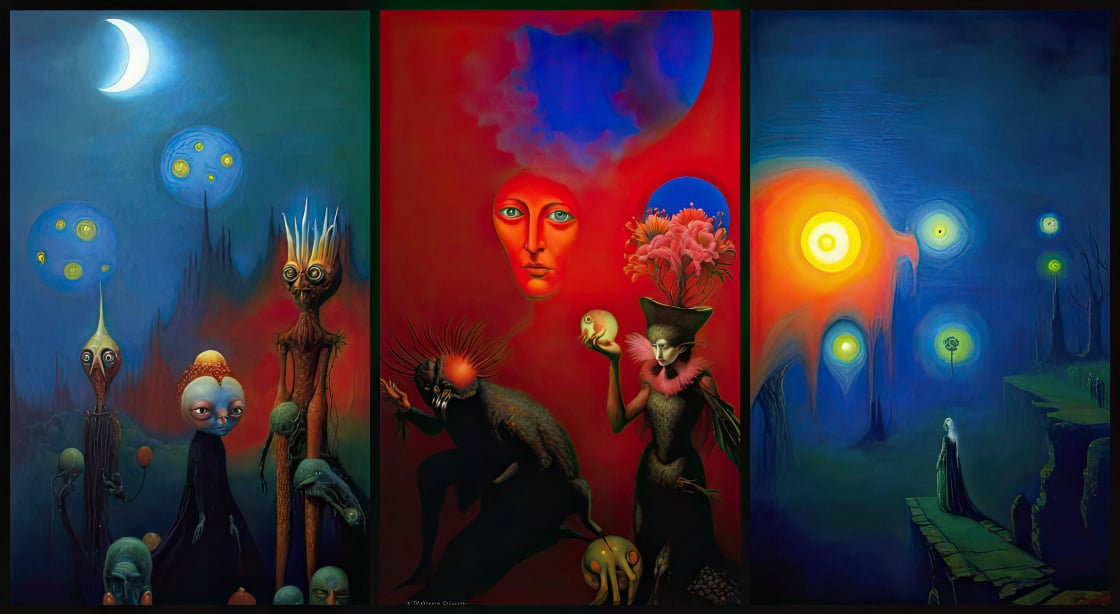
The night has always played a big role in my life, especially the late night filled with its mystical content. Creativity, imagination, thinking, enjoying solitude - there is something seductive about meeting her.
This project is a kind of conversation with the subconscious, a hunt for hallucinations that occur on the border between sleep and waking, a record of something deepest and most intimate, which we all possess as individuals.
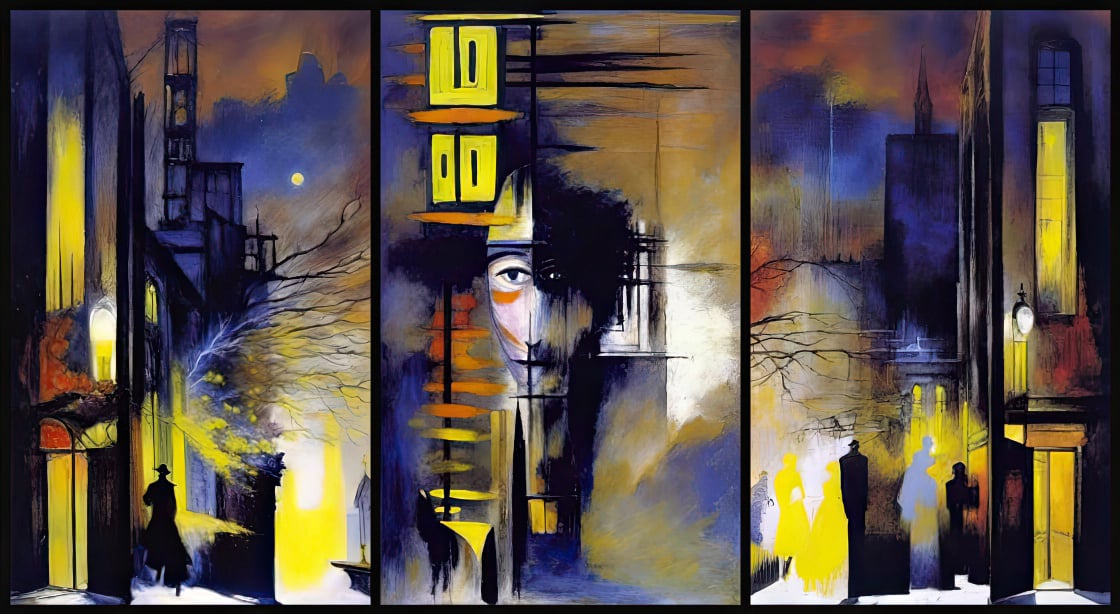
Left panel - "The Silent Watchers"
Central panel - "In Pursuit of Hidden Truths"
Right panel - "Departure of the All-seeing Night"
"The Secret Face of the Night" is a triptych that invites us into the emotional and symbolic landscape of dreams. Here, night is not merely the absence of light, but a terrain of revelation, guardianship, and inner transformation. Each panel functions as a chapter in a nocturnal journey—from observation, through confrontation, to release.
In "The Silent Watchers", elongated spectral figures stand in the stillness of the subconscious, their gazes fixed on something invisible. These are the sentinels of night—symbols of our own hidden awareness and intuition.
The central panel, "In Pursuit of Hidden Truths", captures the intensity of inner searching. Figures swirl in vibrant hues of red and blue, evoking a chaos of thought and desire. At the center, a calm face floats behind the action—an anchor in the turbulence of the dreaming mind.
Finally, "Departure of the All-seeing Night" marks the end of the nocturnal phase. A lone figure watches as the night withdraws, its glowing orbs fading like memories. This is the moment of introspection, where we part from the vastness of the inner world and reenter wakefulness—changed.
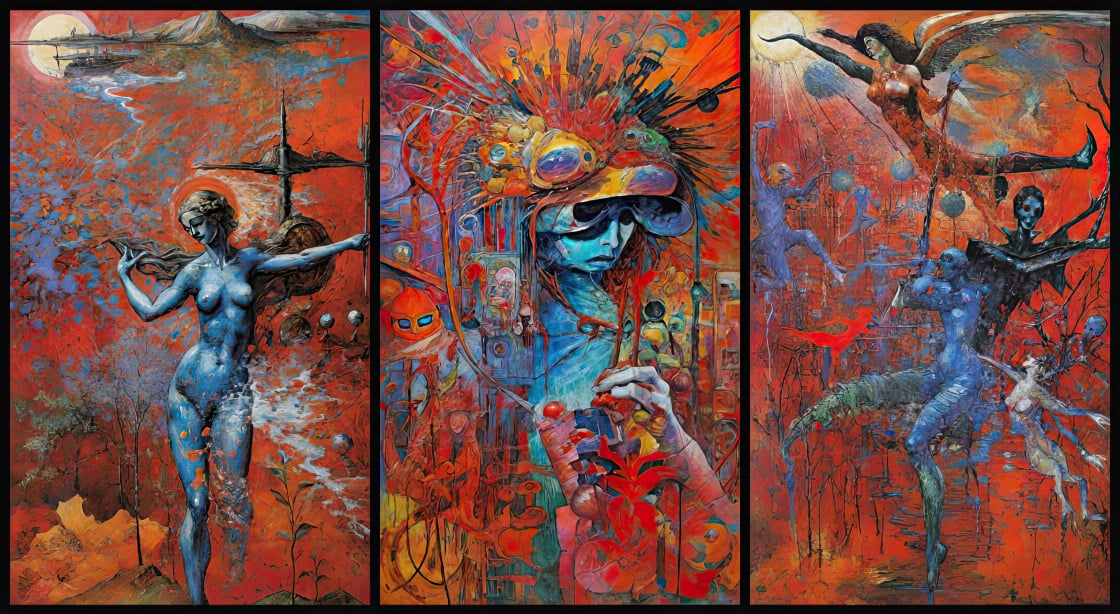
Left panel - "Blue Nymph"
Central panel - "The Inner Labyrinth"
Right panel - "Dance of Liberation"
The triptych "Meditation" was created under the influence of the work of the same name by the famous artist Gerhard Richter and his intense use of red.
The left panel, through the blue nymph, tries to convey the idea of beauty: pure, perfect and intangible, something that exists only in our imagination.
The central panel represents our inner labyrinth, linked to a specific female person. There is unrest, drama and abstract swirling dynamics, just like in real life.
The right panel represents the discharge, the release, all the actors are in flight trying to reach, with variable luck, their imagined goals.
In short, "Meditation" is a kind of visual prayer that unfolds through three scenes: the first brings serenity and a delicate connection with nature, the second introduces a more complex introspective dynamic, and the third suggests struggle and eventual liberation. Each panel is a stage in the difficult ritual of returning to oneself—with the body acting as both canvas and oracle.
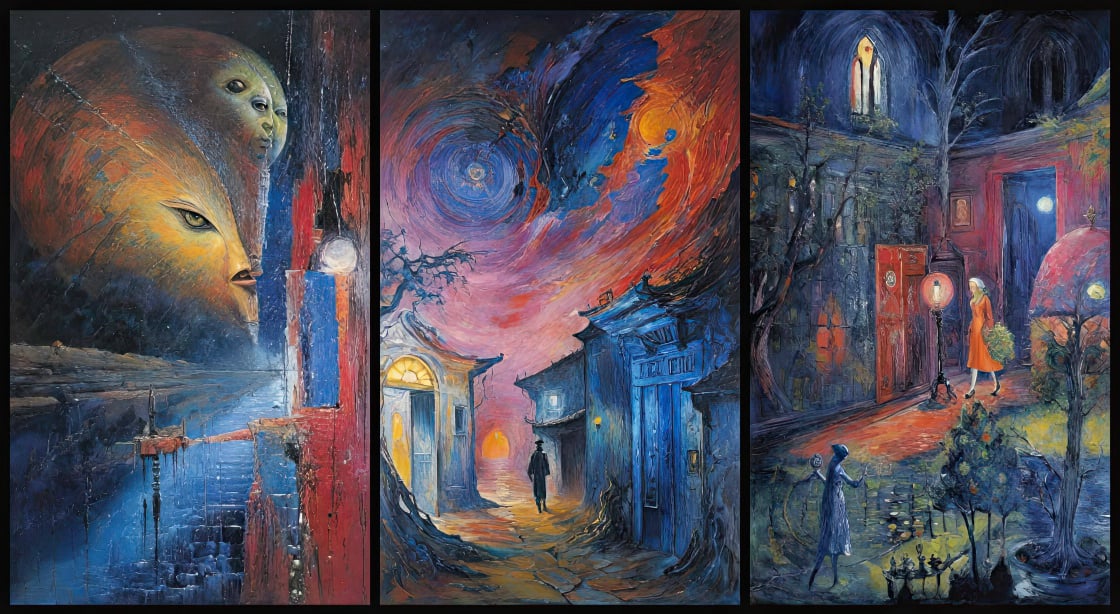
"Lunar gods arise,
Fractured mind meets burning skies,
Fate whispers her name."
The entire work exudes a mystical Edgar Allan Poe atmosphere, which on the one hand is fairy-tale, and on the other hints at a horror outcome.
The left panel represents the mysterious forces that begin their destructive influence. This is the beginning of the story that comes from the subconscious, perhaps from dreams, shaping the destinies of the characters.
The middle panel shows a male person walking down the street who, under the influence of forces, moves into action. He's still surrounded by the street light, but he's about to head off into the dark. He is some kind of rapist, maybe a killer looking for his victim. The swirling sky further emphasizes the chaos in his mind, while the symbolism of light represents moments of moral dilemma or last attempts to maintain control.
The right panel shows the potential victim. It is a girl-woman who returns to her apartment late at night after an evening walk. This panel concludes the story, leaving the viewer in suspense – what will happen? Will the tragedy be avoided or is it inevitable?
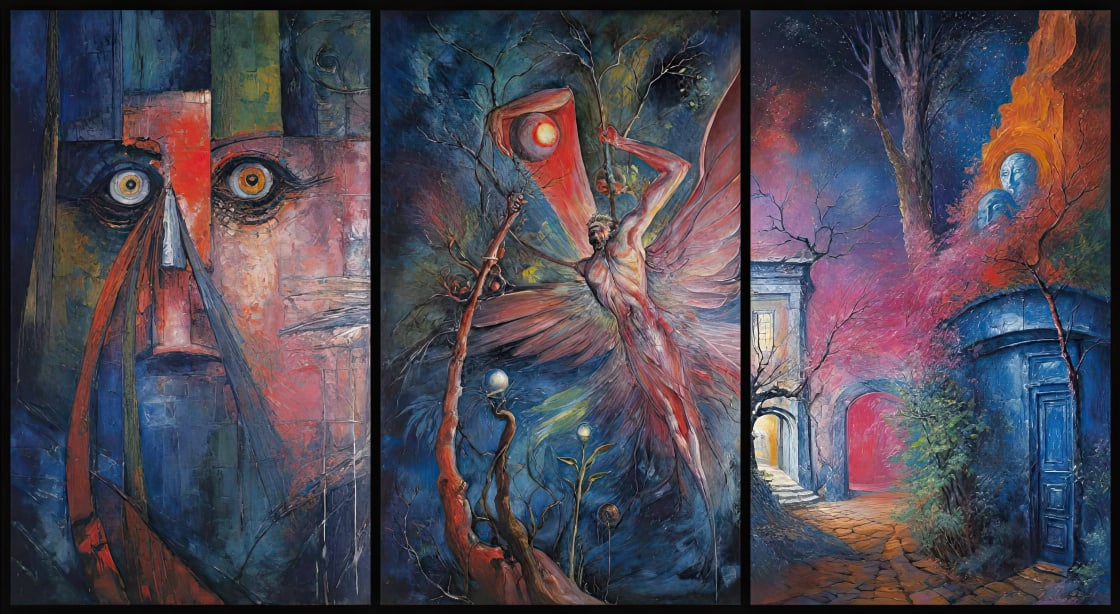
"Eyes of dread take hold,
Flames consume the restless soul,
Paths to void remain."
This triptych describes dreams that straddle the border between fairy tale and horror denouement, attempting to evoke an atmosphere steeped in suspense and symbolism that leads to universal questions about fate, mortality, and inner demons.
The left panel evokes entering the dream space, where unknown forces take control. The appearance of a figure with huge eyes, which seems diabolical and disturbing, can be understood as the first act of the drama, when the dangers become visible and frightening, but not yet clear enough.
The central panel is the heart of the triptych, the moment when threats become reality. It symbolizes the experience of dying in dreams, which represents not only physical but also mental destruction. The figure in agony, surrounded by fire and swirling sky, symbolizes the culmination of fear and a sense of inevitability.
Finally, the right panel contrasts with the previous two with its calm, idyllic atmosphere. The path illuminated by the light, the stillness of nature, and the mysterious figures in the background that symbolize the passive observers of the drama, represent a moment of reflection, but also of uncertainty. Is the possibility of release from sleep and awakening hidden here, or is it the final act of tragedy and the end of the journey?
Left panel - "Flaming Grove"
Central panel - "The Watcher"
Right panel - "The Silent Clock"
"Whispers of the Night" is a triptych that navigates the emotional terrain between existential awe and internal reckoning. These are not literal dreams, but echoes—fragments of memory, fear, desire, and awareness, suspended in symbolic space.
In "Flaming Grove", trees burn in silence. This is not a violent fire, but a metaphoric one—symbolizing emotional crisis, psychological rupture, and the start of an inner journey. The grove blazes like thought under pressure, a forest of unresolved memory.
At the center, in "The Watcher", a solitary figure stands between perception and surrender. Surrounded by shadow and flickers of surreal forms, the Watcher represents the meditative self—detached, aware, questioning. Is he watching the dream—or dreaming the watcher?
In "The Silent Clock", the final scene, a suspended clock hovers in an undefined night. It does not tick. It does not count. It only hangs—present, symbolic, still. Time is no longer progression—it becomes weight. The figure gazes toward it without fear, perhaps accepting that time, too, is a whisper.
"Whispers of the Night" transforms philosophical abstraction into vivid symbolism, building a quiet, burning dialogue between perception and presence.

No Code Website Builder