“Humanity ++” is an ongoing visual exploration of posthuman transformation — a series of narrative triptychs that question what remains of the human as we evolve beyond biology.
Through hybrid forms, symbolic tension, and speculative beauty, the project confronts the emotional, ethical, and spiritual dimensions of a future where consciousness may outlive the body, and perfection may silence passion.
It is not a prophecy — but a visual meditation on thresholds: between chaos and control, memory and mutation, flesh and code.
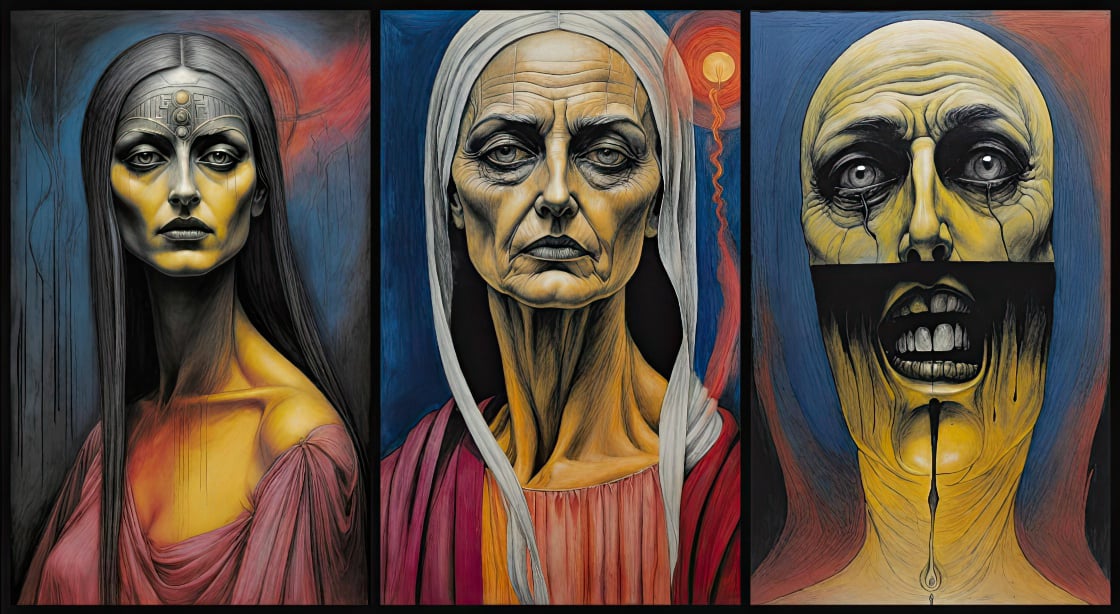
Left panel - "Hint of Transience"
Central panel - "Knowledge of Inevitability"
Right panel - "Dread"
"Meaninglessness of Dying" marks the philosophical genesis of the "Humanity ++" project.
Through three portraits — a goddess of beauty sensing decay, a prophetess of mortality, and a scream of existential horror — this triptych confronts the terrifying transparency of death.
There is no spiritual comfort here, no metaphysical reward. Only the raw, unfiltered recognition that if death holds no meaning, perhaps the only true rebellion is the pursuit of immortality.
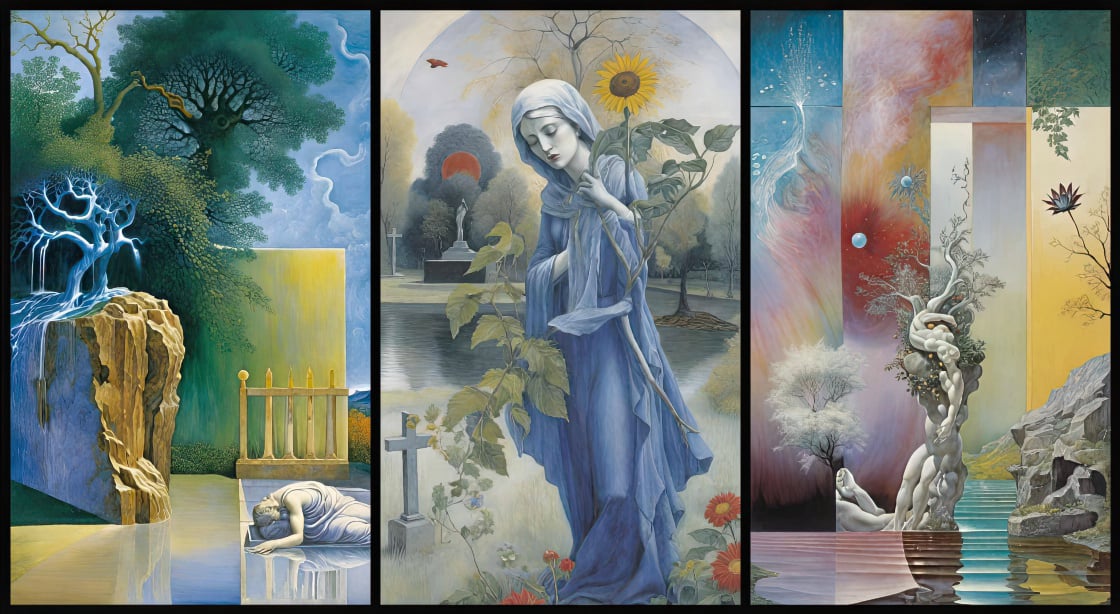
Left panel - "Stillness Before the Wind"
Central panel - "Do not stand by my grave and cry"
Right panel - "I am not there, I did not die"
Inspired by Clare Harner’s poignant poem “Immortality”, this triptych explores death not as an end, but as a gateway — a metamorphosis of form and meaning.
The first panel, "Stillness Before the Wind", depicts the quiet surrender of the human body before the threshold of death — a moment suspended between dissolution and transcendence.
The central panel, "Do not stand by my grave and cry", features a Madonna-like figure, embodying spiritual systems of mourning, yet receiving the message: “do not weep — I am not gone.”
The final panel, "I am not there, I did not die", departs from metaphor into posthuman vision — showing rebirth not in heaven, but in material, physical evolution. It is a form of immortality rooted not in myth, but in transformation.
The triptych weaves sacred iconography with surreal natural elements, digital alchemy, and poetic symbolism. It invites us to contemplate a future where death is neither final nor fearful — but a passage into something beyond, something yet to be defined.
Immortality is not about solace.
It is about continuation.
It is not about memory.
It is about becoming.
"Skin opens like mist,
Muscle entwined with the bloom —
A god learns to breathe."
"Becoming Godseed" explores the metamorphosis of humanity under the immense pressure of technological acceleration.
Through three panels — organic unrest, biochemical transformation, and biomechanical rebirth — the triptych chronicles the involuntary evolution toward posthumanity.
The work confronts the viewer with an ambivalent vision: raw and unsettling, yet filled with transcendental tenderness.
It is not a warning, nor a celebration — it is a silent affirmation that the future is already blooming inside us.
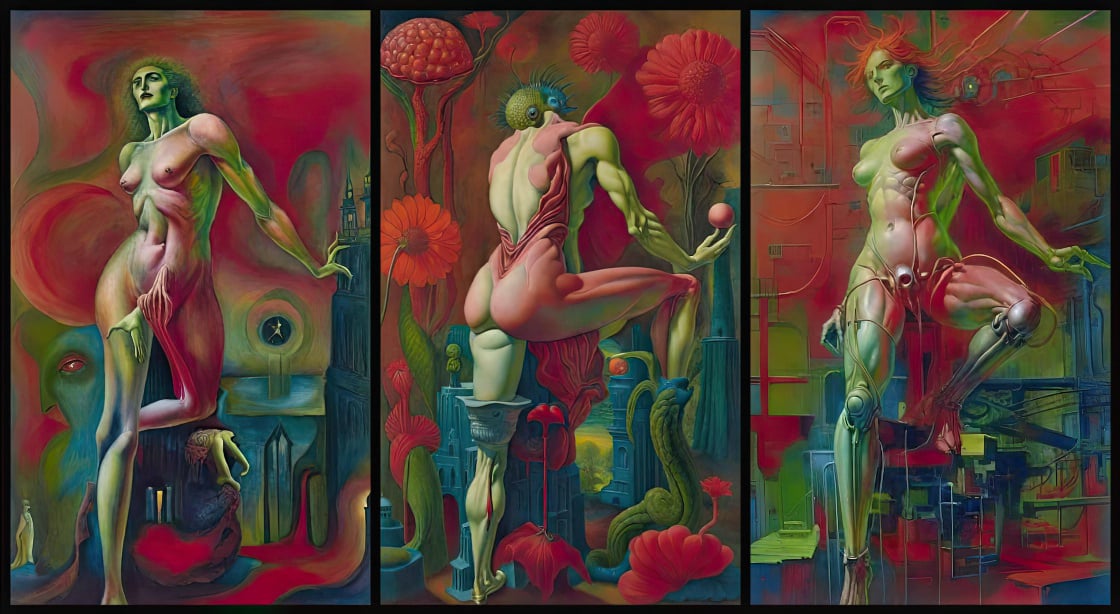
Left panel - "Between Desire and Dread"
Central panel - "Echoes of Sacrifice"
Right panel - "Roses Amidst Ruin"
"Endgame of the Self" is a post-apocalyptic triptych that delves into the deepest dilemmas of humanity’s survival. It explores the final moments of human existence, where the very foundation of our way of life must be sacrificed for any chance of salvation.
Through three visually striking panels, the work portrays humanity’s collective struggle with its fate: from the uncertainty of our present condition, to the desperate willingness to embrace change and transformation, to the haunting aftermath of that inevitable reckoning.
At its core, the triptych is a reflection on the price of survival, the inevitability of sacrifice, and the stark reality of our choices. Will humanity evolve through this process, or will it be consumed by its own hubris? This work challenges the viewer to reflect on the fragility of existence, the urgency of change, and the possibility of rebirth amidst destruction.
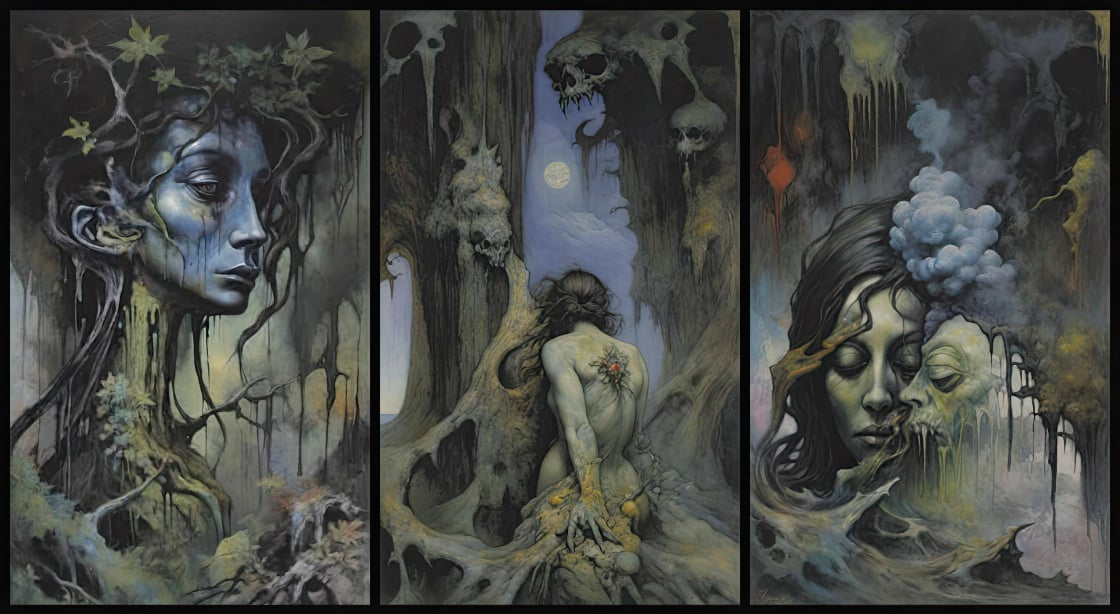
Left panel - "The Last Strain"
Central panel - "Witness to Despair"
Right panel - "Rise of the Phoenix"
"When the Ashes Settle" is the second act in a larger narrative that began with "Endgame of the Self". This post-apocalyptic triptych depicts humanity’s final moments of struggle, the cosmic witness to our fate, and the fragile hope of rebirth.
The first panel, "The Last Strain", captures the desperate, agonizing effort of a species on the brink — a final surge of will in the face of extinction.
The second panel, "Witness to Despair", shifts the perspective beyond Earth, portraying the universe itself — symbolized by the wary, human-faced Sun — as an impartial observer to our dangerous game. The final panel, "Rise of the Phoenix", offers a vision of renewal: the mythical bird emerges in a blaze of victory, scattering the remnants of destruction.
Together, these panels form a meditation on exhaustion, judgment, and the possibility of transformation. While hope emerges from the ashes, it remains delicate — its survival dependent on whether we have truly learned from the collapse that preceded it.
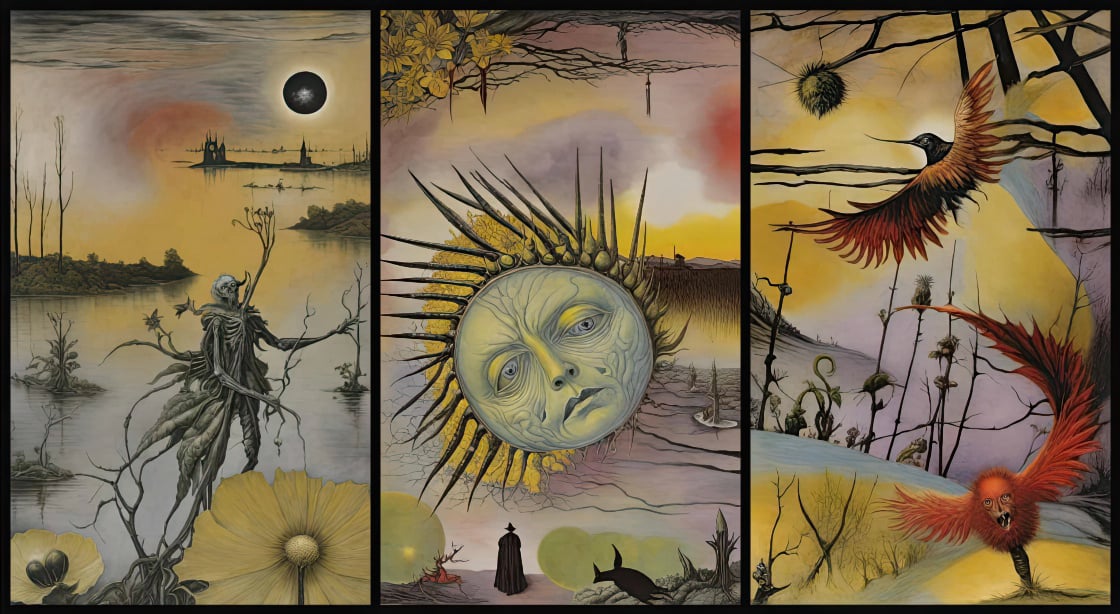
Left panel - "Impending Necessity"
Central panel - "Sterile Virtue?"
Right panel - "The Echo That Remains"
"The Birth of Gray Divinity” is a speculative vision of the threshold where humanity begins to surrender its chaotic vitality in pursuit of synthetic equilibrium.
The triptych unfolds across three states: rational awareness (Impending Necessity), the sterile harmony of a posthuman future (Sterile Virtue?), and the raw struggle to preserve emotional depth (The Echo That Remains).
Is perfection worth the price of passion?
This work does not provide answers — it opens space for necessary doubt.
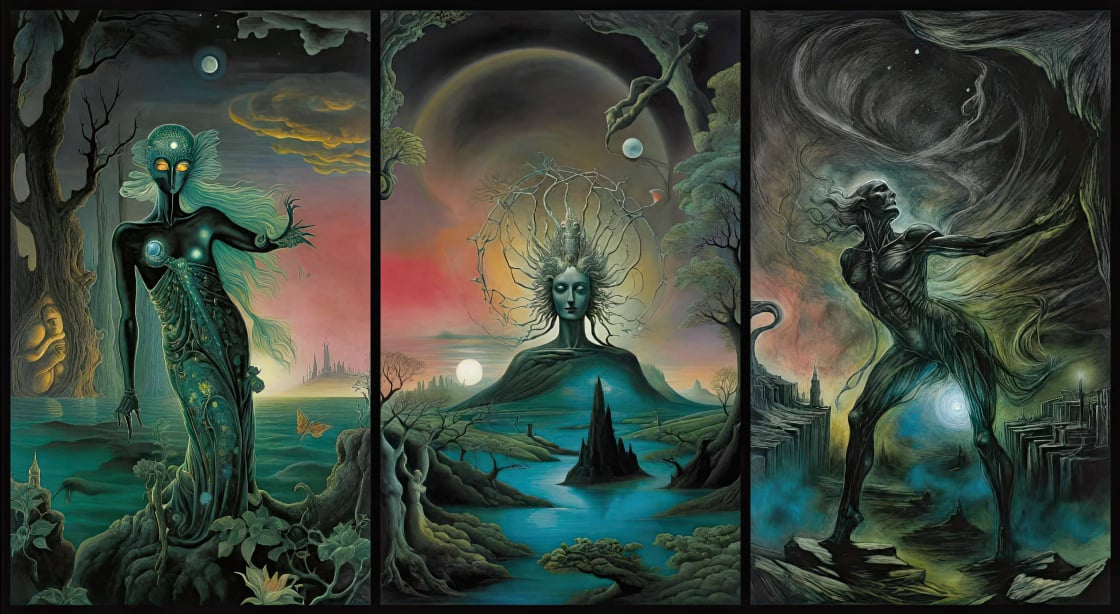
Left panel - "In Search of Solace"
Central panel - "The Flesh Whisperer"
Right panel - "In Search of Harmony"
Part of the ongoing project "Humanity ++", this triptych explores the nature of intimacy in a posthuman world — a reality in which physical bodies may still exist, but are no longer the primary language of connection.
In "In Search of Solace", a synthetic woman seeks comfort among her biomechanical companions. She does not open her eyes — her emotional life unfolds in inner space, far from sensory touch.
The central figure, "The Flesh Whisperer", stands as an emotional interface — a being who retains memory of human affection and transmits it as pure signal. Its body may no longer need skin, but it speaks the language of closeness better than any heart ever did.
"In Search of Harmony" closes the cycle with a human hybrid in silent communion with a reengineered natural world. Insects, branches, and birds are no longer separate from her but part of a subtle equilibrium.
This is not a dystopia.
Nor a utopia.
It is simply a vision of what intimacy might become — when touch is no longer physical, but deeply, silently shared in dreams.
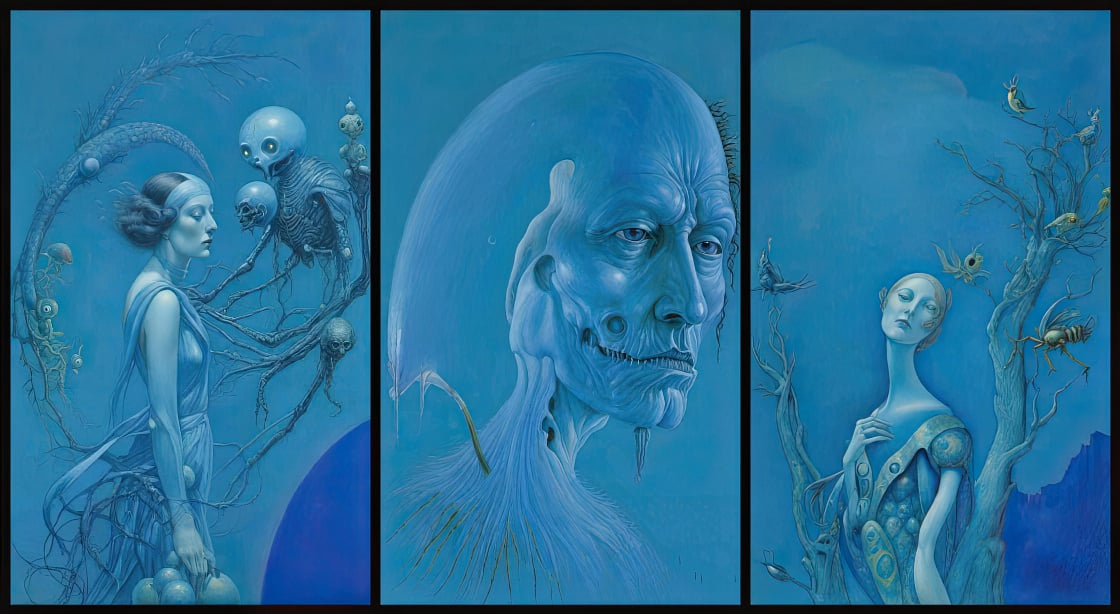
Left panel - "The Silent Warden"
Central panel - "Crown of Stillness"
Right panel - "The Velvet Blade"
“The Three Graces” is the eighth piece in the "Humanity ++" cycle — a posthuman reinterpretation of classical mythological archetypes.
This triptych replaces harmony with tension, sisterhood with psychological divergence, and beauty with the unsettling allure of the unknown.
Each figure stands as an autonomous force:
One is the silent guardian of dangerous intimacy.
Another embodies isolation cloaked in power.
The third pulses with ambiguity — part vulnerability, part instinctive manipulation.
Together, they do not reflect the joyful unity of Botticelli’s Graces, but rather a speculative emotional architecture of beings who share space, but not sentiment. They are not characters, but emotional protocols of the posthuman condition.
In this world, intimacy is ambiguous, connection is optional, and beauty is inseparable from unease.
Their coexistence forms a new myth: not of balance — but of silent, coexisting tensions.
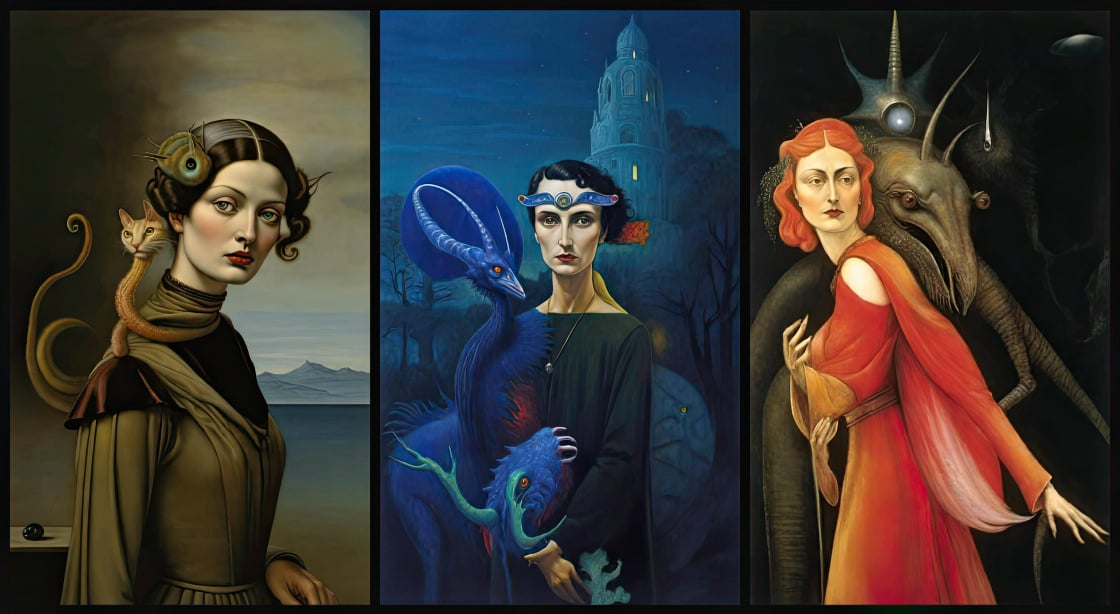
"Empty eyes still see,
What the body can’t contain,
Roots bloom into grief."
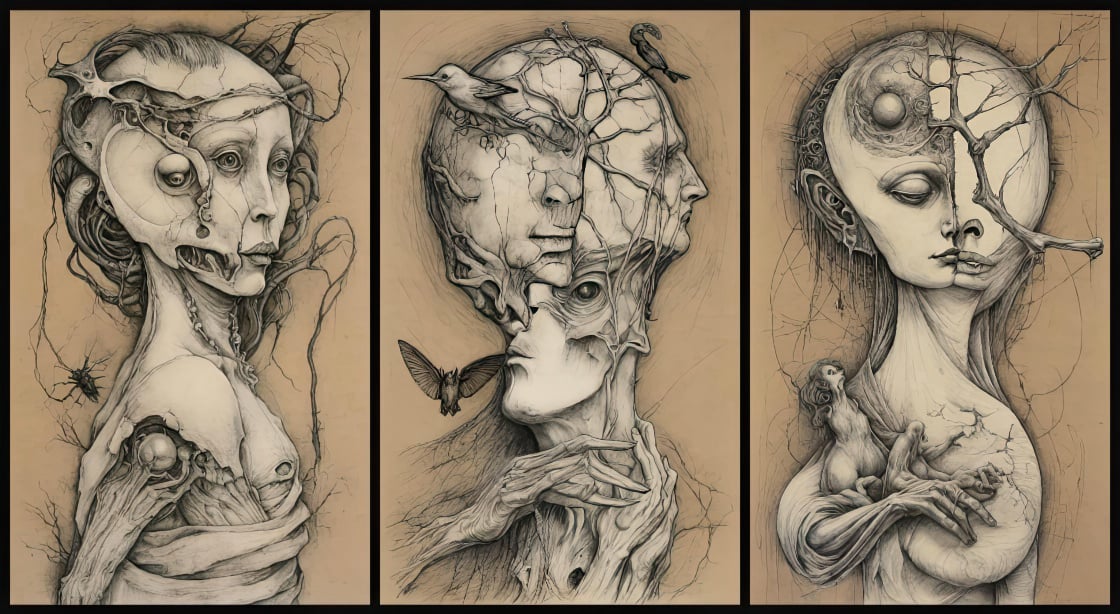
"The Rooting" delves into the subterranean architecture of human identity, where memory, trauma, and longing entangle into one organic web.
Through fragmented anatomies and penetrating gazes, this work evokes both tenderness and disquiet — an elegy for the self before transformation.
It is not a look into the future, but into the deepest soil of the past, where posthumanity takes root in pain and reflection.
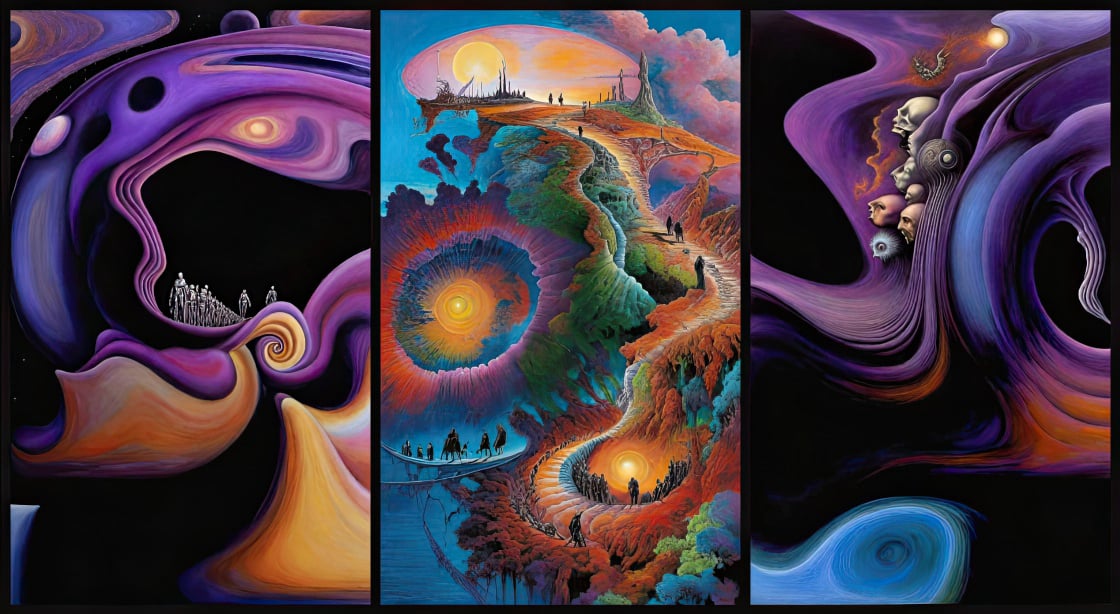
Left panel - "Genesis of the Life"
Central panel - "Veil of the Unknown"
Right panel - "In Search of Balance"
"The New Light" is a triptych that explores a pivotal phase in the evolution of humanity — the transition from our earthly existence to a cosmic mission. Through three panels, the work illuminates new horizons for the future, highlighting the mysterious beginnings, the posthuman journey, and the search for balance.
"Genesis of the Life" depicts the birth of life through abstract forms, symbolizing the beginning of abiogenesis.
"Veil of the Unknown" unveils the unknown, mysterious spheres humanity must explore, revealing cosmic realms in the unseen.
"In Search of Balance" symbolizes the quest for harmony between technology and nature, individualism and unity.
The triptych raises the question of how we will approach new worlds. Will we conquer them, or will we strive to understand, respect, and share them? "The New Light" invites us to venture into the new cosmos with humility and responsibility, through a process that is about exchange, not domination.

Offline Website Builder