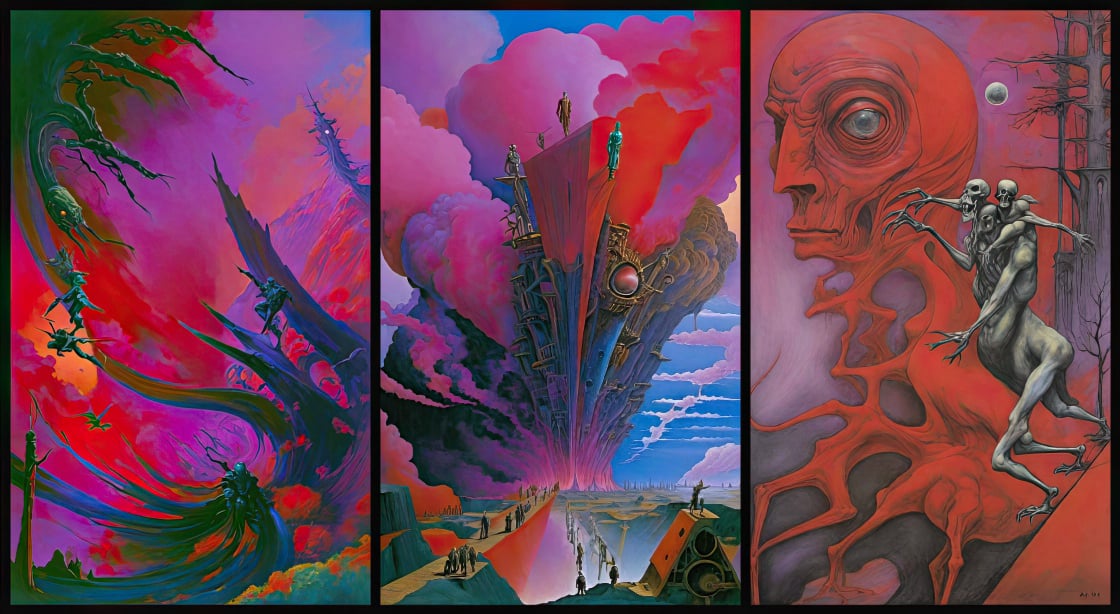
This project is a story about autocratic regimes - How do they come about? Do we enjoy being deceived by false promises? Is liberalism finally losing the battle? How do they govern and what governance mechanisms do they use? Is our struggle futile and is escapism the only solution? And yes, sometimes we manage to beat them!
Left panel - "The Vortex of History"
Central panel - "They Are Coming"
Right panel - "One People, One Empire, One Leader!"
The triptych"Weimar World" is an attempt to use a combination of historical allusions, political criticism and visual drama to draw attention to the danger of the growing wave of authoritarian regimes, which modern society is currently exposed to. It's as if the whole world has become the Weimar Republic, which is slowly turning into Nazi Germany!
The left panel, "The Vortex of History," reflects the universal idea of the cyclical and unpredictable nature of human history. The dynamism of the scene, combined with destructive symbolism, is an attempt to cause restlessness and fascination in the viewer. Our impotence to resist the vortex of inevitability is evident, which creates a sense of fear before the merciless forces of history.
The central panel, "They Are Coming," depicts the coming of authoritarian forces to power, where a monumental structure that looks like an apocalyptic fortress rises into the clouds, symbolizing the coming of something big and dangerous. Small human silhouettes, who are aware of the terrifying moment, serve to emphasize the powerlessness of the individual in the face of such phenomena.
Finally, on the right part of the triptych, individuality is defeated, which is best explained by the name of the panel. The central figure, symbolizing tyranny, completely dominates the people, who have become a deformed, impersonal, obedient mass. Colors are saturated, with red tones symbolizing danger and destruction, while the moon-themed background adds to the dystopian tone.
Left panel - "The Herdsman"
Central panel - "The Death of Liberalism"
Right panel - "The Herd"
This triptych is a sharp critique of the current political reality in the USA, reflecting on the consequences of populist ideologies that threaten liberalism.
In "The Herdsman", we see a leader, detached from reality, leading his followers down a destructive path. "The Death of Liberalism" symbolizes the collapse of democratic values, suffocated by the weight of manipulation and falsehoods.
Finally, in "The Herd", we witness the obedient followers, powerless and blind, living in the shadows of tyranny.
This triptych represents the stark choice between truth and deception, where the destruction of truth paves the way for the rise of falsehoods. It serves as a chilling warning of the dangers of authoritarianism, and the inevitable decay of freedom when society becomes complicit in its own manipulation.
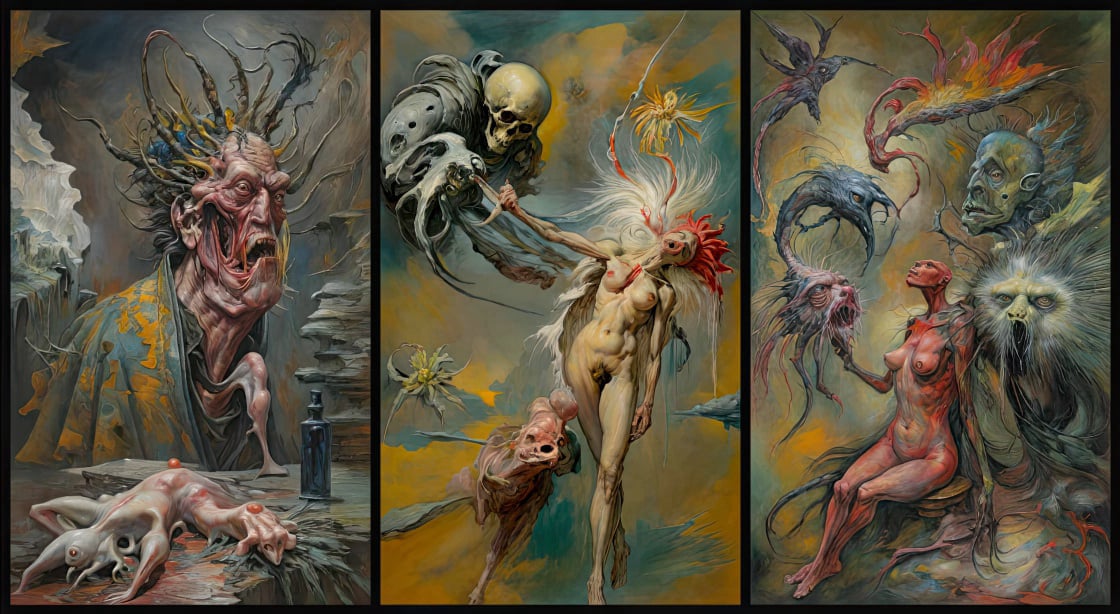
Left panel - "The Rise of the Leader"
Central panel - "The Glass Throne"
Right panel - "The Panopticon"
"The Birth of Tyrant" is a powerful triptych that explores the creation and consolidation of power in a
contemporary world dominated by surveillance, control, and manipulation.
Left panel, "The Rise of the Leader" represents the birth of a tyrant, where a figure begins to ascend, drawing followers to its cause.
Central panel, "The Glass Throne" symbolizes the fragility of absolute power, a monstrous system that hovers in the air, relying on unstable foundations.
Finally, the right panel, "The Panopticon" portrays the ultimate surveillance society — a world governed by a cold, indiferent system that monitors every move.
The triptych weaves together surrealist imagery and existential themes to create a meditation on power and the mechanisms that sustain it.
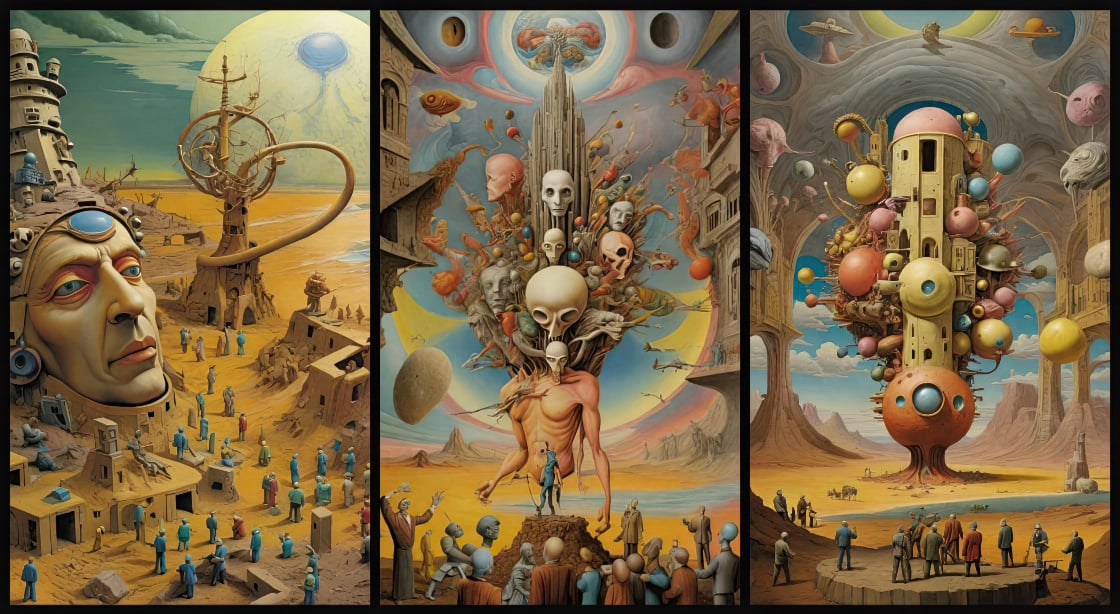
Left panel - "Court Games"
Central panel - "The Ruler's Eyes"
Right panel - "The Group Portrait With Victims"
"Golden Age" is a powerful exploration of the dark, perverse mechanisms of authoritarian rule. Through the three panels, this triptych sheds light on the twisted nature of governance in such regimes.
"The Court Games" symbolize the strategic and manipulative tactics used to gain and maintain control, while "The Ruler’s Eyes" depict the obsessive, almost pathological focus of a ruler whose perception is shaped by power and dominance.
In "The Group Portrait With Victims", we see the chilling consequences of their reign—focusing not on the destruction of these systems, but on the pure suffering they impose, a reminder of the brutal realities that never fade in the shadows of authoritarian regimes.
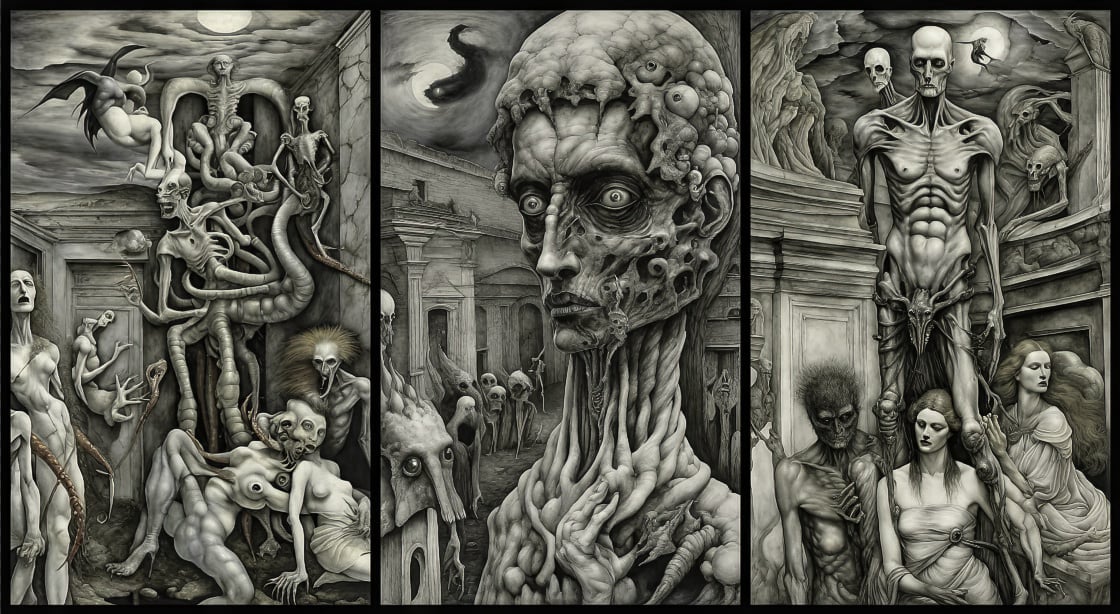
Left panel - "The Defiant Refusal"
Central panel - "The Judgment"
Right panel - "Among the Sacred"
This triptych delves into the darkness of power, control, and the harrowing consequences of defiance. In the story of Tiberius, one of Rome's most notorious emperors, we see the complexities of authority and submission, illuminated by the stark contrasts between the ruler and the ruled.
On the left panel, the act of refusal is portrayed. The figure’s rejection of the tyrant’s will is an ultimate act of defiance against absolute power. This panel speaks to the heavy burden of defiance, one that brings the promise of both purity and peril.
In the center panel, the harsh and swift judgment is passed. There is no trial, no defense. The system acts without mercy, as the ruler's eyes meet the defiant subject's, sealing their fate. Here lies the cold finality of the authoritarian rule—unforgiving and inevitable.
The right panel presents a transcendental space, where the defiant spirit finds itself among the angels—both metaphorical and literal. It is not a victory, but an escape into the purity of resistance. The figure here exists in limbo, far from the tyranny, yet still tied to it in an inescapable way.
"The Legend of Tiberius" explores the price of freedom and the inevitability of authoritarian control. It is not a story of final redemption, but a meditation on the nature of power and the ultimate cost of defying it.
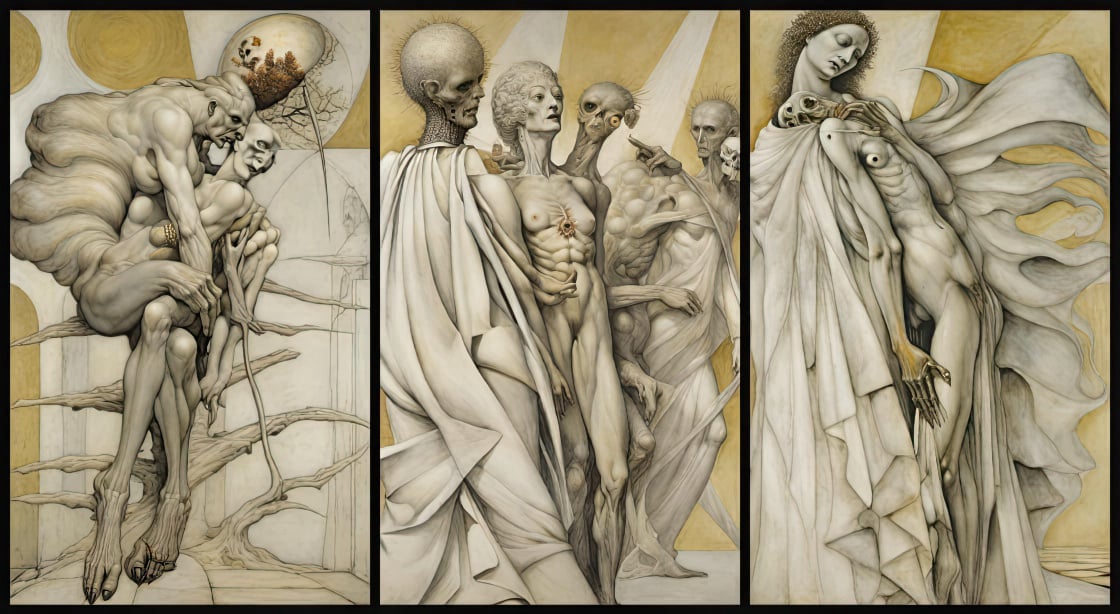
Left panel - "Messiah With the Four Breasts"
Central panel - "The Followers"
Right panel - "The Shattered Throne"
The triptych "Feeding on the Flock" explores human weaknesses through a direct and merciless critique of undeservedly acquired power, which rests on the cunning manipulation of the "chosen" and the blind faith of the masses. There is no room for ambiguity in this work - it represents a clear condemnation and mockery of the collective unenlightenment of the followers, which enable the rise and affirmation of false messianism.
The title of the left panel, "Messiah With the Four Breasts," sets a grotesque, perverse frame for the entire work. The caricature figure of the messiah indicates a deep irony, where he presents himself as a nurturer and savior, while in reality he is a simple manipulator.
On the other hand, the central panel, "The Followers", explores the dynamics of obedience, but in the context of blindly following and worshiping a leader. The leader is the one who manipulates and controls, while the "followers" are individuals without the power of critical thinking, unaware of their dependence on him.
"The Shattered Throne" best wraps up the story of a messianic reign and an authoritarian regime that eventually crumbles, leaving consequences as ugly as the fall itself. The motives for the downfall and destruction of the leader's authority are evident as the theme of authoritarianism reaches its culmination.
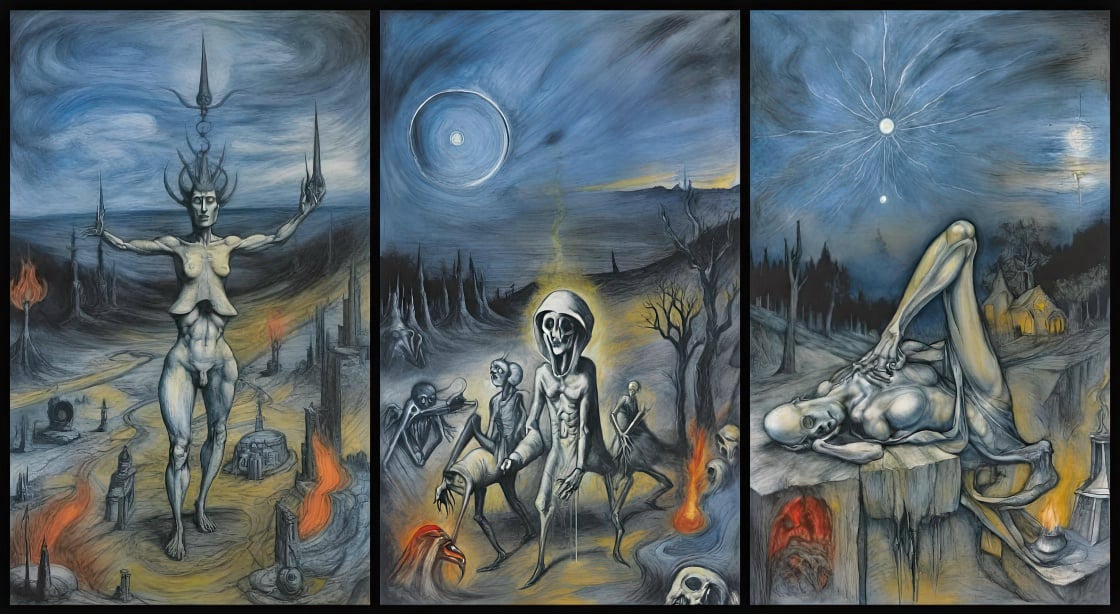
Left panel - "Voyage to Nowhere"
Central panel - "Stranded Glory"
Right panel - "The Face of Oppression"
"Ship of Fools" is a surreal, tragicomic triptych about the absurdity of authoritarian leadership and the blindness of its followers.
In the left panel, a ship of fools rests absurdly on dry land within a dark, cave-like chamber. The open mouth of the cave reveals a moonlit water surface — distant, unreachable, and entirely disconnected from the path chosen by the leader. This dissonance symbolizes the irrationality of the leader’s vision and the false voyage he has proclaimed.
In the central panel, the ship is now stranded, yet the leader celebrates as if victorious. His caricatured, oversized figure — alongside his equally exaggerated consort — waves triumphantly to an obedient crowd. The grotesque proportions mock the illusion of greatness. A lone minotaur, the embodiment of raw instinct and primal rebellion, refuses to take part in the farce and tries to escape the delusional pageant.
In the right panel, the dictator exhibits a grotesque mixture of celebration and rage — aware, perhaps, of his failure but unable to admit it. He is surrounded by petrified followers, frozen in loyal submission, blindly enacting his hollow commands.
This work portrays the surreal theater of failed leadership: where vision is detached from reality, failure is masked by spectacle, and power survives only through inertia and denial.
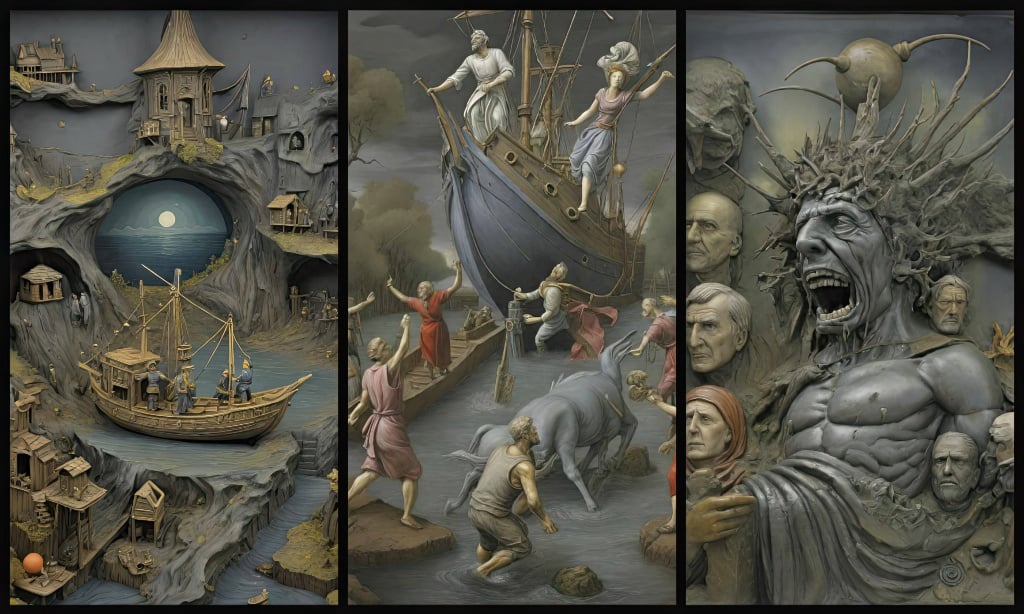
Left panel - "The Light Bearer"
Central panel - "The Hand of Power"
Right panel - "The Organization"
This triptych delves deep into the mechanics of political tyranny, showcasing not only the figures that hold power but the chilling infrastructure that maintains their control.
The first panel, "The Light Bearer", portrays the reformer, the individual who dares to spark change,
while the central panel, "The Hand of Power", depicts the oppressive force that stifles any movement of hope.
Finally, The Organization reveals the sinister undercurrent of power—an invisible network of control and manipulation.
This piece serves as a stark reminder of the dangers of unchecked power and the fragility of hope under authoritarian rule.
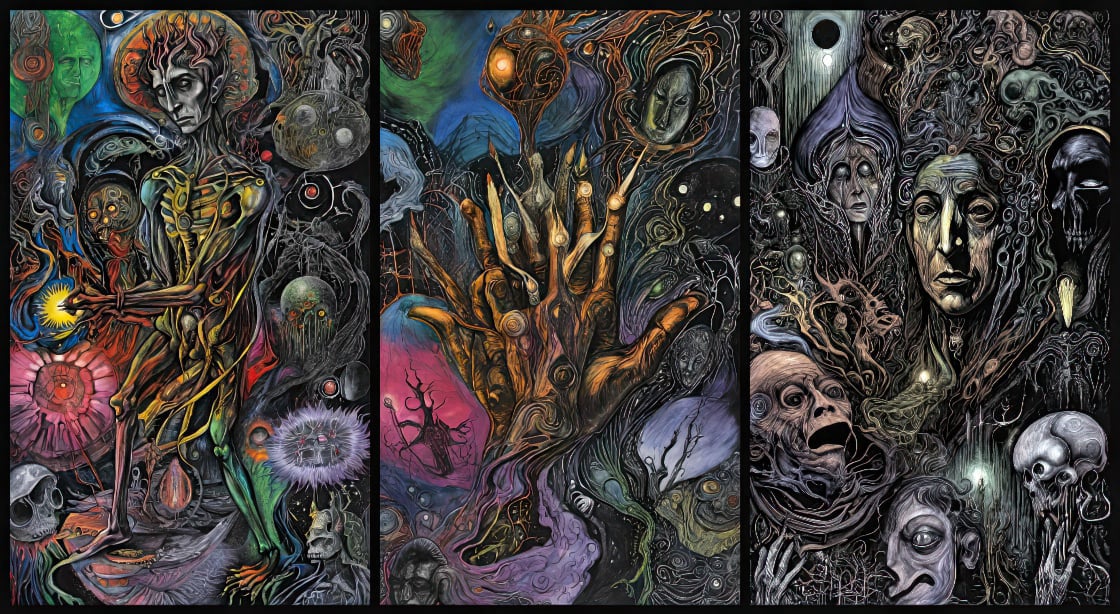
Left panel: "Sin City"
Central panel: "The Guardians"
Right panel: "Big Punishment"
"Guardians of the Grave" exudes a dark, post-apocalyptic atmosphere with elements of fantasy and horror. It is a work that, with the help of supernatural and dystopian elements, tries to point out, in the most plastic way possible, the decadence of society that despotic regimes necessarily carry within themselves.
"Sin City" is a place of sin and moral decay, where tall, decaying buildings and monstrous creatures suggest a world of chaos, debauchery and corruption, and where the social fabric is completely degraded and destroyed.
"The Guardians" depicts the guardians of the tombs of despotic rulers. They symbolize the political systems, military and secret services that protect the heritage and tombs of those rulers, keeping the people in fear and submission preventing any attempt to criticize and reform society.
Finally, the "Big Punishment" is the inevitable punishment that befalls the despotic rulers and their successors, but unfortunately also the citizens who allowed such a society to be created. The punishment is great and terrible, and can symbolize the revolution or popular revenge that comes as a result of decades of repression.
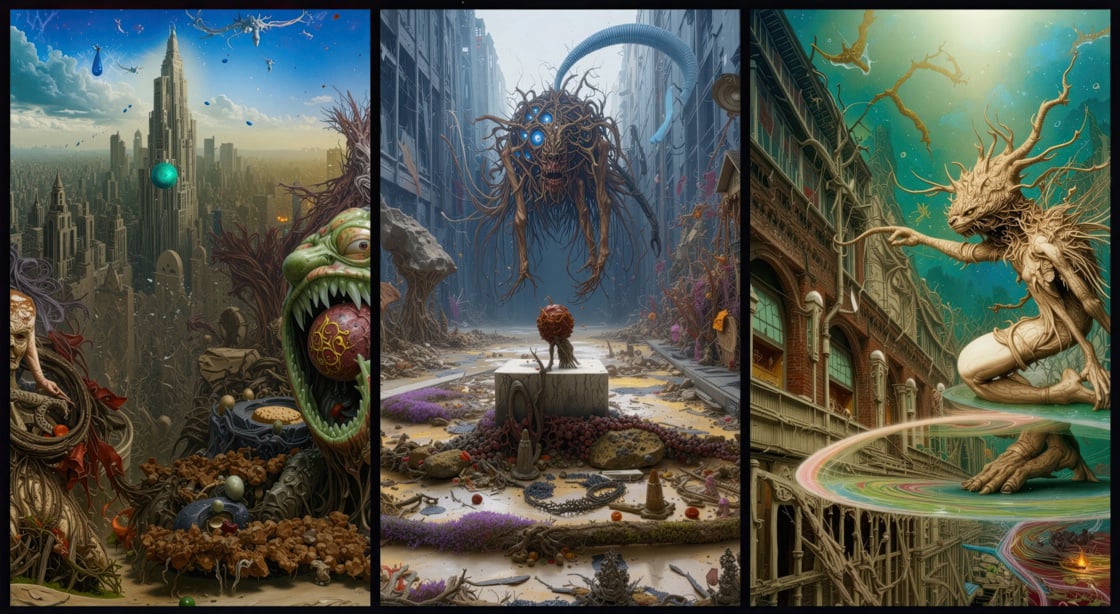
Left panel - "Welcome Party"
Central panel - "Endless Agony"
Right panel - "Now You Are Free!"
Sednaya Prison was a military prison and death camp in the Damascus, Syria. It was considered the most notorious of the Assad regime's network of prisons and a symbol of the regime's repressiveness due to torture, sexual assault, and mass executions.
This work explores the horrors that arise within authoritarian regimes, delving into suffering, loss of identity, and the distorted nature of freedom.
At the core of every dictatorial regime, a fundamental question arises: what happens to those who survive the system that sought to destroy them? This triptych focuses on the psychological and physical consequences of life under repression, depicting humiliation, exhaustion, and defeat, leading to a moment of "freedom" that is far from true liberation. The work illuminates the dark dynamics of power, suffering, and the return to a world that can no longer be called "normal."
Through a grotesque and expressionistic aesthetic, the artwork invites reflection on what it means to be "free" after the most harrowing of experiences.
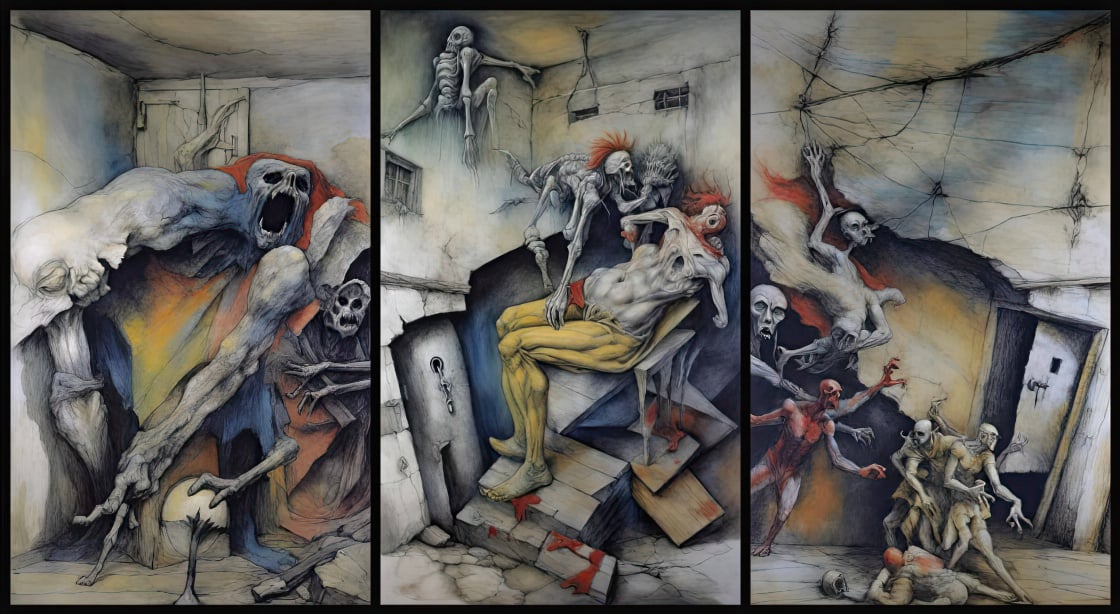
Left panel - "The Dance of Freedom"
Central panel - "Dreams in Chains"
Right panel - "The Shadow of Control"
This triptych explores the fragile and often elusive nature of freedom, especially in countries where the hope for democracy clashes with the harsh reality of geopolitical forces.
"The Dance of Freedom" symbolizes the idealized vision of a democratic society—full of struggles but also offering hope.
"In Dreams in Chains", the figure of the girl captures the melancholy of nations trapped by authoritarian regimes, unable to reach their dreams of freedom.
Finally, "The Shadow of Control" represents the overwhelming power of dictatorship, a force that shadows and suppresses any hope for change.
This piece is dedicated to countries that, despite their desire for democracy, find themselves stifled by oppressive regimes.
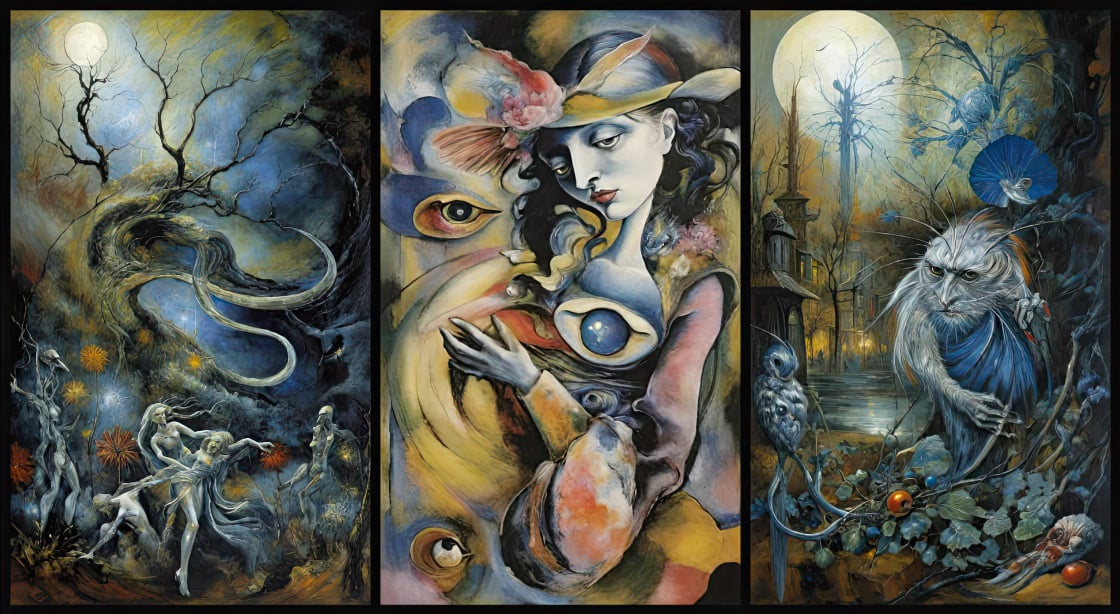
Left panel - "Silent Witnesses"
Central panel - "The Road to Tomorrow"
Right panel - "Solitary Struggle"
This triptych is dedicated to this year’s student protests against the autocratic regime in Serbia, embodying the struggles and aspirations of youth seeking freedom and justice.
"Silent Witnesses" represents the world that remains silent, either out of powerlessness or selfish interest, while "The Road to Tomorrow" symbolizes the distant light of hope, a better future that seems unreachable yet persists as a beacon.
"Solitary Struggle" illustrates the individual fight, marked by agony yet driven by determination, capturing the emotional cost of fighting for a brighter tomorrow.
A tribute to those who dare to dream of a better world despite the overwhelming odds.
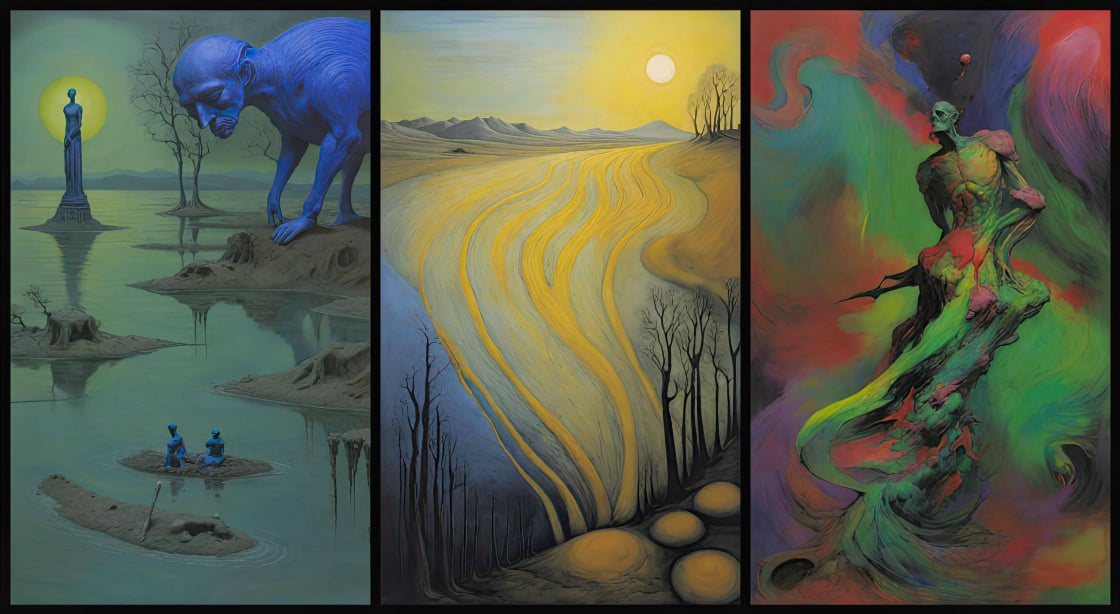
Left panel - "The Nation"
Central panel - "The Social Order"
Right panel - "The Fortress"
This triptych explores the grim reality under authoritarian regimes and the internal coping mechanisms that people resort to when faced with a loss of freedom.
The first panel, "The Nation", depicts the passive, defeated people who, trapped in a struggle for survival, no longer have the will to resist.
The central panel, "The Social Order", portrays the decaying structures of power, with the regime’s corruption and greed ultimately driving it towards its own collapse.
The final panel, "The Fortress", symbolizes the retreat into personal isolation, where individuals withdraw from society, attempting to build their own world to survive in a repressive system.
This work serves as a reflection on both the fragility and resilience of society in the face of overwhelming forces.
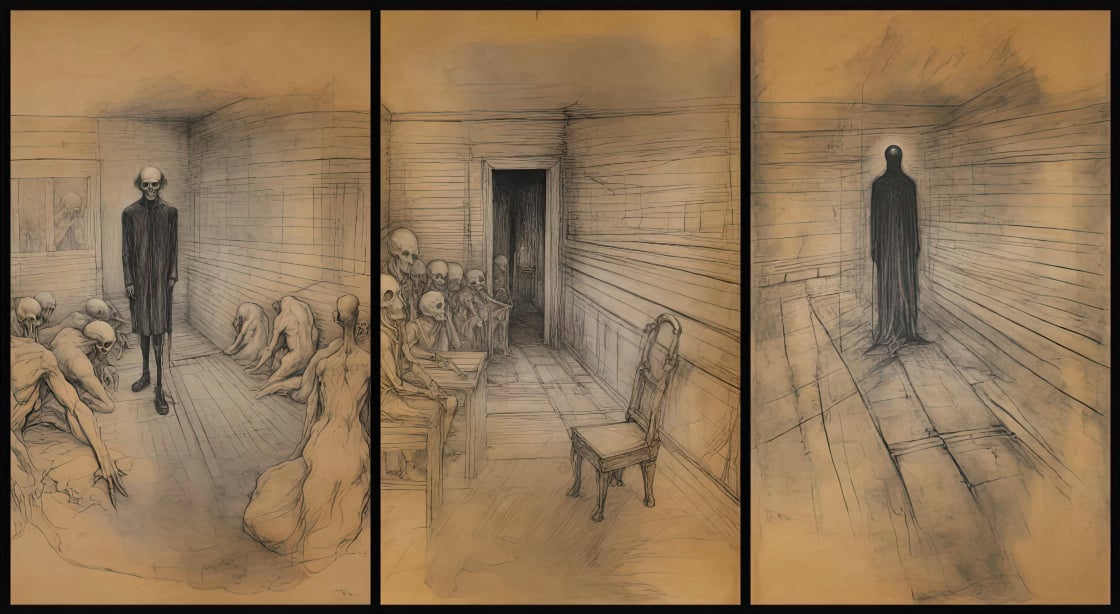
Left panel - "The Weight of Tyranny"
Central panel - "The Empty Chair"
Right panel - "Nothing Will Be Named After Him"
This triptych reflects the aftermath of the fall of authoritarian power and the unsettling vacuum it leaves behind.
The central panel, "The Empty Chair," portrays the haunting moment when a ruler's power is dissolved, yet the people, unwilling to learn from history, passively await another tyrant.
"The Weight of Tyranny" and "Nothing Will Be Named After Him" portray the oppressive atmosphere of power and the inevitable emptiness that follows its collapse.
This work is a reflection on the cycle of power, the consequences of passivity, and the peril of waiting for a new leader to fill the void. It challenges us to consider what lies beyond the fall of power: are we prepared to break the cycle, or are we destined to repeat it?

AI Website Creator