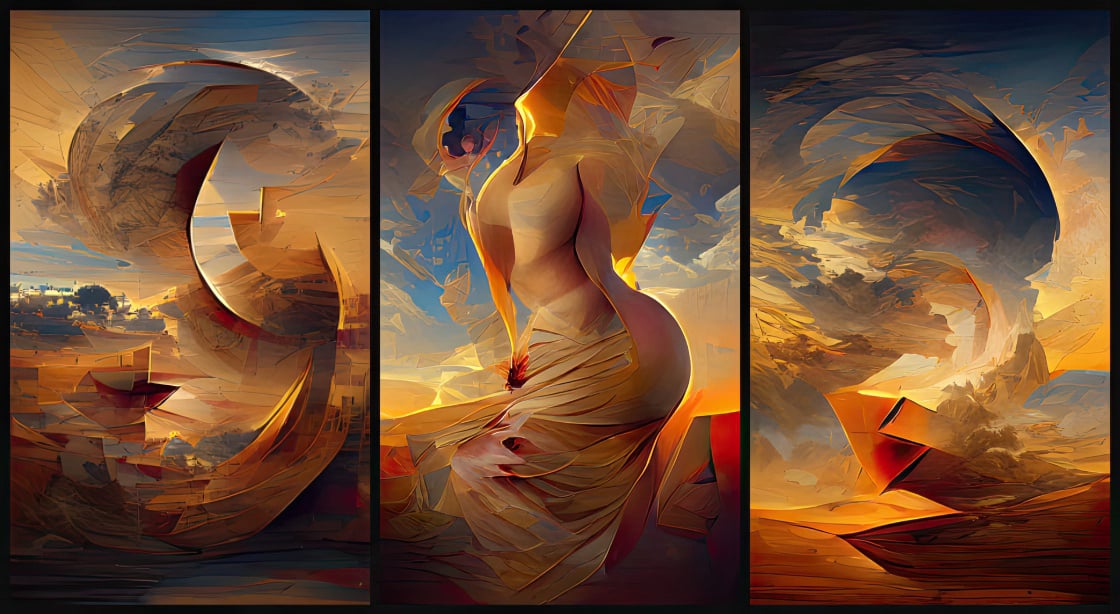
This project is a meditation on the female existence, on her divine nature and complete orientation towards life. Let's love them, they deserve it!
I have always been fascinated by Gustave Courbet's provocative manifest of realism: "Origin of the World". But, for me it is manifest of femitheism (my neologism), and I tried to highlight this in my work. No Adam, only Gnostic Eve as a mother of all gods!
In this sense, the triptych "Scent of Woman" was created, which not only tries to celebrate female energy and strength, but also invites the viewer to connect with that universal principle. Strong colors, abstract forms and a central figure create a composition that is both meditative and provocative, trying to balance between aesthetic beauty and deep symbolism.
The dominant female figure in the middle panel is draped in a flowing fabric, meant to evoke elegance and sensuality, and the blue background contrasts the warmth of the figure, representing a balance between inner and outer beauty.
On the other hand, the left and right panels serve only as a symbol of eternal life energy, which a woman carries with her as a symbol.
Pliny, the first-century historian of the ancient world, writes in his work "Natural History" of how: "hailstorms, whirlwinds and lightning are all quited and dispelled by a face-off with a naked woman."
And last of all, the old Catalan proverb says: "The sea calms down if it sees a woman's cunt"!
(Catherine Blackledge: "A Natural History of Female Sexuality").
Left panel - "Sailing Through Light"
Central panel - "Goddess of the Sea"
Right panel - "The Wandering Minds"
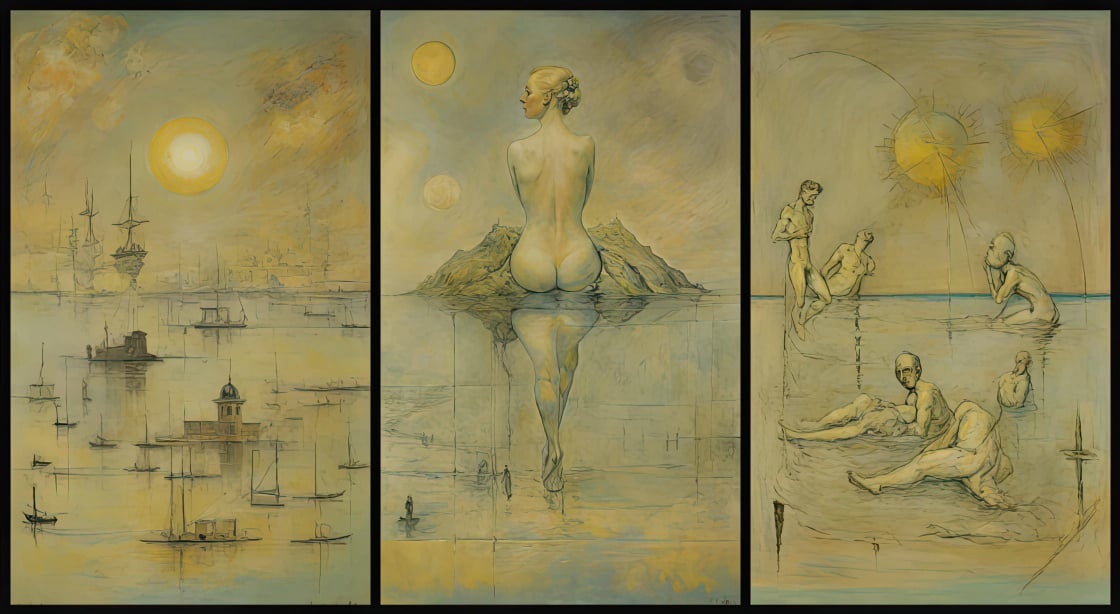
The triptych "Goddess and the Seekers" explores the deep contrast between the feminine intuitive harmony and the masculine search for meaning. Through three panels, dominated by a soft, dreamy atmosphere that tries to create a sense of surreal calm, the woman is shown as a source of life and stability, while the men represent those who are lost in their search for answers they may never find.
The panel "Sailing Through Light" depicts our peaceful (relative to the Universe!) existence and harmony that is grounded in nature. Ships symbolize human life journeys, which take place in accordance with the cosmic flow - an idealized and calm image of existence on Earth.
The central female figure in the "Goddess of the Sea" panel turns into an island that blends into the landscape, expressing the power of life, balance and being in the moment. It is an archetypal representation of a woman as a symbol of fertility, beauty and universal connection with the world. Her turning to life without the need to question its meaning emphasizes her inner wisdom, which does not seek answers, but existence itself. She is nature, she is harmony, she is impermanence!
As a complete contrast, "The Wandering Minds" depicts an uncertain and disoriented male world, which has lost its direction and wandered in search of meaning. The figures are elongated, deformed and uncertain, suggesting loss and a quest that never ends and cannot be fulfilled.
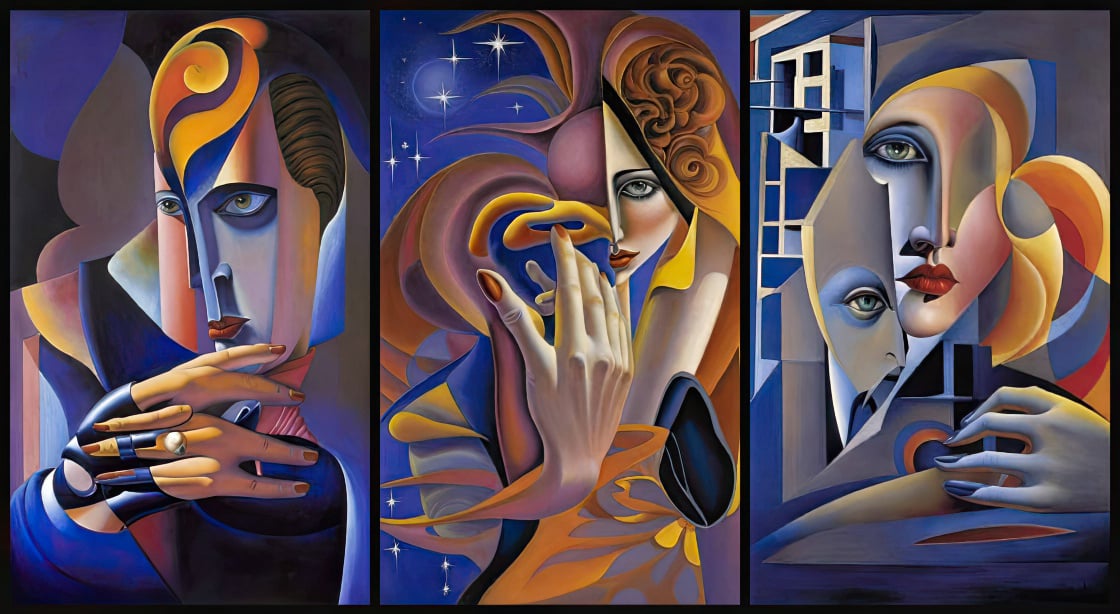
Left panel - "Craftiness"
Central panel - "Sensuality"
Right panel - "Secret"
"Three Times a Lady" is an attempt to explore the female essence by bringing to the fore three layered aspects of her nature. Also, this work is a kind of homage to the work of the famous Art Deco artist Tamara de Lempicka, as well as a show of respect for her as an independent free woman, especially considering the time when those values were far from social acceptance.
The left panel, "Craftiness," shows her craftiness, but it is not a manipulative craftiness, in which someone is outwitted or tricked. Women's cunning is biologically determined, it is imposed on her and is her natural tool. What Nietzsche said: "Everything about a woman is a secret, and everything ceases to be a secret the moment she remains in another state". She has to be cunning because she chooses, and she chooses because she needs a partner who will provide her with maximum security for her offspring. Of course, modern times are changing traditional gender roles, but the essence, in the prevailing sense, has remained unchanged.
In the central panel, "Sensuality", there is a female figure dominating the space. Her gaze, half hidden by her hand, suggests a sensuality that is both open and mysterious, representing a powerful way of communication and attraction. Also, the sensuality here is not only physical – it is also emotional and spiritual, associated with the mystery and beauty of a woman.
The right panel, "Secret," closes the triptych on an introspective note, with a woman's face divided between the outside world and an inner secret. Secrecy is presented here as an essential part of a woman's character – something that inspires curiosity but remains elusive. This aspect of her nature is perhaps the most complex, as it suggests that a woman, like the Universe, can never be fully revealed – she is a mystery at her core, which transcends our understanding and leaves us eternally fascinated.
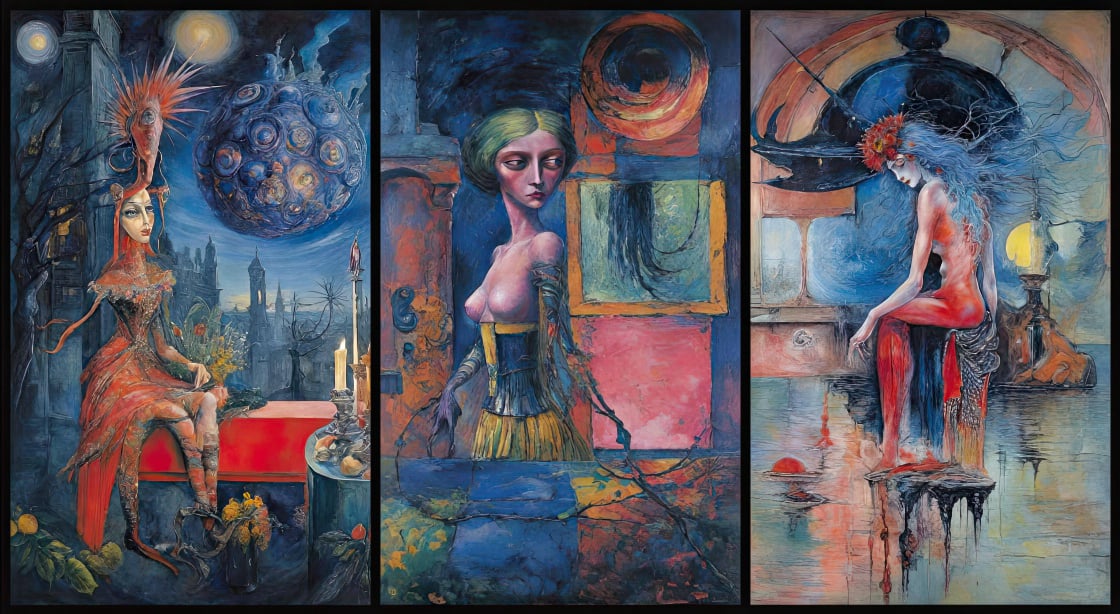
Left panel - "Full of Dreams"
Central panel - "Full of Desire"
Right panel - "Full of Yearning"
"Remote and Unattainable" is a triptych that explores the layered emotional progression from hope to longing, told through the interior worlds of three female figures. Each panel offers a distinct psychological state—dream, desire, and yearning—framed not as linear phases, but as echoing emotional loops.
In “Full of Dreams,” a woman sits amid a symbolic universe of surreal geometry and lunar tension. Her surroundings are dense with celestial motifs and candlelit artifacts. She exists within a dream-space, one where the impossible still feels within reach. This is not naivety, but reverence for potential—a state of willing self-deception in the name of hope.
“Full of Desire” marks the moment where dreams condense into focused emotion. The central figure appears exposed, internally torn between attraction and vulnerability. Her gaze is direct but uncertain, caught in a moment of unfulfilled momentum. Warm tones dominate—deep reds, golds, oranges—communicating the friction between wanting and not having.
In “Full of Yearning,” desire collapses into sorrowful fixation. The woman here sits alone at the edge of a reflective world, her form wrapped in blues and silver-greys. The water around her is thick with symbolism—depth, distortion, dissociation. Her body still radiates beauty, but her posture has surrendered. What once was dreamed now becomes an absence that defines her.
Remote and Unattainable does not romanticize longing—it dissects it. The figures do not move through time, but through inner terrains, caught in a suspended state where emotion becomes architecture.
"Silence stands upright,
Shadow stitched to empty limbs,
She is not like us."
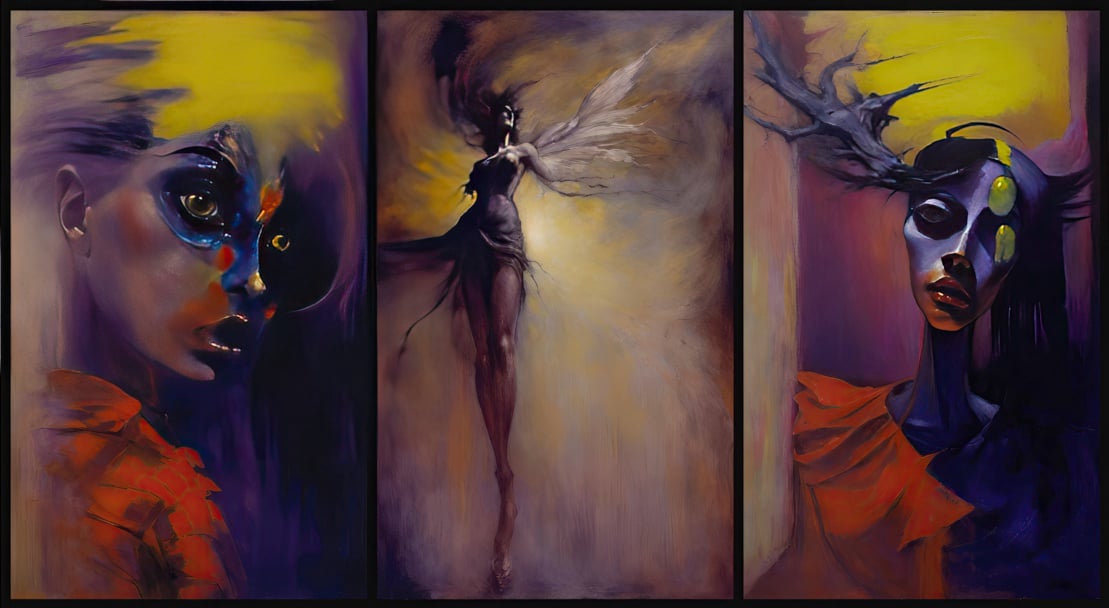
"Where the Gaze Breaks" is a triptych that stages a silent psychological confrontation among three female presences. Rather than telling a linear story, the work reveals an emotional topology—a charged moment where perception destabilizes identity, and difference becomes a source of both awe and threat.
At the center stands a being who defies clear classification. Her limbs fuse with shadow; her form is elongated, elegant, and unnervingly alien. She is not a deity, nor a monster—she is "other". Her body radiates both power and estrangement, like a biological anomaly that bends the rules of beauty and presence.
Flanking this central figure are two women who observe her—not as passive onlookers, but as active participants in an inner conflict. Their faces, veiled in vibrant hues of purple, red, and yellow, speak of curiosity, suspicion, envy, perhaps even reverence. Their gaze is not broken—it is breaking.
The chromatic choices function as psychic projections, mapping emotional undercurrents rather than physical settings. The figures are not symbols of femininity—they are agents of perception, thrown into silent competition over the meanings they attribute to difference.
"Her silence feeds us—
we climb toward burning stars,
watched by mirrored eyes."
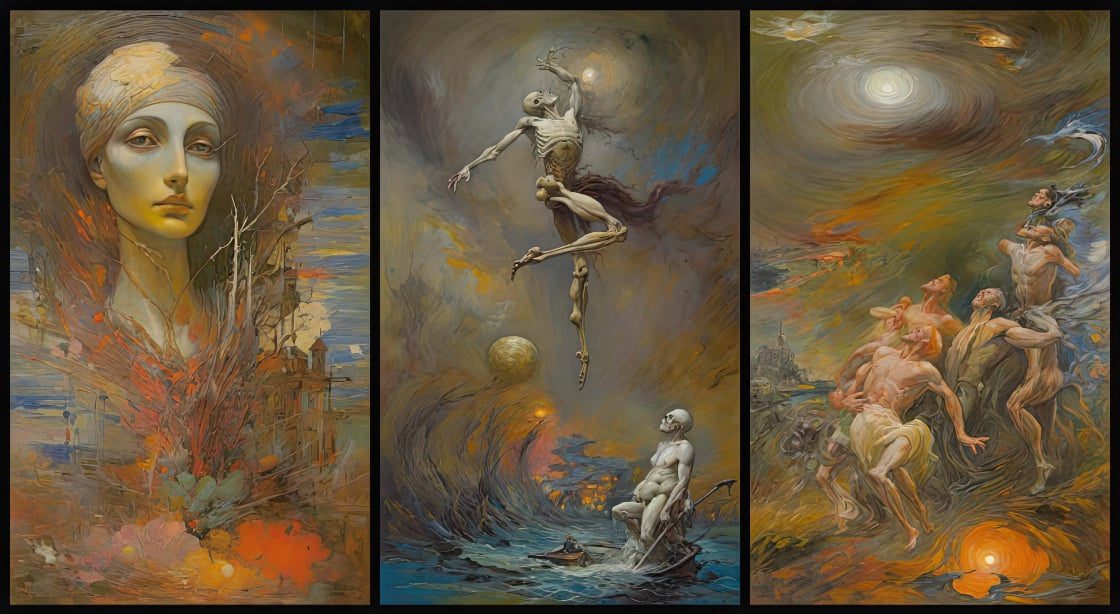
"Mistress of the Flies" is a triptych that stages the myth of ambition and spectacle as both timeless ritual and modern neurosis. Composed of three thematically linked yet visually distinct panels, the work unravels the interplay between seduction, aspiration, and passive consumption.
The left panel presents the central figure—the enigmatic “Mistress.” Her expression is composed, unreadable, and perfectly still, a portrait of beauty rendered so idealized it becomes abstract. Her silence is powerful, magnetic, and intentionally vacant—a canvas for the dreams, obsessions, and projections of those who follow.
The central panel depicts a storm of striving. Skeletal figures leap skyward, ascending toward an ambiguous celestial orb. One figure spirals upward in a contorted pose of self-elevation, while below, Death waits calmly in a boat, a reminder of the game’s inevitable outcome. This is the theater of desire, where greatness and demise share the same stage.
In the right panel, a rapt audience stretches upward, limbs elongated in ecstatic imitation. They do not act—they witness. Their faces suggest wonder, awe, envy, or perhaps even complicity. As voyeurs of power and pursuit, they reflect the contemporary obsession with visibility and vicarious living.
This triptych invites viewers to question the machinery of attention and the illusion of transcendence. In a world built around curated identities and unattainable ideals, "Mistress of the Flies" reveals not what we chase, but why we chase it.

HTML Maker